Rank the whole cluster, not the keyword
Cover the whole topic cluster, because AI Mode fans one question into many.
What to do: Build deep, interlinked coverage of a topic so you show up for the dozens of narrow sub-questions a model spins off, not just the head term. Map the follow-up questions a buyer asks and answer each one on its own page or section.
Why it works: Google's AI Mode breaks one question into many parallel searches and stitches the answer together from whoever ranks across them.
Example: Ahrefs studied 4 million AI Overviews and found the share of citations coming from pages in the organic top 10 fell from 76% to 38% in a year. Surfer found pages that rank for those fan-out sub-queries are 161% more likely to be cited than pages ranking only for the main term.
Walk it through
I ran the same buyer query through Perplexity and Google in July 2026. Here is exactly what came back.
1. Ask Perplexity the head term and watch it split into segments.
open "https://www.perplexity.ai/search?q=best+crm+for+startups"
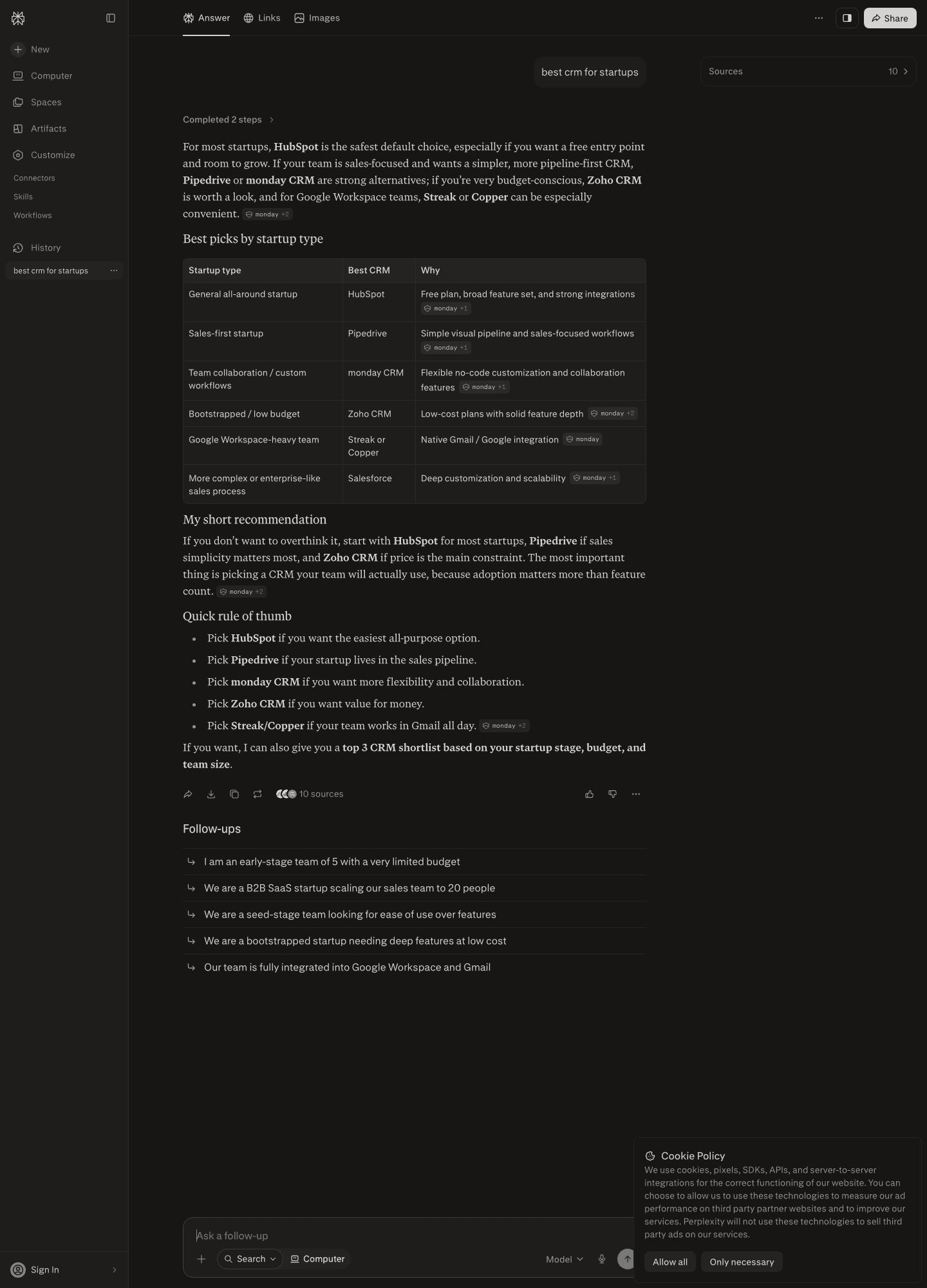
Perplexity did not hand back one ranked list. It built a table, "Best picks by startup type," with six rows: general all-around, sales-first, team collaboration, bootstrapped-low-budget, Google Workspace-heavy, and complex-enterprise. Six sub-questions, six different winners, HubSpot, Pipedrive, monday CRM, Zoho, Streak or Copper, and Salesforce. One query in, six rankings out. Look at the citation pill on almost every row: monday +1, monday +2, monday. monday.com's own comparison page is cited as a source in five of the six rows, including the ones recommending its competitors.
2. Run the identical query through Google and check what surrounds the AI Overview.
open "https://www.google.com/search?q=best+crm+for+startups"
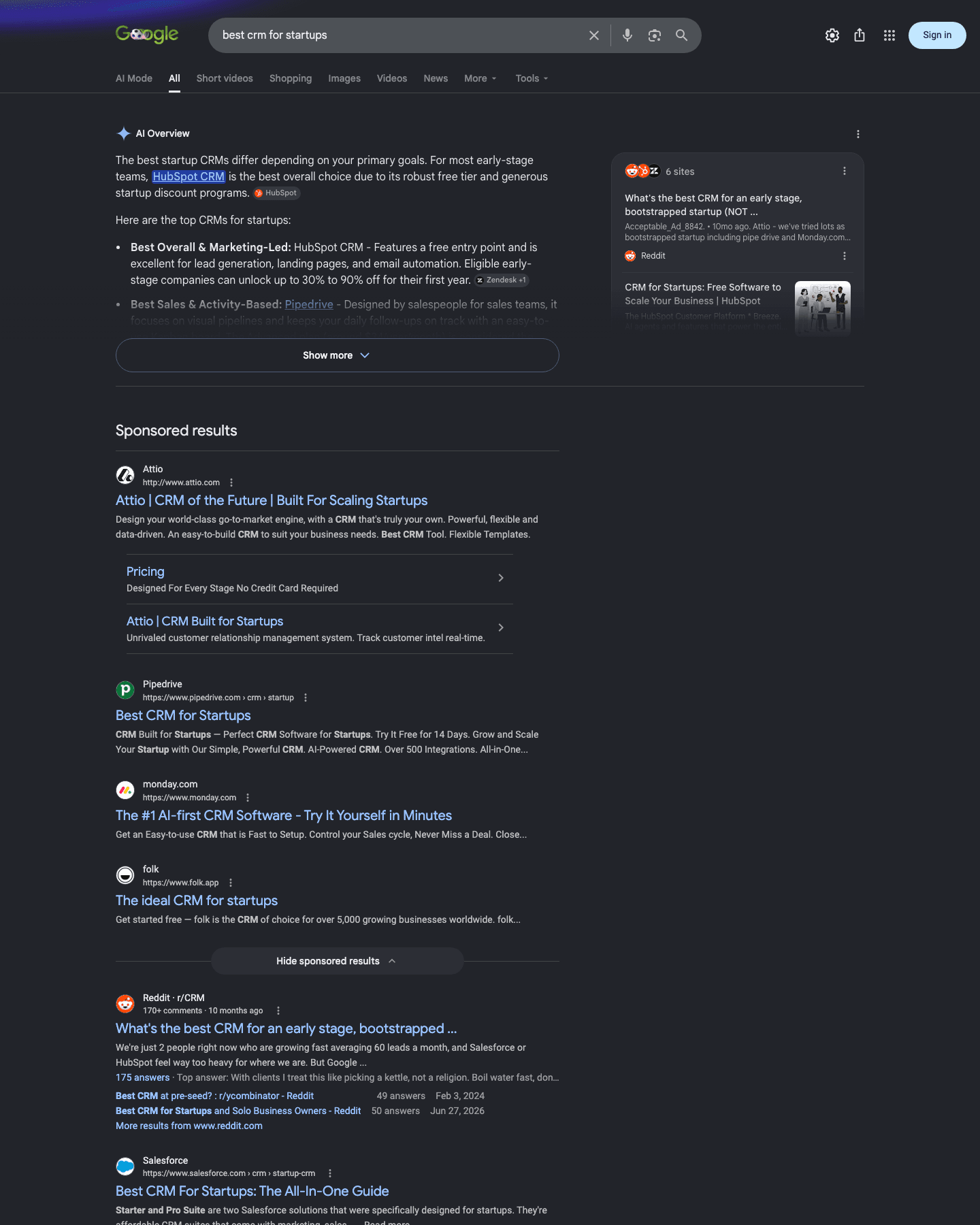
Same fan-out, different packaging. The AI Overview cites HubSpot and Zendesk for the overall pick, while a separate "6 sites" panel next to it cites a Reddit thread and a HubSpot landing page for a different sub-claim entirely. Below that, four vendors, Attio, Pipedrive, monday.com, and folk, are bidding on the identical head term, and the organic results mix a Reddit thread with vendor comparison pages. Nobody owns this query. Everybody owns a slice of it.
3. Scroll past the ads. Google hands you the cluster map for free.
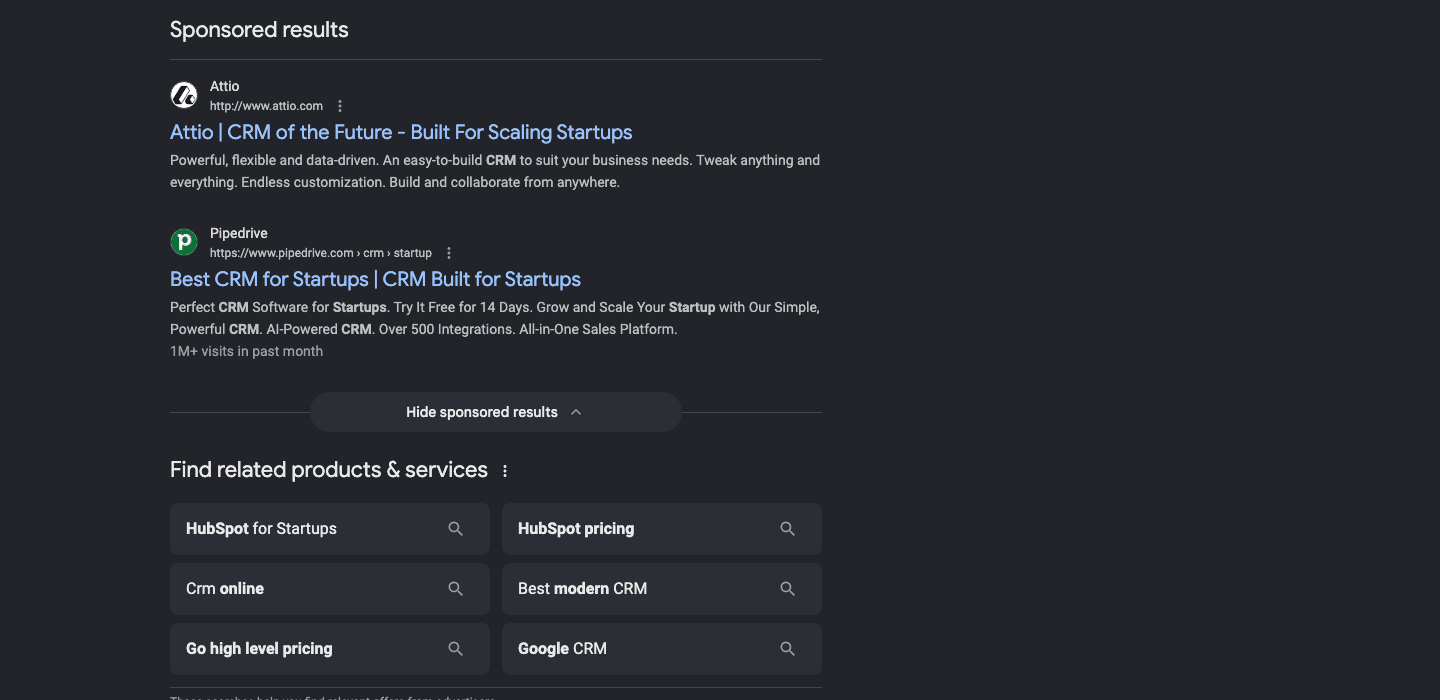
Under the sponsored block sits "Find related products & services": HubSpot for Startups, HubSpot pricing, CRM online, best modern CRM, Go High Level pricing, Google CRM. That is Google showing its own homework. Each chip is a sub-query with its own ranking and its own citation opportunity, sitting in plain view under the ad block nobody scrolls past.
The read
- One answer, six rankings. Perplexity did not pick a single winner for "best CRM for startups." It fanned the query into segments (by team size, sales motion, budget, stack) and ranked a different product for each one. If you only track your position for the head term, you are measuring one-sixth of the actual game.
- The cited source is not always the recommended product. monday.com showed up as a citation on rows where HubSpot, Pipedrive, and Zoho won the recommendation. Its content did not have to be the "best" answer, it only had to be the page that explained the segmentation. Getting cited and getting recommended are two different jobs.
- The fan-out is visible, not hidden. Google's own "Find related products & services" box and Perplexity's "Follow-ups" list are the model telling you exactly which sub-queries it considers part of this cluster. You do not have to guess the segments, both tools print them for you.
Steal it
Take your own "best X for Y" head term and list the segments a real buyer fans it into: by company size, budget, integration, industry, use case. For each one, check whether you have a page or section that names that segment in its own heading and answers it directly. If a competitor's single comparison post already covers all six segments in one place, the way monday.com's did, that one page is out-competing your six separate landing pages, because the model found one place to lift every answer.
Then defend it. If you are not covering every segment yourself, someone else's listicle becomes the connective tissue an AI model cites across your whole cluster, even in the rows where your product is the better fit. Publish the "best [product] for [segment]" answer yourself, for every segment you can name, before another comparison page does it for you across the whole set at once.
Gotchas
- The fan-out is not stable. Run the identical query twice and Perplexity can reshuffle which sources it cites per row. Treat any single snapshot as a sample, not a scoreboard, and re-check monthly.
- Citation share and recommendation share are different metrics. Don't confuse "we got mentioned" with "we got picked." Track which segment rows name your product as the pick, separately from which rows merely cite your content as a source.
- Anonymous sessions get rate-limited. Perplexity pushed a sign-up wall into our own logged-out research session after a handful of queries in one browser profile. Budget for that if you are doing this by hand, a fresh session buys you a few free looks before it asks you to log in.