Reverse-Engineer The Aha Moment
Find the exact action that predicts a lifelong user, then rebuild onboarding backward from it.
Every founder has a theory about the moment a new user "gets it." Almost none of them have tested the theory against actual retention data. They watched a demo land well once, wrote that scene into the onboarding flow, and never checked whether the users who actually stuck around a year later did that thing at all. Dropbox ran the real numbers back when the company was tiny, and the answer was not what anyone expected. It was not signing up. It was not installing the app. It was putting one file into one folder.
What to do: Instrument every distinct action a new user can take in their first session, then run a retention-correlation report against your event data instead of guessing from a founder's memory of a good demo. Rank every event by how strongly it predicts the user still being active weeks later. Whatever sits at the top is your aha moment, and onboarding gets rebuilt to force that one action before the user leaves.
Why it works: It replaces a founder's anecdote with the one action that actually separates retained users from churned ones.
Example: Dropbox found that new users who put at least one file into a Dropbox folder retained far better over the following month than users who signed up and never did. Sean Ellis, Dropbox's first marketer and the person who later coined the term "growth hacking," helped rebuild onboarding around forcing that exact action, incentivizing it with bonus storage space so it happened inside the first session instead of whenever the user got around to it.
Walk it through
1. Start from what Dropbox actually did, not the tidy version of the story.
Dropbox's early growth team did not brainstorm a guess about what made the product sticky. They looked at usage data and found one action, dropping a file into a folder, that split retained users from churned ones more cleanly than anything else new users did. Not "explored the app." Not "invited a teammate." One file, one folder.
2. Run the same test on your own product with a tool built for exactly this.
You do not need Dropbox's data team to do this in 2026. Amplitude's Compass chart takes every event a new user can trigger and ranks each one by how strongly it correlates with that user still being active weeks later. Mixpanel's Signal does the same job under a different name, scoring actions by precision and recall against a retention goal instead of a hunch.
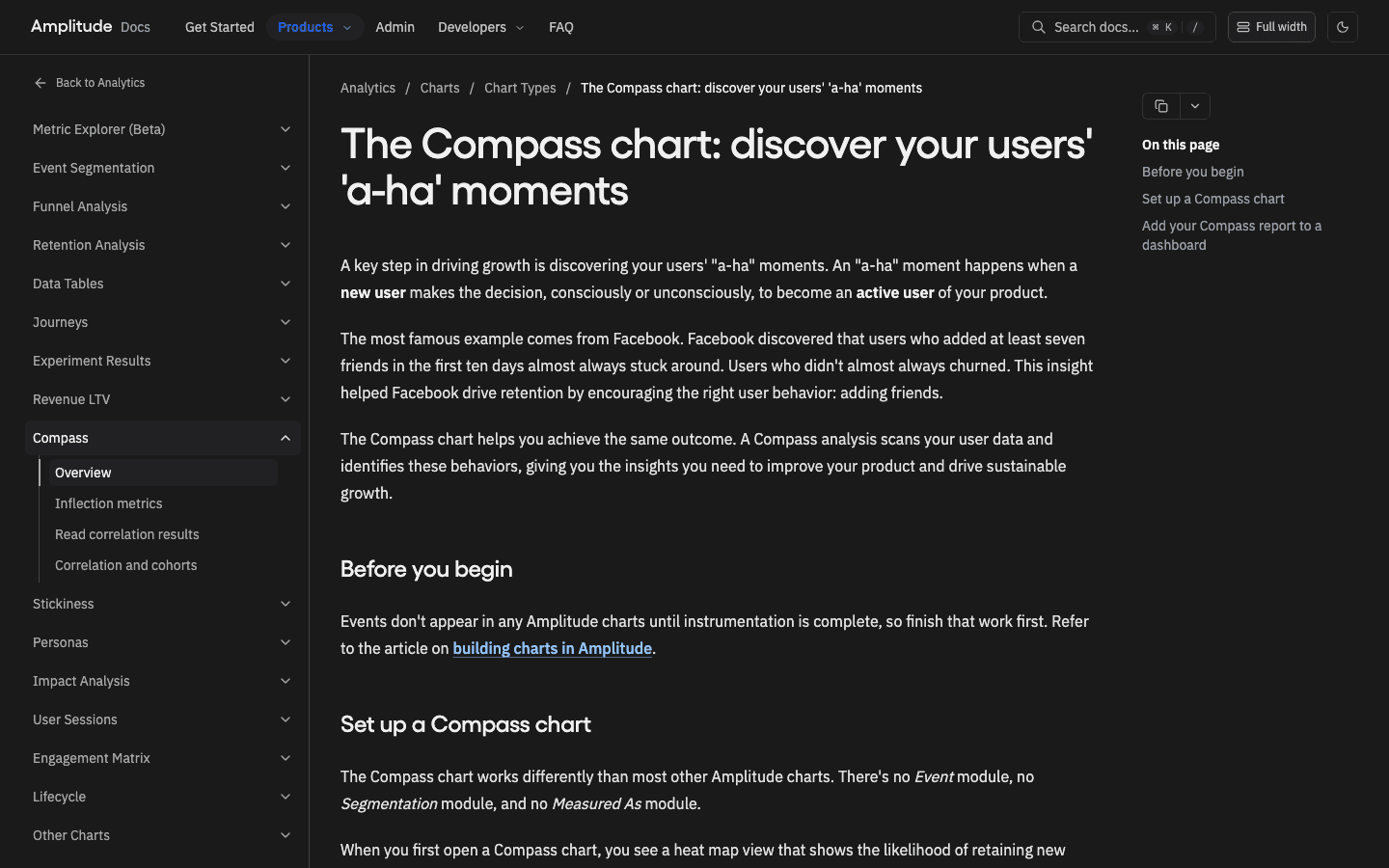
This exists as an off-the-shelf tool because the problem is solved now, not guessed at. Amplitude's own docs cite the other famous case: Facebook found that users who added seven friends in their first ten days almost always stuck around, and users who did not almost always churned. Same shape of finding as Dropbox's, on a completely different product, found the same way.
3. Take the top of the ranked list seriously, even when it is not the feature you are proudest of.
Dropbox's team did not expect "put one file in one folder" to be the answer. It is not glamorous. Nobody demos a drag-and-drop to investors as the star of the pitch. A correlation report does not care what looks impressive on stage, it only reports what actually happened to the users who stayed.
4. Rebuild onboarding backward from that one event, and force it into session one.
Once Dropbox knew the action, onboarding stopped being "let the user find their way to value eventually" and became "get them through this one specific step before they close the tab." They built a getting-started checklist that handed out extra storage for completing it, including the file-drop step, so the incentive and the retention-predicting action pointed at the exact same behavior.
The read
- Specific beats vague. "Put a file in a folder" is concrete enough to instrument, test, and design onboarding around. "Engaged with the product" is not an event, it is a mood, and you cannot build a checklist out of a mood.
- Correlation ranks candidates, it does not crown a winner. The top of the list is a strong hypothesis, not proof. You confirm it by forcing the behavior into onboarding and watching whether retention actually moves, not by trusting the ranking alone.
- Session one is the only window that matters. If the action does not happen before the user leaves their first sitting, it will not get force-fit back in later with a drip email. Onboarding has to walk them to it directly.
Steal it
Pull the last 90 days of event data and list every distinct action a new user can take before their first session ends. Run a retention correlation for each one against day-30 active status, or day-7 if your product has a faster usage cycle, using Amplitude's Compass, Mixpanel's Signal, or a plain SQL query against your warehouse if you do not run either tool. Whatever comes out on top, even if it is a small, unglamorous, easy-to-overlook click, redesign the first session so nothing ships before the user does that specific thing.
Then defend the finding. Re-run the correlation every quarter, because the aha moment drifts as the product changes and last year's answer can quietly stop being true. And watch for the metric getting gamed once you build a checklist around it, a user who checks the box without getting the actual value behind it was never the retained user the data described in the first place.
Gotchas
- Correlation is not causation. Users who were always going to stick around may simply be more likely to explore the product, including the action you just flagged. The action can be a symptom of engaged users rather than a cause of it.
- Small sample sizes throw up noise. A few hundred signups can produce a top-ranked event that is really just chance. Wait for real volume, or sanity-check the finding against a second time window before you rebuild onboarding around it.
- Do not gut the product to force the checkbox. Gamifying a checklist to hit the metric on paper while stripping out the context that made the action meaningful in the first place gets you a better dashboard and a worse product. The incentive should make the real action easier, not fake it.