Wake Dormant Signups, One Ask
A single, specific reactivation ask beats a newsletter blast to people who never came back after the trial.
Most win-back emails are a monthly digest wearing a reactivation costume. Ten links, three feature announcements, one "we miss you," and no actual ask anywhere in the body. A person who tried your product once and quietly drifted away does not need a roundup of everything you shipped since their trial ended. They need one small, specific reason to open the product again, and they need the account to still be there, in a usable state, when they do.
What to do: Trigger one email off trial-expiration-without-conversion, containing exactly one ask (reconnect a data source, finish the table they abandoned, claim a specific credit), never a roundup. Separately from the email, auto-downgrade the account to a real, usable free tier instead of shutting it off, so the door stays open even on the emails that fail.
Why it works: A single task a tired person can finish in ten seconds beats a newsletter they have to skim to find the point, and an account that still works when they wander back means the email did not have to be the thing that saved the relationship.
Example: Clay, the B2B data-enrichment tool, does not lock a lapsed trial out. Its own docs put the trial at 14 days and 1,000 data credits with full Pro-plan access. When that runs out without a card on file, the account does not die, it drops to Clay's real Free plan, which Clay's pricing page describes as unlimited seats and tables, multi-provider waterfalls, Claygent enrichment, and Clay Sequencer for email, "comes with 100 Data Credits and 500 Actions/mo." Nothing about that plan is a locked demo. It is a smaller version of the real product, still sitting there the next time that user has a reason to open it.
Walk it through
I pulled this from Clay's own docs and pricing page in July 2026. Here is exactly what is published, and how to translate it into your own trigger.
1. Read the trial terms straight from the source.
curl -s https://university.clay.com/docs/plans-and-billing | grep -A2 "<h3>Trials"
Real text back:
Clay offers a 14-day free trial with 1,000 data credits, giving you
access to webhooks, CRM integrations, email sequencers, and HTTP
API capabilities. Phone number enrichments aren't available during
the trial period.
Fourteen days, a real credit number, one feature carved out to protect the paid tier. Nothing vague.
2. Look at what the account becomes, not just what it loses.
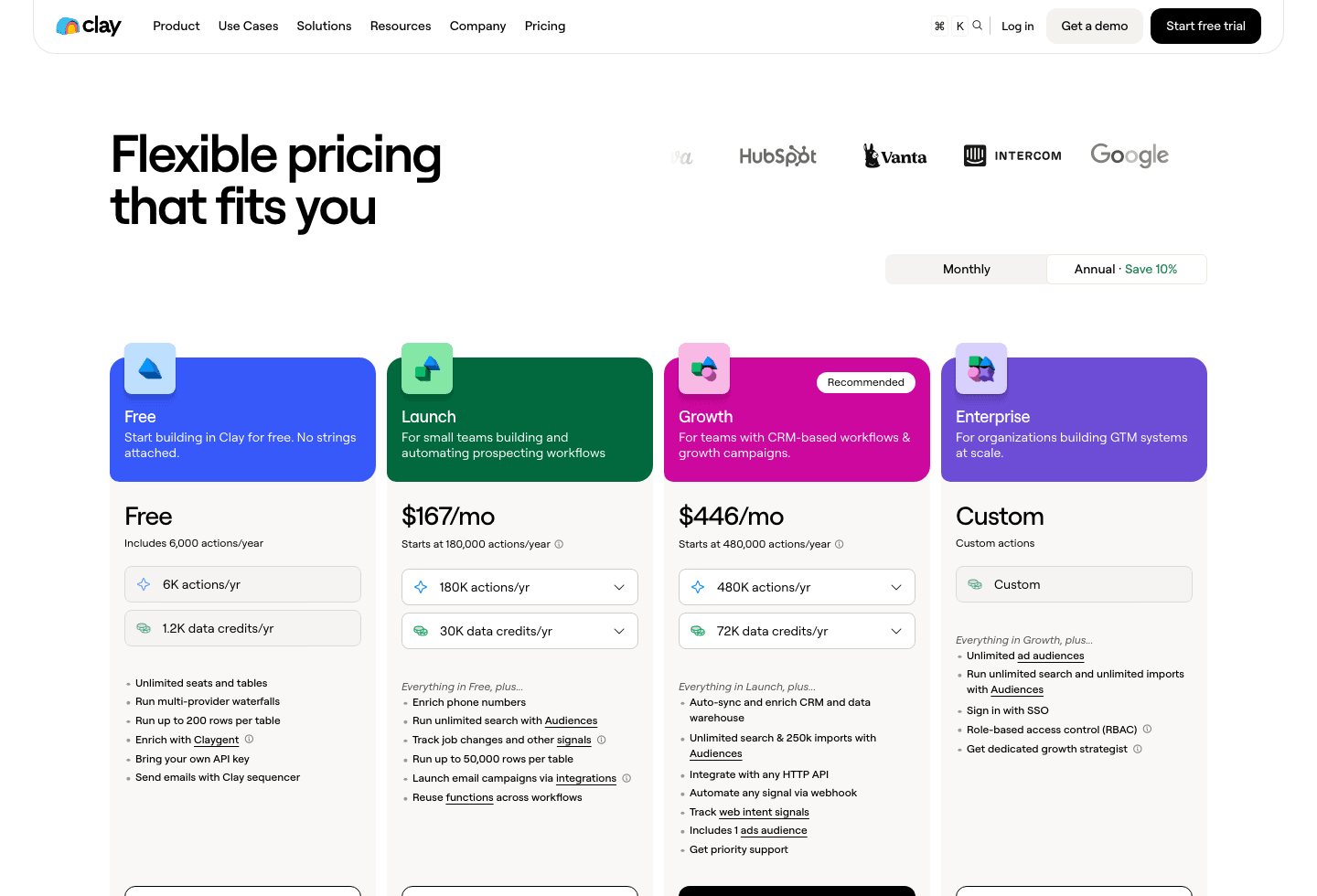
Every plan card on that page, Free included, sits under the same "Start 14-day trial" button. Clay is not selling you a separate, lesser sign-up path for people who just want to poke around. Everyone starts on the same trial, and the Free plan is simply where you land if you never convert. The card's own copy calls it "a low risk way to learn and experiment with Clay," and lists what is actually included: "unlimited seats and tables, multi-provider waterfalls, Claygent enrichment, Clay Sequencer for email, and up to 200 rows per table. Comes with 100 Data Credits and 500 Actions/mo."
3. Check what happens to the credits, not just the features.
curl -s https://www.clay.com/faq | grep -A3 "capped at 2"
Real text back:
The maximum accumulation is capped at 2x your plan's monthly credit
limit. ... If you cancel or downgrade, you can use any excess
credits until your current billing cycle ends. After the billing
cycle ends, your balance will be reduced to the credit rollover
limit of your new plan.
Run that formula against the Free plan's own published 100-credits-a-month figure and the ceiling on the account is double its own monthly allotment. That is a number Clay printed, applied to a number Clay printed, not a bonus I am inventing on their behalf. The point is not the exact figure. The point is that a lapsed account is not zeroed out and left for dead.
4. Build the same shape for your own product.
Say your trial is 14 days and your dormancy trigger fires on day 15 with no payment method added. The email is one line: "You left the Acme table half-enriched, want us to finish it?" with a single button. No pricing recap, no "here's what's new," no second link. Behind that email, the account itself drops to a free tier that still opens, still holds their data, still runs a capped version of the core action, so a person who ignores the email today can still come back on their own in month three and find something real waiting, not a locked screen asking for a card.
The read
- The trigger is a date, not a feeling. Pick the exact day the trial lapses without conversion and fire from that, not from a vague sense that engagement dropped. A clock is testable. A vibe is not.
- One ask is a task, a roundup is homework. A single button asking for one specific action gets finished in the time it takes to read it. A digest asks the reader to do the triage work of finding the one thing that applies to them, and most will not bother.
- The free tier is what makes the email optional. Clay's own numbers show the account survives the trial's end on its own. That means the reactivation email is a bonus shot at winning someone back sooner, not the last chance before the relationship ends.
Steal it
Build the trigger and the downgrade before you touch the email copy. Define the exact moment dormancy starts (trial day 14, last login plus 21 days, whatever fits your product), and decide what the account becomes at that moment, not just what it loses. If your product can meaningfully run at a smaller scale for free, let it. If it genuinely cannot (a product that is only valuable at volume, a tool with real per-seat infrastructure cost), say so honestly and design the softest version of a pause you can afford instead of pretending a full lockout is a growth tactic.
Then write the one-ask email against a real, specific, observable action inside your own product, not a guess. Look at your own usage data for the single step that correlates hardest with someone coming back to life, an unfinished import, an unconnected integration, a report they started and abandoned, and ask for that one thing. Defend the single-ask rule in review. The moment someone on the team wants to add "while you're here, check out our new feature" as a second line, you have rebuilt the newsletter you were trying to avoid.
Gotchas
- Auto-downgrading is an engineering decision, not a marketing checkbox. Someone has to define exactly what gets capped, what data survives, and what breaks silently at the boundary, before you can promise a user "nothing is lost."
- The one ask has to be the right ask. If you guess wrong about which action predicts reactivation, a single-ask email fails as quietly as the newsletter did, it just fails with less clutter. Check the correlation before you commit to the copy.
- Honest caution: a free tier that is too generous cannibalizes the upgrade. If dormant users can do everything they actually needed on the free plan, you have built a reason to never pay, not a reason to come back. Cap it against a real constraint your paying customers would miss, not an arbitrary one.