Get onto other people's "best X" lists
Listicles are the most-cited format for buying-intent questions.
What to do: Build comparison and "best tool for Y" pages for your commercial queries, and separately work to get included in independent editorial roundups you do not control.
Why it works: Listicles are the single most-cited content format for buying-intent questions, and the ones you do not own carry the most weight.
Example: Wix analyzed 75,000 AI answers and found listicles are the most-cited format at 22%, rising to around 40% for commercial queries. In professional services, independent editorial lists earned 81% of citations versus 19% for self-promotional ones.
Walk it through
I ran a live buying-intent query against Perplexity in July 2026. No login needed, perplexity.ai answers public search queries for anyone.
1. Ask the question a real buyer would ask.
# no login required
https://www.perplexity.ai/search?q=best+project+management+software+for+startups
Perplexity searches the web, drafts an answer, and drops a small citation badge on almost every sentence.
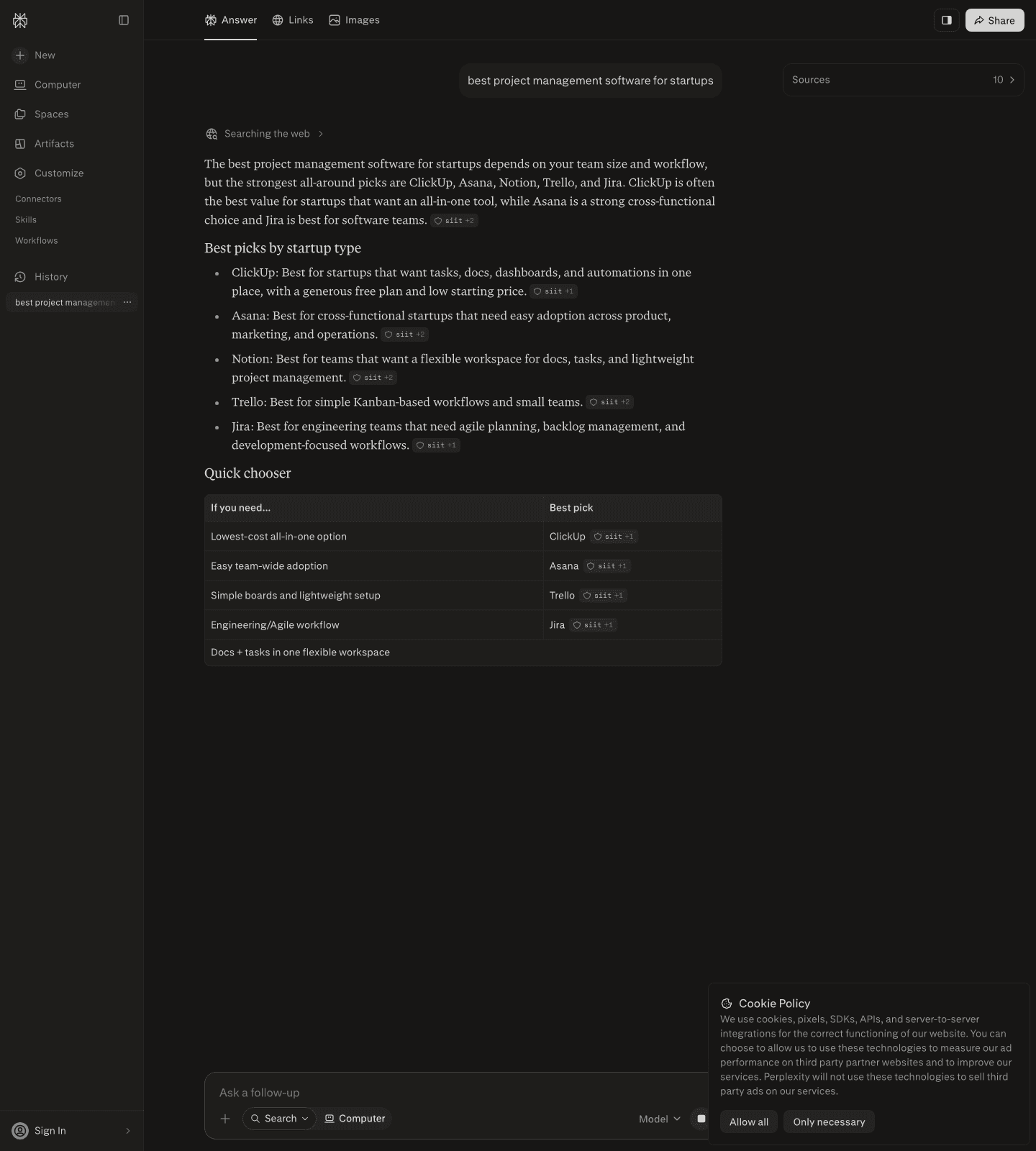
The answer names ClickUp, Asana, Notion, Trello, and Jira, then breaks into a "Best picks by startup type" section and a "Quick chooser" table. Every claim carries a badge, siit +2, siit +1, and so on. Those are not decoration. Each one names the actual domain the sentence was pulled from.
2. Open the Links tab and read where those badges point.
Click "Links" at the top of the answer and Perplexity hands you the full source list it built the answer from, ten pages for this one query.
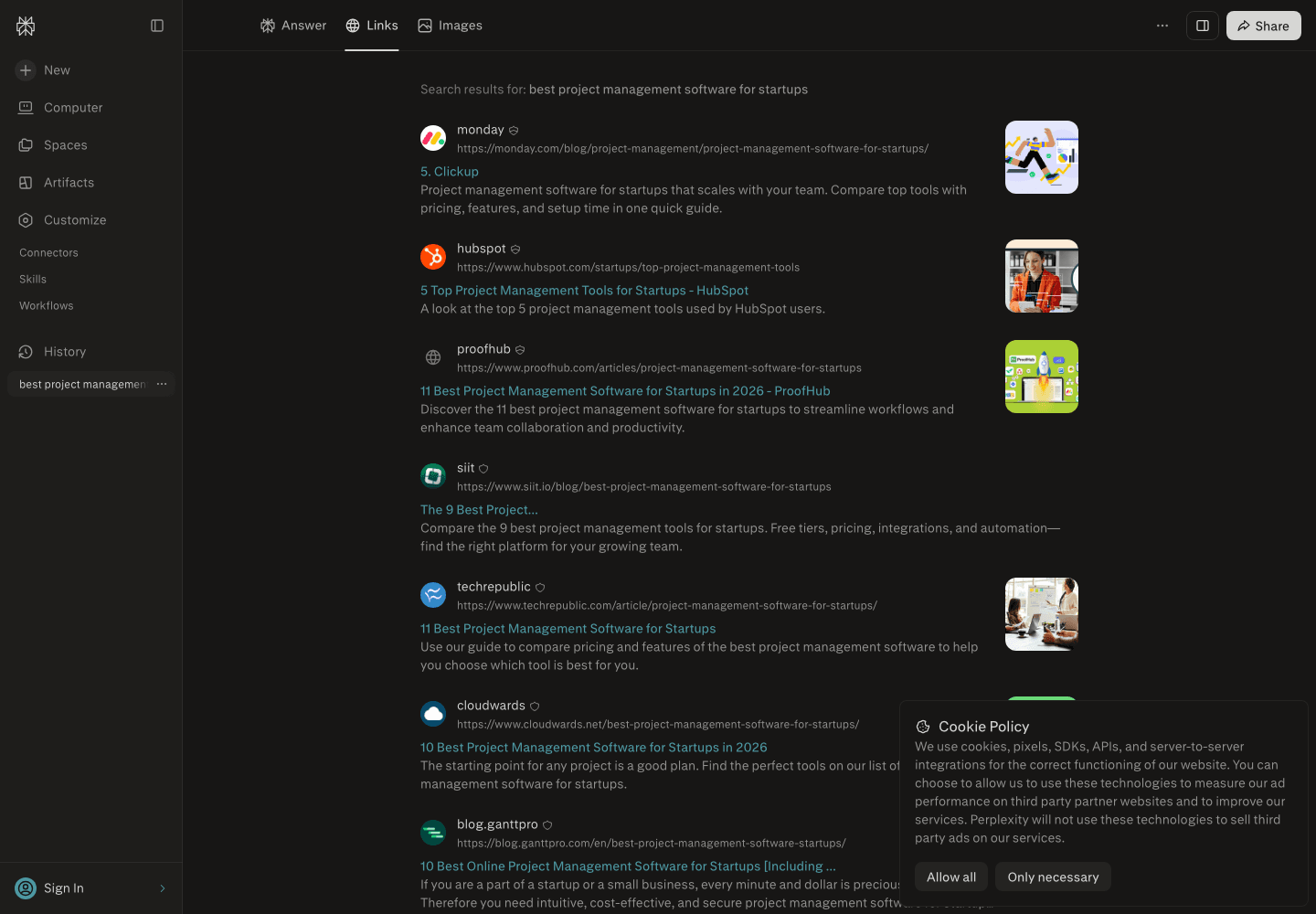
Read the titles, not just the domains. "11 Best Project Management Software for Startups," "5 Top Project Management Tools for Startups," "The 9 Best Project Management Software Tools for Startups," "10 Best Project Management Software for Startups in 2026." Every one of the seven sources visible without scrolling is a numbered listicle. Two of them, monday.com and GanttPRO, are competitors ranking themselves on their own blog. The rest are independent sites whose whole business is comparing tools.
3. Open one of the cited pages and look at the format that actually won.
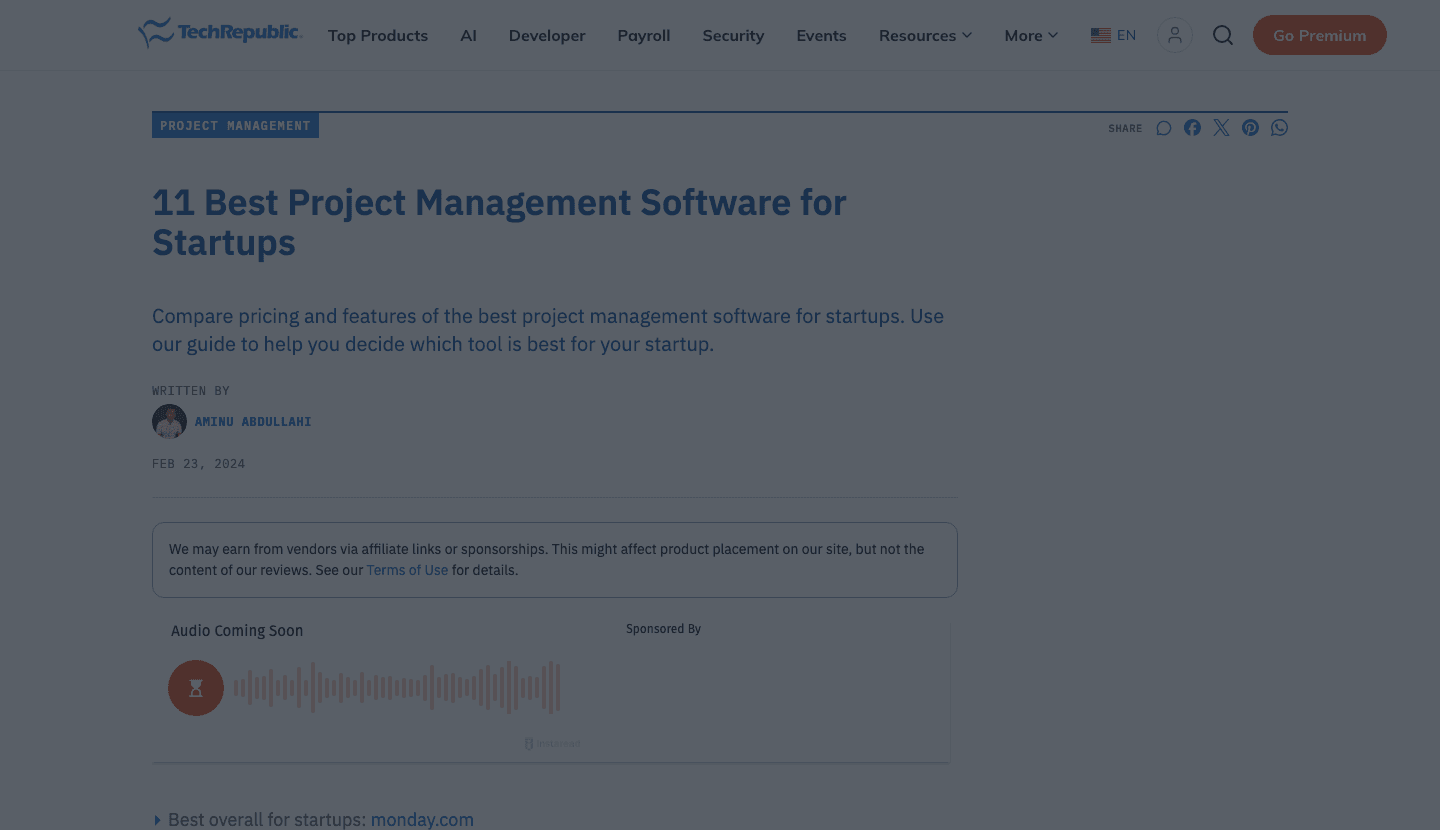
TechRepublic ranks monday.com best overall, Trello for kanban boards, Basecamp for team communication, Jira Service Management for dev teams, Asana for collaboration. One tool per use case, a clear winner up top, a short reason underneath. That structure is exactly what got lifted into the Perplexity answer. It is not a coincidence. It is the shape the model is built to extract.
The read
- Every source in the list is a listicle. Not a homepage, not a feature page, a "best X" or "N best Y" post. If your product isn't on one of these pages, it doesn't exist for this query, no matter how good your own site is.
- Competitors publish their own rankings and get cited for it anyway. monday.com and GanttPRO both showed up citing their own blog's "best project management tools" post, sitting right next to independent picks from TechRepublic and Cloudwards. The model doesn't obviously discount a vendor ranking itself.
- "Sources 10" is the whole opportunity, counted. Ten pages decided the answer to this query today. Re-run it next month and watch which of the ten keep their seat and which get replaced. That turnover is your target list.
Steal it
Run the same move for your own category. Take your highest buying-intent query, "best [category] for [audience]," open it on perplexity.ai, and click Links. Every URL in that list is a page you now know to pitch, submit your tool to, or ask the author to update. That list isn't a guess. It's the literal input to the answer your buyer just read.
Then defend the same way monday.com and GanttPRO do. Publish your own "N Best [category] Tools" post, list real competitors honestly, and place yourself where you'd actually rank. It costs one blog post, and it's exactly the shape of page these engines already trust enough to cite, even when the publisher is a vendor.
Gotchas
- The source mix moves. Run the same query twice in the same week and you can get a different set of ten pages back. Treat one capture as a sample, not a fixed ranking, before you commit budget to chasing a single listicle.
- Being cited is not being trusted. A vendor's own "best X" post sitting in the source list next to an independent review site doesn't mean the model rates them the same way, it means both happened to match the query well enough to get pulled from.
- Honest caution: this rarely turns into a click. The numbers in this section's intro already say most AI answers never send anyone anywhere. Chase listicle placement for brand exposure and downstream demand, not for a line item in Analytics.