Own your entity
Entity schema helps a model resolve who you are.
What to do: Ship Organization and Person schema that links out to your Wikipedia, Wikidata, LinkedIn, and Crunchbase pages with sameAs, and keep your brand facts identical everywhere they appear.
Why it works: This is one of the few uses of structured data that still earns its keep. It helps a model resolve who you are and attach claims to the right brand.
Example: Google states plainly that there is no special AI schema, but it still uses structured data and consistent entity signals to understand brands. The sameAs links are how you wire your site to the Wikipedia and LinkedIn pages models already trust.
Walk it through
I ran this against zapier.com in July 2026. Here is exactly what came back.
1. Curl the homepage and pull the Organization block straight out of the page source.
curl -s zapier.com | grep -o '"@type":"Organization".*"sameAs":\[[^]]*\]'
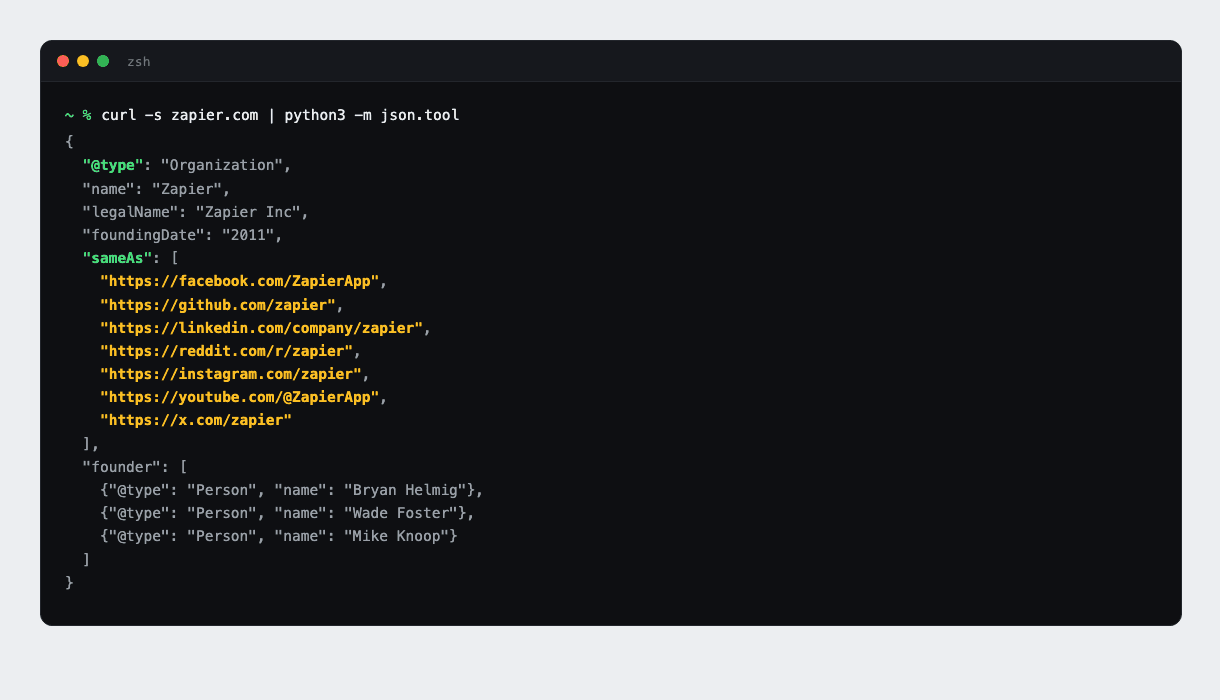
Every field a model wants is in there: legal name, founding date, logo, address, three named founders. The sameAs array holds seven links, and every one of them is a social profile, Facebook, GitHub, LinkedIn, Reddit, Instagram, YouTube, X. Not one points to Wikipedia, Wikidata, or Crunchbase. The three founder objects carry a name each and nothing else, no sameAs of their own.
2. Feed the same URL to Google's own parser and see if the schema actually validates.
search.google.com/test/rich-results?url=https://zapier.com
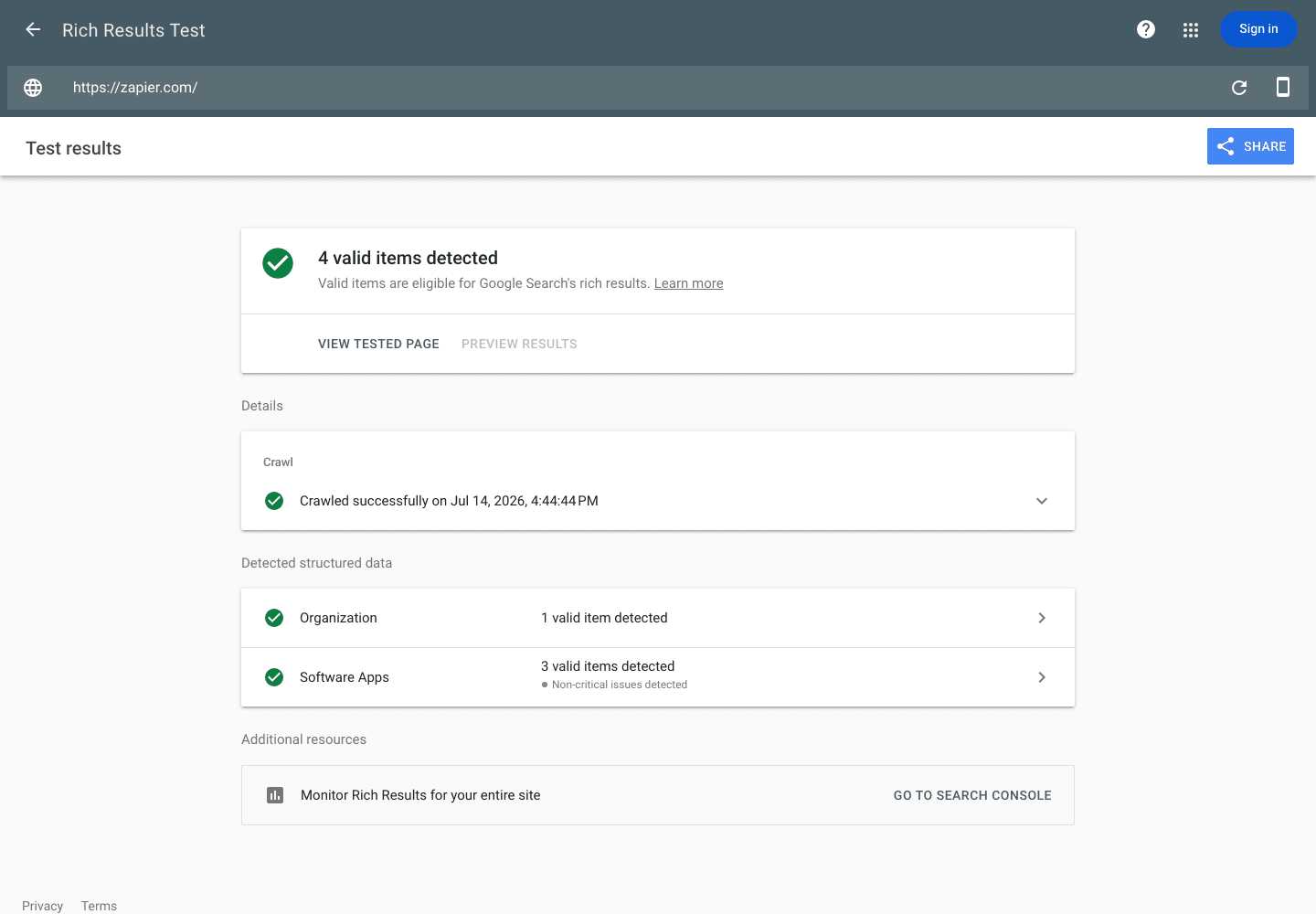
Four valid items came back: one Organization, three SoftwareApplication entries for Zapier, Zapier MCP, and Zapier SDK. Google crawled the live page, parsed the JSON-LD, and read all seven sameAs links without complaint. The schema is not just present, it is syntactically clean and eligible for rich results. That confirms the box is shipped correctly. It says nothing about whether the box points anywhere useful.
3. Ask an AI engine the exact fact the schema is trying to establish, and watch who gets the credit.
I sent Perplexity a real, no-login query: "who founded zapier and when."
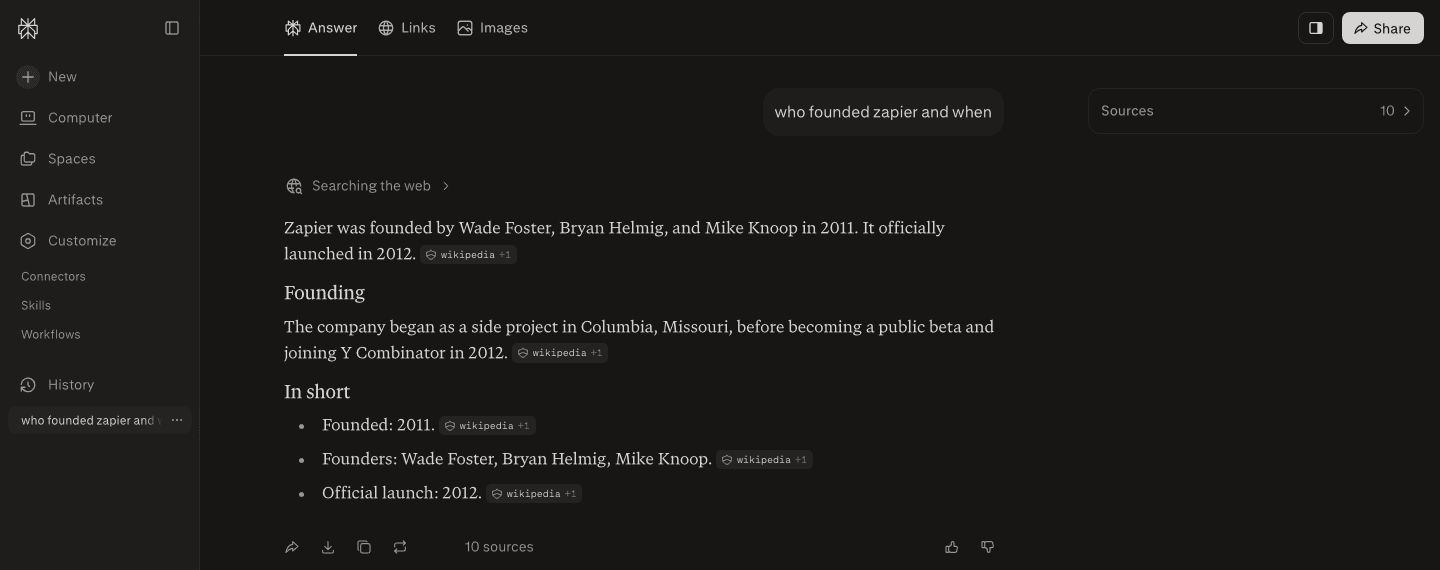
The answer names all three founders and the 2011 founding date, and every single claim carries a wikipedia source chip, not a zapier.com one. Ten sources went into that search and the model still reached past Zapier's own homepage for the citation. Zapier's schema never points at Wikipedia. It did not need to. The model found Wikipedia on its own and trusted it more than the brand's own structured data.
The read
- Passing validation is table stakes, not the win. Google will happily mark seven social links as "valid" without ever checking whether one of them should have been Wikidata.
- A
sameAslink only helps if it points where the model already looks. Zapier wired its brand to every social network and skipped the three destinations, Wikipedia, Wikidata, Crunchbase, that a model treats as ground truth for company facts. - A missing link does not stop citation, it just moves the credit. Perplexity still resolved the entity correctly. It handed the citation to Wikipedia instead of to zapier.com, because Wikipedia is where the trail actually led.
Steal it
Run the same three-step check on your own domain before you touch anything else. Curl your homepage and grep for "@type":"Organization". No sameAs array means you have nothing linking your brand to a source a model trusts. A sameAs array full of social links and nothing else means you have Zapier's exact gap: schema that validates but never resolves to the pages that actually settle disputed facts.
Close that gap the way Zapier hasn't. If you do not have a Wikidata item, create a minimal one, official website, founding date, that is enough to start. Add sameAs links to it and to your Wikipedia page from your own Organization schema, and give your named founders individual Person schema with sameAs pointing at their LinkedIn and any Wikidata item they hold. On a site that already ships clean Organization JSON-LD, this is a same-day edit, not a rebuild.
Gotchas
- Valid schema is not complete schema. "4 valid items detected" tells you Google's parser can read the file. It tells you nothing about whether you linked to the sources that actually carry weight with a model.
- Sitewide consistency matters as much as the schema itself. If your Organization schema says one founding year and your About page or press kit says another, you have manufactured the exact conflict a model has to resolve, and it will not always resolve in your favor.
- The fix is not instant, and I have not verified how fast it moves. Adding
sameAslinks today does not retroactively make Perplexity cite you tomorrow. Models work off crawled and cached data, so check back in weeks, not hours, and do not assume the citation has shifted just because the schema now points the right way.