Answer first, in a capsule
Engines retrieve passages, so every section has to stand alone.
What to do: Lead each section with a real question as the heading, then a two-to-four sentence self-contained answer, then expand with bullets or a table. Write so any single chunk can be lifted and still make sense.
Why it works: Engines retrieve passages, not whole pages, so every section has to stand alone as a quotable answer.
Example: Webflow rebuilt its top feature pages into clear question-and-answer blocks and reported answer-engine signups climbing from 2% to 10% of all signups in a year, with 300-plus new citations. That is their own number, but the mechanism is the lesson: give the model a clean answer and it quotes you.
Walk it through
I ran a real buyer question through Perplexity in July 2026 to watch passage retrieval happen instead of just describing it.
1. Ask the question you want to own.
https://www.perplexity.ai/search?q=what+is+a+growth+loop+in+marketing
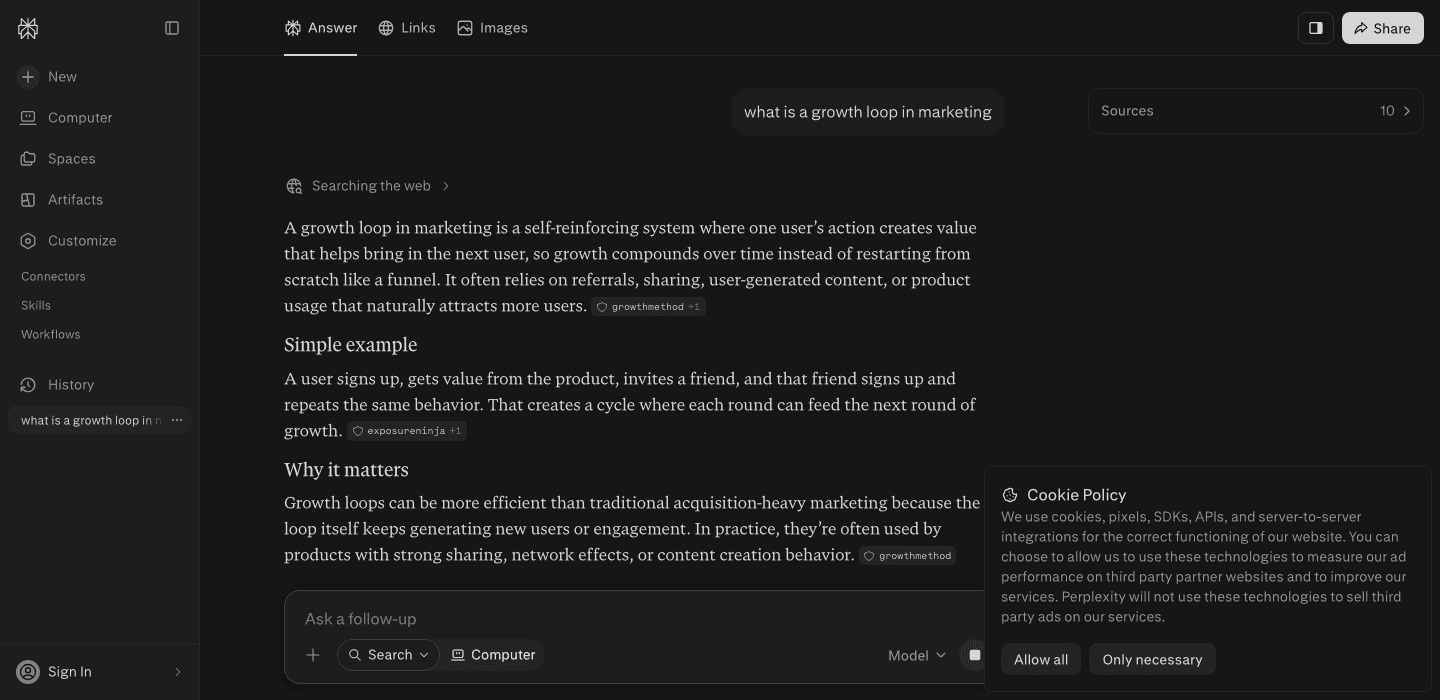
Perplexity doesn't write one paragraph and cite it once. It builds three separate capsules, a definition, a "Simple example," and a "Why it matters," and tags each one with its own source chip. That is passage retrieval happening in front of you. The model isn't reading one page top to bottom, it is stitching together whichever paragraph on the open web answered that specific piece of the question best.
2. Open the page one of those chips points to.
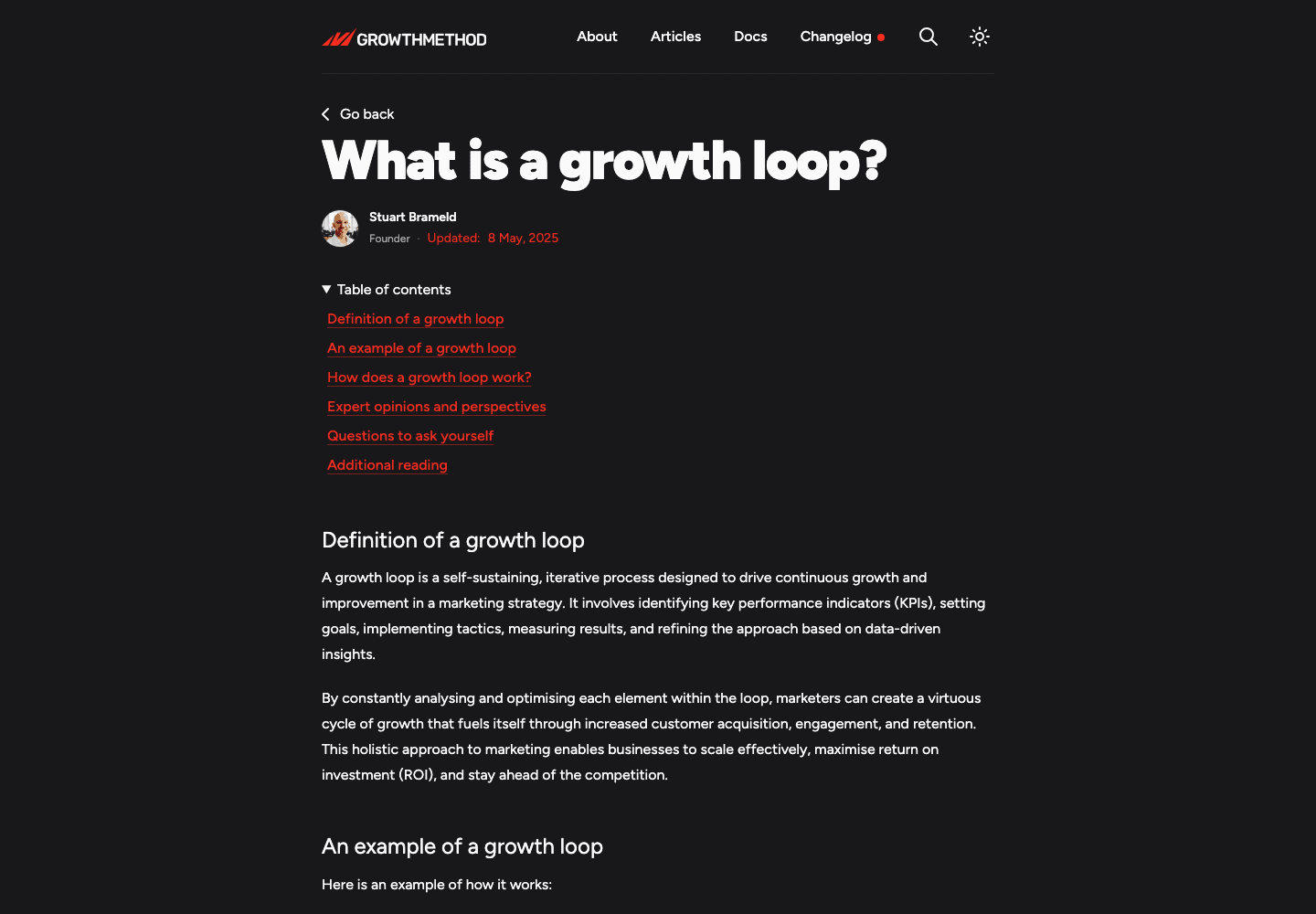
The growthmethod chip on Perplexity's opening paragraph points here. Look at the table of contents: "Definition of a growth loop," "An example of a growth loop," "How does a growth loop work?" Every heading is the exact question a reader would type. Under the first one sits a two-sentence definition, self-sustaining, iterative, feeds itself, before the page ever elaborates. That is the paragraph Perplexity paraphrased. The page was built to be lifted, and it got lifted.
3. Check that your own headings actually read like questions.
curl -s growthmethod.com/what-is-a-growth-loop/ | grep -oE '<h2[^>]*>[^<]*</h2>'
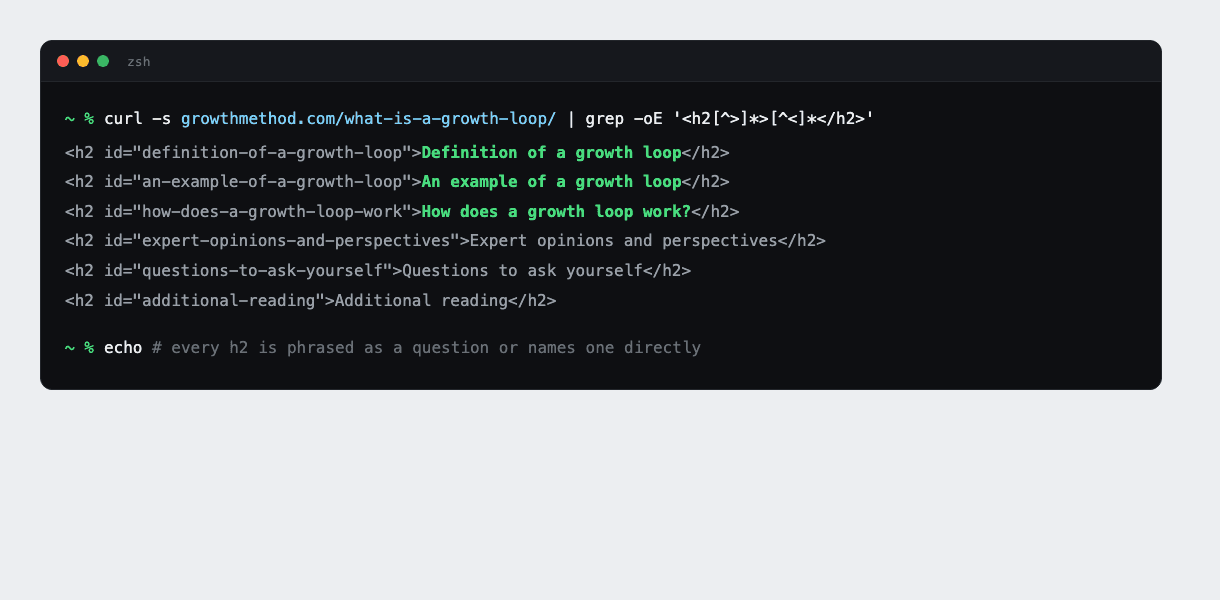
Six headings come back, and every one of them is a question a buyer would actually search, or names the thing that answers it. Run the same one-liner against your own URL. If your H2s read like section labels, "Overview," "Background," "Use cases", instead of questions, you have found the gap before an engine ever has to.
The read
- A citation chip is a unit of retrieval, not a page visit. Perplexity pulled from two different domains inside one answer to my single query, so ranking your whole page for a topic no longer wins the game. One paragraph on that page has to win the specific sentence.
- The heading is doing the work, for both SEO and AEO. Growthmethod's H2s are literally the questions people search. That is not a happy accident, it is the entire content plan for a page shaped like this.
- Short and self-contained beats long and clever. The capsule that got cited was two sentences before the page moved on to elaborate. Nothing in it needed the rest of the article to make sense on its own.
Steal it
List the ten questions your buyers actually type about your category, not your product, and give each one its own H2 phrased as that exact question. Under it, write a two-to-four sentence answer that would survive being dropped onto a stranger's screen with zero context, no "as mentioned above," no pronoun pointing back at a previous paragraph. Expand underneath with the detail, examples, and nuance you'd normally lead with. The capsule is the bait, the rest of the section is where you make the sale.
Defend the position by running your own product's core questions through Perplexity every few months. If a competitor's page is the one earning the citation chip, open it and set its heading and first sentence next to yours. Nine times out of ten the fix isn't more information, it's a tighter first sentence sitting under a better-phrased heading.
Gotchas
- Paraphrase isn't proof. Perplexity's wording and growthmethod's wording aren't identical, the model compresses and rewrites, so don't expect a verbatim quote back as your evidence. Track the citation, not the exact string.
- A citation today isn't a lease. Run the same question again next month. Engines reshuffle which source they lean on as they re-crawl, so one good screenshot is a snapshot, not a permanent ranking.
- Perplexity's answer streams in and shifts run to run. The exact sentences and section headers it lands on can change between one load and the next. Give it time to finish before you judge the result, and rerun once if it cuts off mid-thought.