Catch Them Before They Bounce
One question asked at the exact moment someone stalls beats a quarterly satisfaction survey sent to everyone.
Most teams learn why people leave from a survey that goes out to the whole list once a quarter, weeks after the moment that actually mattered. By the time that email lands, the user who almost quit during onboarding has either pushed through or is gone and will not remember there was a reason at all. The fix is not a better survey. It is a much smaller one, asked at the one moment it can still change the outcome, right when the person visibly stalls.
What to do: Pick one behavioral trigger where users are known to disengage: an onboarding step almost nobody finishes, three idle days after signup, a pricing page opened twice with no upgrade. Fire a single on-page question at that exact moment, in plain language, with an open text box instead of a multiple-choice grid. Read the raw answers yourself before you look at any rollup number.
Why it works: A person mid-stall will hand you the real reason in one sentence. The same person, surveyed next quarter, will not remember there was a reason at all.
Example: Qualaroo built this play before growth marketing had a name for it. Hiten Shah's team at KISSmetrics launched it in 2010 as KISSinsights, Sean Ellis bought and renamed it Qualaroo in 2012, and its whole pitch was one on-page question at the moment a visitor was about to act instead of a survey blasted to a list. GraphicSprings, a custom apparel site, used it to ask homepage visitors what they expected to find and to catch abandoning shoppers with an exit-intent question. In the case study Qualaroo still publishes, GraphicSprings credits the surveys with a 41% increase in revenue, an 8-point drop in bounce rate, and a 7-point lift in call-to-action clicks.
Walk it through
Qualaroo is still selling this exact mechanism in 2026, just with an AI layer bolted onto the back end. Here is what that looks like end to end, on the actual product and the actual result it points to.
1. Pick the moment, not the calendar. Qualaroo's targeting runs on time on page, specific URL, click behavior, and exit intent instead of a send date. That is the entire trick. The question fires because of something the user just did, not because a week passed.
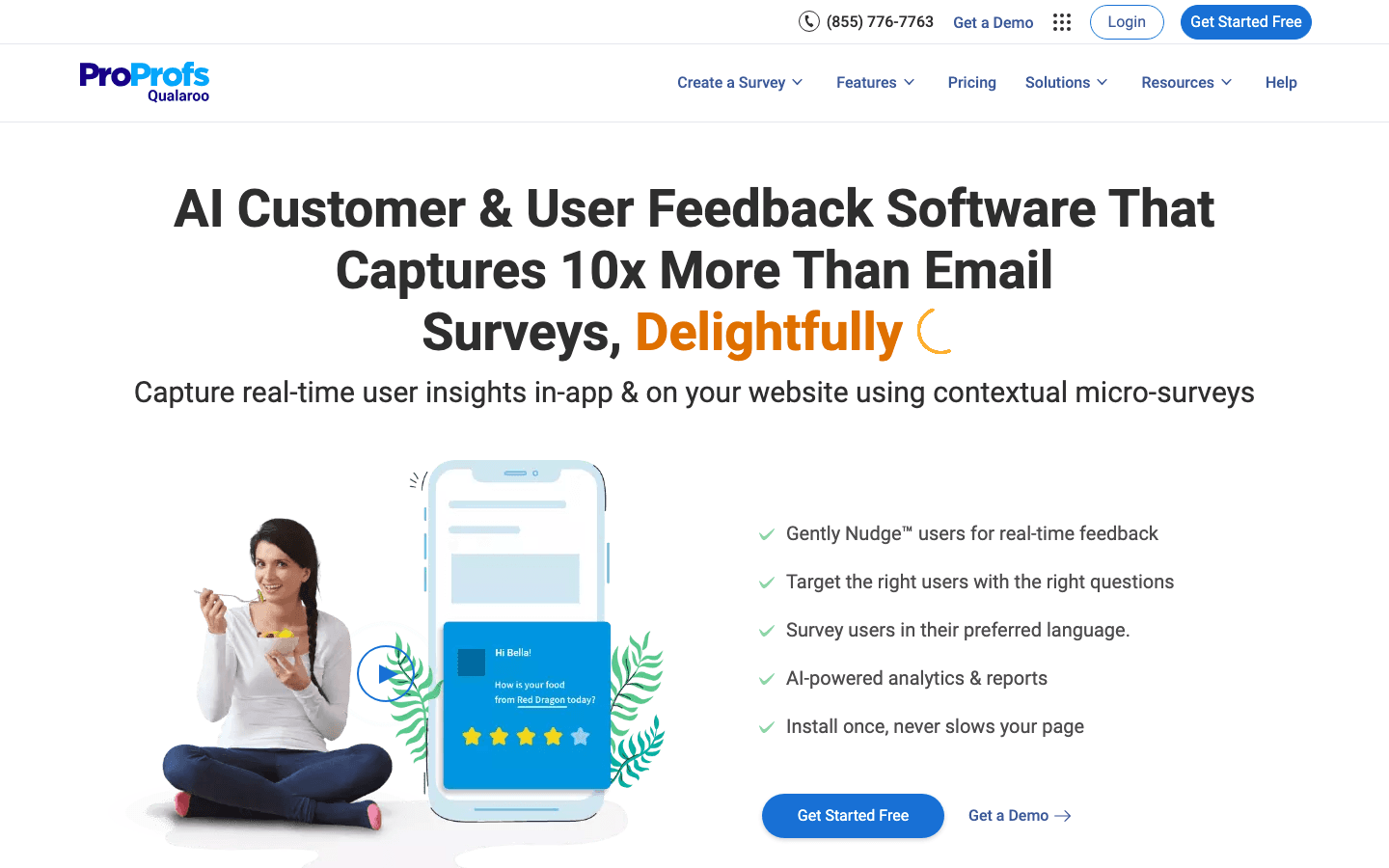
That is Qualaroo's own homepage today, still run by the team at ProProfs. The pitch has not changed since 2010: "contextual micro-surveys" that "gently Nudge users for real-time feedback," targeted to the right person at the right action instead of mailed to everyone. The phone mockup on the page shows the shape of the whole idea in one line, a single short question asked inside the product at a specific moment, not a ten-field form.
2. Ask one question, in the product, in plain words. Not "how satisfied are you with your experience," which nobody can answer honestly in a text box. Ask the thing you actually need to know: "What's stopping you from finishing setup?" or "What were you hoping to find on this page?" One question, free text, no required fields.
3. Route the answer somewhere it actually gets read. The 2026 upgrade on this old play is what happens after the answer comes in. Sprig, a newer entrant in the same category, now runs every open-text response through a GPT model that clusters answers into named themes in real time as they arrive, surfacing representative quotes instead of a spreadsheet nobody opens. You do not need that specific vendor. You need the habit: someone, or something, actually reads what people typed.
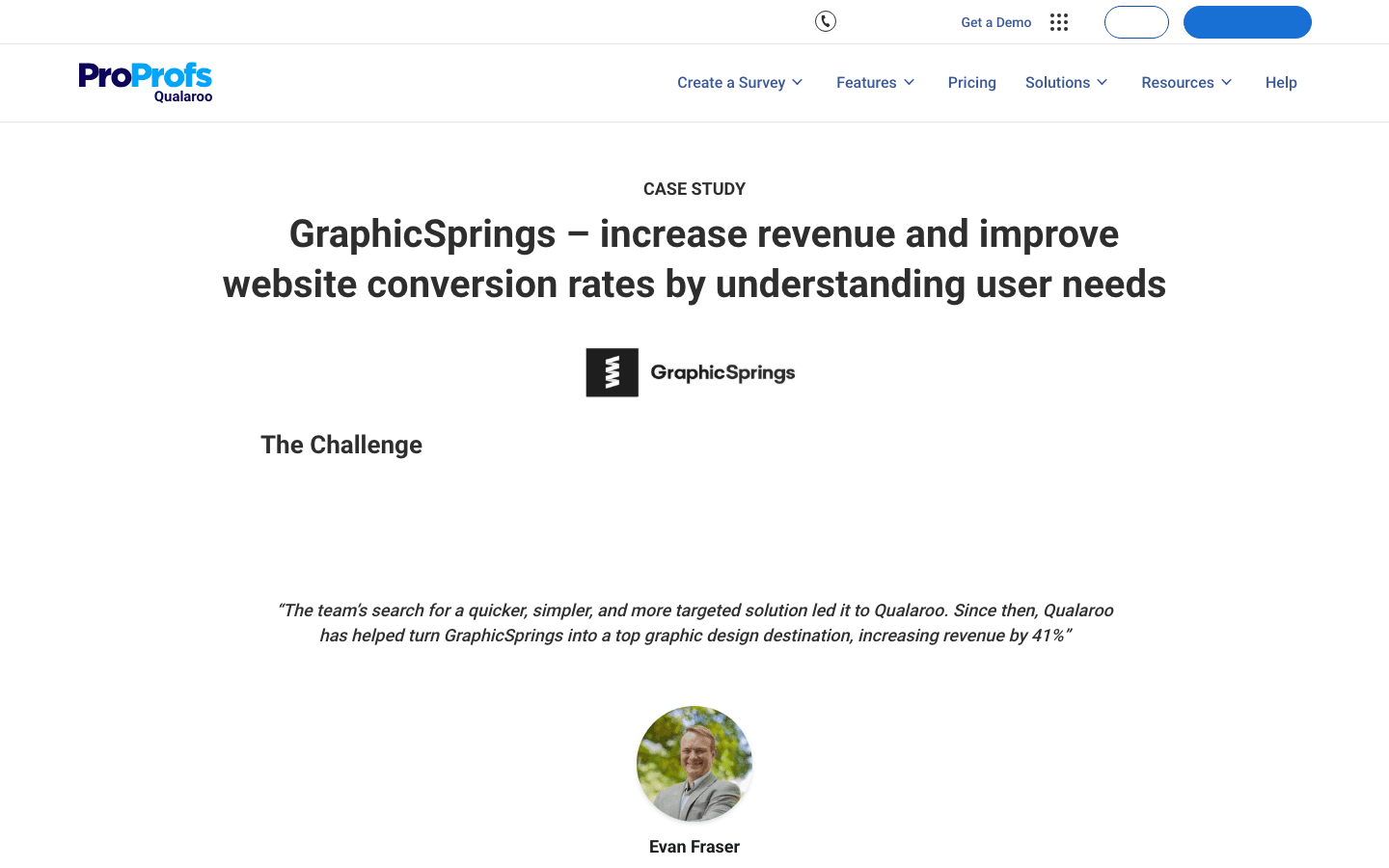
That quote from GraphicSprings founder Evan Fraser is the proof this is not a theoretical tactic. A small ecommerce team asked visitors real questions at real moments and changed the site based on the answers. The 41% is their number, on their own case study page, not a projection.
The read
- Timing beats volume. One question asked at the right second outperforms twenty questions mailed to people who have already mentally left.
- Free text beats multiple choice. A dropdown gives you the options you thought of. A text box gives you the words the user actually used, including the ones that surprise you.
- Clustering is a shortcut, not a substitute for reading. An LLM sorting a thousand answers into five themes is useful. Trusting the theme labels without ever reading the underlying quotes is how you miss the one answer that mattered.
Steal it
Look at your own funnel and find the step with the ugliest drop-off number, the onboarding screen people abandon, the setup wizard nobody finishes, the three-day mark where trial users go quiet. Write one specific question tied to that exact moment, not a generic "how are we doing." Fire it once per user, cap it at one nudge per session, and read the first fifty raw answers yourself before you let any tool summarize them for you. You will know more about your stall point in a week than a quarterly NPS survey would tell you in a year.
Defend the other side of this too. The question you choose to ask is itself a confession about what you think is broken. A generic "how can we improve" gives nothing away. A pop-up that fires the moment someone hovers over your pricing page's back button tells any competitor watching closely exactly which step you are worried about. Keep the wording plain enough that it reads as helpful, not as a tell.
Gotchas
- Only some people answer, and they are not a random sample. The users angry or engaged enough to type a sentence are not the same as the silent majority who just close the tab. Read the answers as a signal, not a census.
- Auto-clustering can invent a theme out of noise. Feed an LLM forty free-text answers and it will confidently name five themes even when three of them are really one theme split by wording. Spot-check the raw quotes behind any cluster before you act on the label.
- One nudge per visit is a ceiling, not a suggestion. Trigger this on every stall point you can instrument and you have rebuilt the annoying pop-up you were trying to avoid. Pick the one or two moments that matter most and leave the rest alone.