The Honest Cancellation Flow
An honest, one-click cancel is a trust signal now, not just a compliance chore.
Cancellation used to be a private lever. Bury the button, gate it behind a phone call, stack three save offers between the customer and the door, and nobody outside the company ever saw the maze. That stopped being true in September 2025, when the FTC fined Amazon $2.5 billion over a cancellation flow its own staff had nicknamed the Iliad Flow, four pages, six clicks, fifteen options, an epic on purpose. Five months later Netflix's co-CEO stood in front of the Senate and used the opposite claim as a selling point. The cancel button stopped being a place to hide friction and became a place to prove you have none.
What to do: Make canceling a single, unambiguous action from account settings. No phone call, no chat gate, no reason-first wall standing between the customer and the button. Once the cancellation is actually confirmed, and only then, ask why on one short screen. Then say the policy in plain words somewhere a prospect can read before they ever hand you a card, a pricing page line, a help center article, a founder quote on record.
Why it works: a prospect who can verify the exit before they commit to the entry trusts the entry more, and that trust now has a regulator backing it instead of just a hunch.
Example: Netflix co-CEO Ted Sarandos was asked before the Senate on February 3, 2026, whether subscribers had any real protection against price hikes tied to the pending Warner Bros. Discovery merger. He pointed straight at the cancel button, calling Netflix "a one-click cancel" and telling the room that anyone who decided the price wasn't worth it could leave immediately, no retention maze required. Netflix's own help center backs the claim in public, right now: the published steps to cancel run to exactly two, open Manage your membership, then tap Cancel.
Walk it through
I pulled both sides of this in July 2026, the fine that forced the industry's hand and the policy a competitor is now saying out loud.
1. Read what actually triggered the shift.
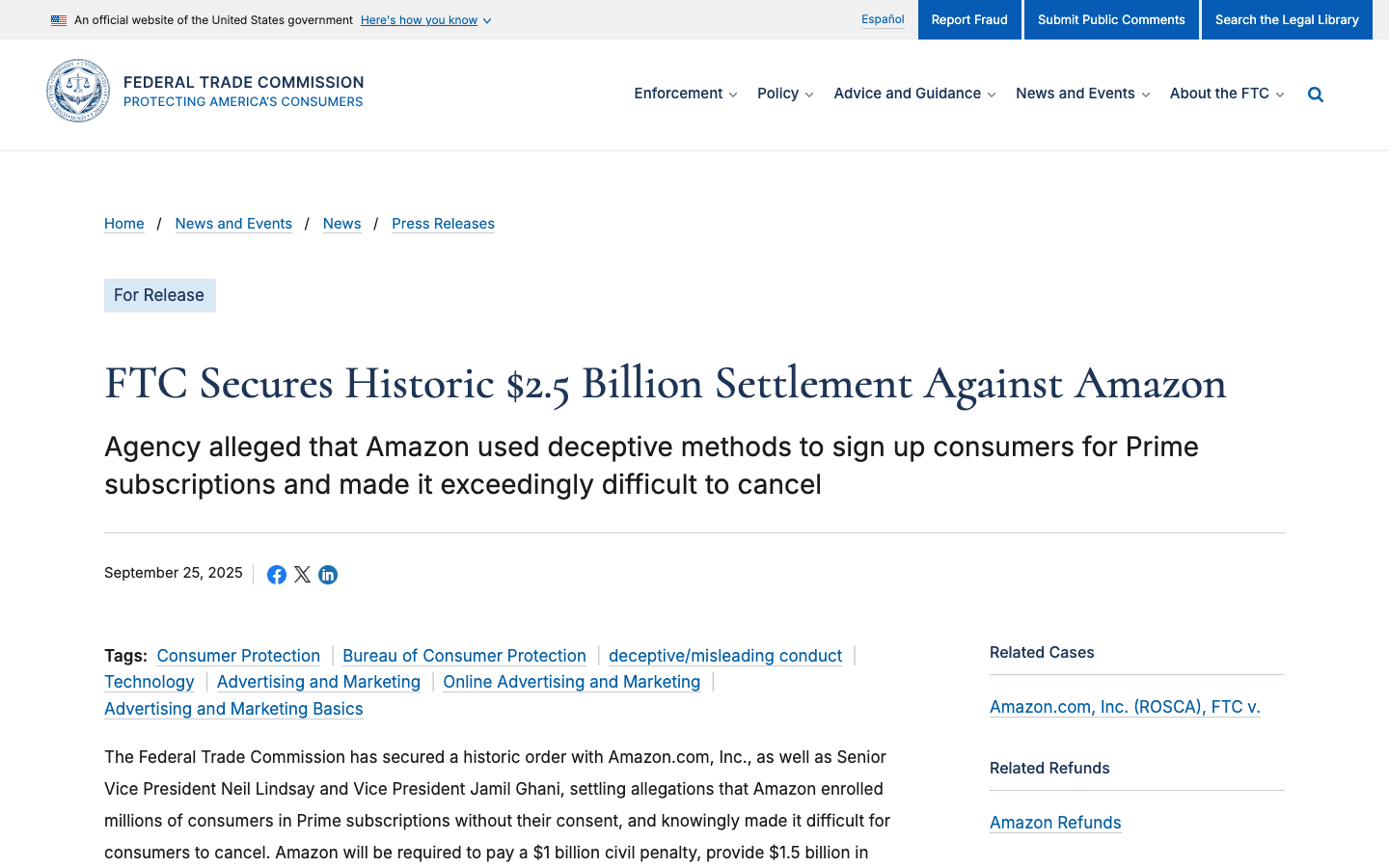
The headline number is $2.5 billion, split into a $1 billion civil penalty, the largest ever for an FTC rule violation, and $1.5 billion back to consumers. The release describes exactly what the money was for: Amazon "knowingly made it difficult for consumers to cancel." The order now requires Amazon to make canceling as easy as signing up, using the same method the customer used to enroll. That line is the entire chapter in one sentence, written by a regulator instead of a growth team.
2. See what a stated one-click policy looks like when a company puts it in writing.
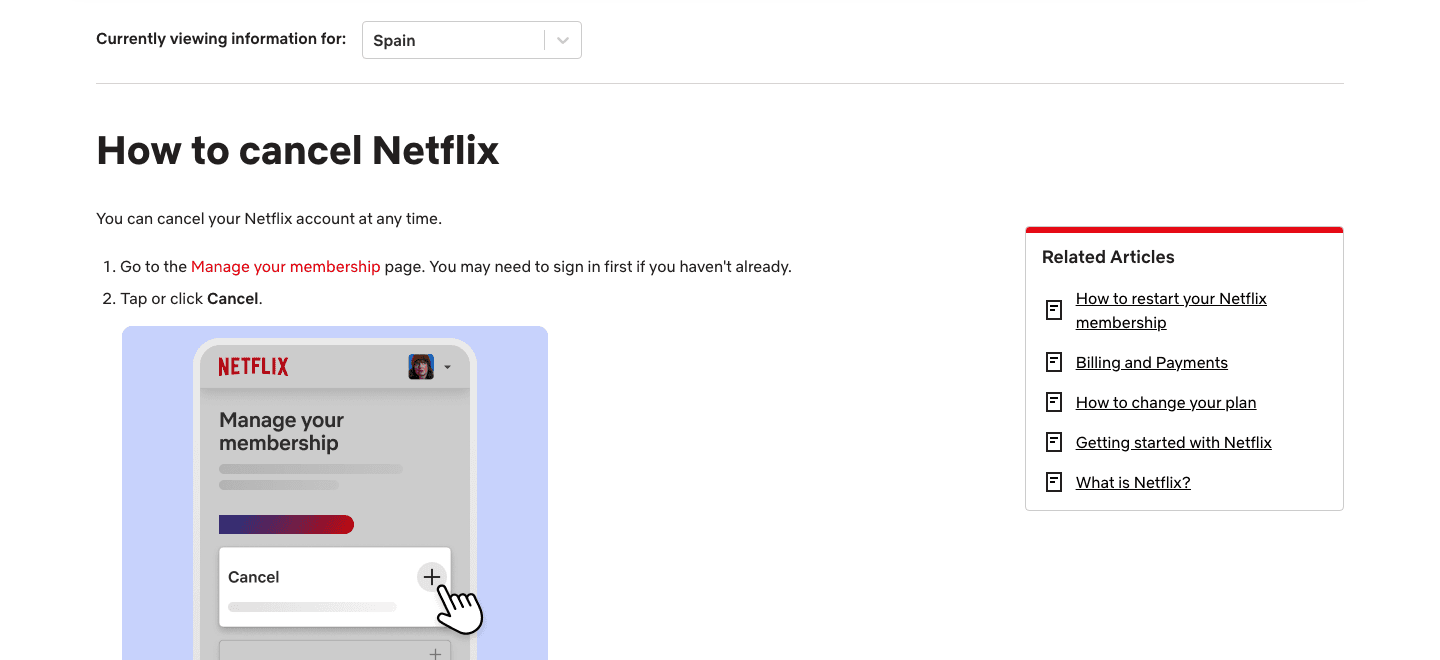
"You can cancel your Netflix account at any time." Two numbered steps follow. Go to Manage your membership. Tap Cancel. No save offer is described, no second confirmation screen, no support ticket. This is the same claim Sarandos made to the Senate, just sitting in a help article instead of a hearing transcript, available to anyone who wants to check it before they subscribe.
3. Check the regulation forcing everyone else to catch up.
The Eighth Circuit had vacated the FTC's original click-to-cancel rule in July 2025 on a procedural technicality, not on the merits. The agency didn't let it go. It filed a draft Advance Notice of Proposed Rulemaking in January 2026, formally opened the new rulemaking on March 11, and closed the public comment period on April 13. A final rule is still a way off, but the substance carried over from the vacated version is already public: clear disclosure, affirmative consent to the subscription, and a simple, easy-to-use way out. Build for that now and you are not guessing at a future rule, you are reading its draft.
The read
- The fine came from the friction, not the failure to disclose. Amazon didn't get hit for hiding that Prime auto-renewed. It got hit for what happened when a customer already knew that and tried to leave anyway.
- A stated policy is free marketing the moment a competitor gets fined for the opposite. Sarandos didn't invent the one-click line for the hearing. He reached for a policy Netflix already had and used it as evidence of good faith at the exact moment good faith was under public scrutiny.
- The rule is coming back whether or not the old one survives court. A vacated rule that gets a fresh ANPRM within six months is not a dead issue. Treat the draft requirements as the baseline you'll eventually have to hit, not a maybe.
Steal it
Run your own flow today, as a customer would, and count. Count the clicks, count the pages, count every screen that asks you to confirm you're sure before the cancel actually lands. If the number is higher than one or two, you are running a smaller version of the Iliad Flow, and the gap between your count and one click is exactly the amount of user goodwill you are spending on every cancellation. Cut it to the minimum, move the exit-reason question to after the cancellation is confirmed so it can't be mistaken for a stall tactic, and route those reasons somewhere a human actually reads them monthly. That is the one part of this that is genuinely valuable to you, a live, ongoing list of why people leave, tagged by the moment they left.
Defend the same way on the other side. If you're the one being undercut by a competitor's public one-click claim, don't respond by adding more friction to buy time, that is the losing move Amazon already ran and already paid $2.5 billion for. Match the claim, publish it somewhere verifiable, and treat every save offer you still want to run as something that happens after the cancellation is confirmed, framed as a genuine win-back, not a checkpoint the customer has to get past first.
Gotchas
- Say only what your product actually does. Sarandos said "one click." Netflix's own help page describes two steps, open the membership page, then tap Cancel. Close enough to be honest, but audit your own claim against your own flow before you repeat it in public, because a prospect who checks and finds a gap trusts you less than one who never heard the claim at all.
- The rule isn't final. An ANPRM is a request for comment, not a regulation. Don't tell your legal team or your board that you're "compliant" with a rule that doesn't exist yet. Build to the direction it's pointing, not to a checklist that hasn't been published.
- Segmenting by reason is only honest if it happens after the exit, not before. Ask why someone wants to leave before you let them leave and you've rebuilt the reason-first wall the FTC just fined a company for. Ask after the cancellation is already confirmed and it's research. The order of operations is the whole difference.