Newsletter Swap Network
Trade audience with someone who shares your reader, not your market.
A sponsorship swap is a favor. You email a founder, negotiate a date, write the blurb, and start over next month with someone else. A recommendation network is not a favor, it is infrastructure. You pick a handful of newsletters that talk to the same person you do about something else entirely, you recommend each other once, and the arrangement keeps paying out subscribers every single week without another email.
What to do: Find four to six newsletters that share your exact reader but sell a different thing, so nobody is competing for the same subscription. Ask each one to add you to their recommended list at signup, and add them to yours. Do this on a platform that supports it natively so the swap runs itself instead of needing a renegotiation every cycle.
Why it works: A new subscriber is asked to say yes again seconds after they already said yes once, so the recommendation reads as editorial pick, not an ad.
Example: beehiiv's Recommendations feature lets any publisher curate a "Top 4" list of other newsletters that appears the moment someone subscribes. Workspaces, a newsletter on the platform, told beehiiv that Top 4 became its top growth driver and accounted for 67% of its new subscribers in one month, and beehiiv's own network data shows publishers running Recommendations grow 2.75x faster than those that do not.
Walk it through
Here is what the mechanic actually looks like, captured from beehiiv's own feature page in July 2026.
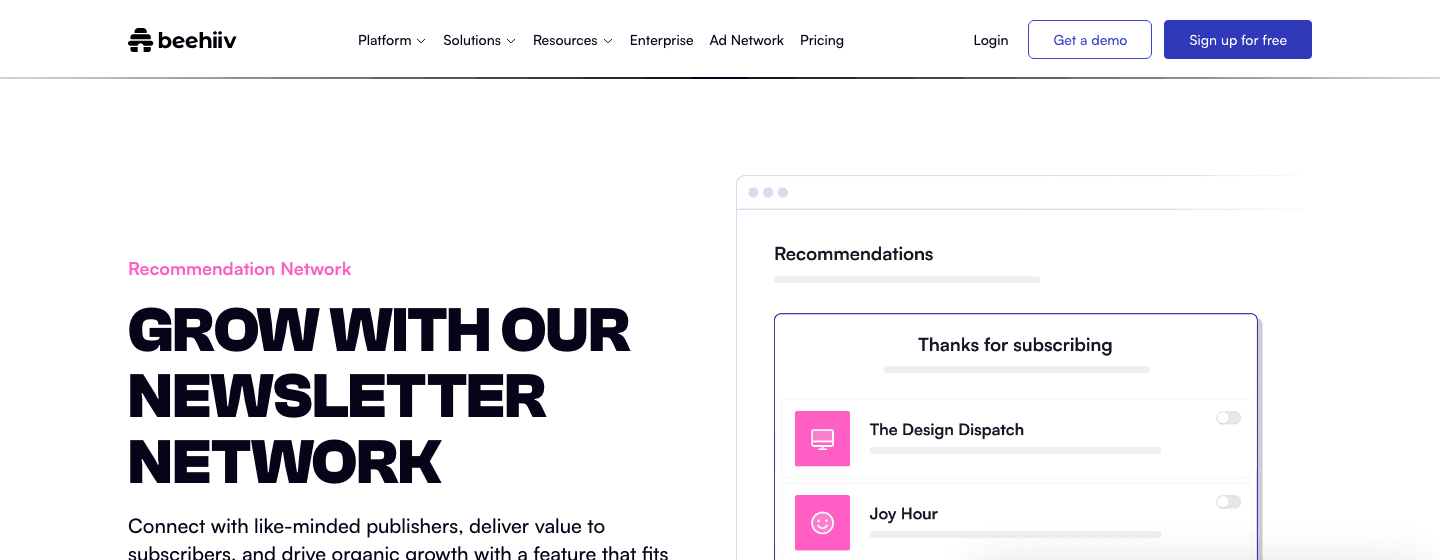
1. The ask happens after the yes, not before it. The mockup shows "Thanks for subscribing" with a short list underneath, "The Design Dispatch," "Joy Hour," each with a toggle to opt in. The reader already committed to you. Now you are handing them a second decision while they are still in the habit of saying yes.
2. The list is small on purpose. Four slots, not forty. A wall of forty logos reads as an ad unit and gets ignored. Four reads as a hand-picked shortlist, which is the entire reason it converts.
3. Every slot is reciprocal. You are not the only one making this ask. Whoever you put in your four is putting you in theirs, and their reader becomes your reader the same way yours becomes theirs. The subscriber flow points in both directions at once.
The read
- The moment matters more than the copy. A recommendation placed right after signup, while the reader is still mid-action, converts differently than the same link buried three paragraphs into an issue.
- It compounds because it is standing, not one-off. A sponsorship swap resets to zero after it runs. A Top 4 slot keeps converting every day a new reader subscribes, with nobody having to remember to re-negotiate it.
- Shared reader beats shared market. Workspaces is not competing with the newsletters it swaps with. They are all fighting for the same person's attention, just from different angles, which is exactly why none of them feel like a threat to recommend.
Steal it
Pick your four before you pick your platform. List the other things your reader reads, follows, or pays for that are not you, not a competitor, and not obviously trying to sell the same thing. A newsletter for freelance designers swaps with a newsletter for freelance accountants, not with another design newsletter. Reach out to four or five of them, propose a mutual Top 4 slot, and if your platform supports native recommendations, turn it on so neither side has to keep managing it by hand.
Defend it the same way you built it. Once a month, actually read what is showing up in your own Top 4 slots and in the ones recommending you. A newsletter that changes focus, goes dormant, or starts running content you would not want next to your name should get swapped out immediately, because your recommendation is a stamp of trust and it decays the moment the other side stops earning it.
Gotchas
- A dormant partner still shows up in your slot. If nobody prunes the list, you end up recommending a newsletter that stopped publishing six months ago. Check quarterly at minimum.
- Reciprocity has to be real, not implied. If you put someone in your four and they never return the favor, you are running a one-way sponsorship again, just without the payment. Confirm the swap before you count on the traffic.
- Overlap kills the pitch. If your reader is already subscribed to the newsletter you want to swap with, you are not adding reach, you are just splitting the same inbox two ways. Check subscriber overlap before you propose the trade, not after.