The Backlink Backtrace
Their best backlinks are a ready-made outreach list.
A backlink is a public vote. Somebody already decided a company was worth mentioning, in a roundup, a directory, an integration page, a stray blog post, and they left the link up for anyone to find. That vote is not exclusive. If a site linked out once for a company in your category, it will very likely do it again for you, and the whole list of who already voted is sitting behind one free tool and a domain name.
What to do: Run the competitor's domain through Ahrefs' free backlink checker, then scan the referring domains it returns for podcasts, best-X roundups, directories, and integration pages.
Why it works: Their best backlinks are their distribution map. The sites that already vouch for them are doors proven to open in your category, and most of those doors will open for a second knock.
Example: Zapier's free-tier check came back with a Domain Rating of 91, 10M backlinks, and 95K referring domains. Buried in the roughly 20 rows the free tool actually shows, Lindy's "18 Best AI Platforms in 2026" roundup (DR 77) and Gumloop's "10 best AI workflow automation tools" post (DR 74) are sitting in plain sight. Both already decided Zapier belongs on their list.
Walk it through
I ran this against zapier.com in July 2026. Here is what came back.
1. Load the checker and drop in the domain.
open "https://ahrefs.com/backlink-checker/?input=zapier.com&mode=subdomains"
No login needed on the free tier, and passing the domain as a URL parameter pre-fills the search box.
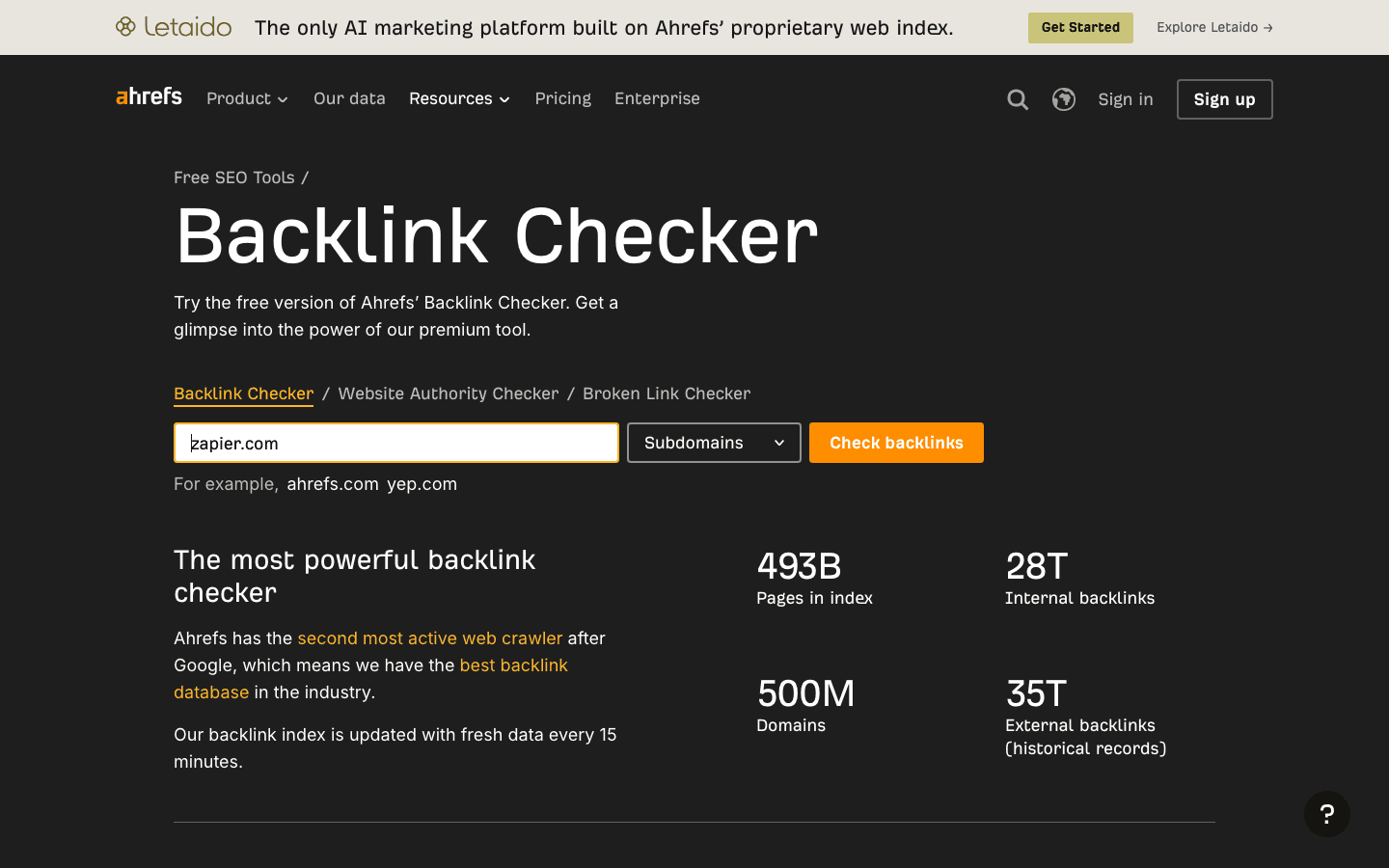
Ahrefs advertises 500M domains and 35T historical external backlinks sitting behind this box. Whatever comes back next is a thin slice of a genuinely large index, not a toy dataset.
2. Read the overview strip, then the referring domains table underneath it.
Screenshot: the results modal, "Backlink profile for zapier.com," showing Domain Rating 91, Backlinks 10M, and Linking websites 95K above the referring domains table.
Zapier's own Domain Rating sits at 91, with 10M backlinks (97% dofollow) from 95K linking websites (86% dofollow). Below that, the free tier hands you a fixed sample, 20 rows in my pull, in an order that has nothing to do with authority. I clicked the DR column header expecting a sort toggle. Nothing happened. This version of the tool does not resort, so you read the whole sample by eye: a ChatGPT wiki page on primo.ai (DR 27), TinyJPG and TinyPNG both linking to the identical private developer-invite URL for a beta integration (DR 80 and DR 90), a Wikipedia article on HTTPS (DR 97) citing an old Zapier blog post as a footnote, and OpenAI's "Introducing GPTs" post (DR 93) linking to Zapier's own AI Actions writeup.
3. Scan for shape, not score, and pull out the real hits.
Screenshot: the two rows for lindy.ai's "The 18 Best AI Platforms in 2026" and gumloop.com's "10 best AI workflow automation tools" posts, DR column visible.
Two rows in that same sample are exactly the shape this tactic is looking for. Lindy's blog post "The 18 Best AI Platforms in 2026 – Tested & Reviewed" (DR 77) links straight to zapier.com/pricing. Gumloop's "10 best AI workflow automation tools I'm using in 2026" (DR 74) links to zapier.com/apps. Both are editorial roundups that already cleared Zapier for inclusion, which means the writer's bar for "belongs on this list" is a bar your product can clear too.
The read
- Shape beats score. A roundup or a podcast page is outreach-able, you can pitch a person to add you or have you on. TinyJPG and TinyPNG linking to the same private beta-invite URL is not outreach, it is Zapier's own integration ecosystem linking back automatically. Every tool that connects to Zapier collects one of those for free, and no email changes that.
- High authority is not the same as high relevance. Wikipedia's HTTPS article carries DR 97 and links to an old Zapier wifi-login post as a citation, not an endorsement. Chasing the highest number in the column wastes a pitch on a site that will never cover your category.
- The target URL tells you which page already sells. When Lindy's roundup links to
/pricinginstead of the homepage, that is the page competitors are actually being judged on. Pitch the equivalent page on your own site, not your homepage.
Steal it
Run your own domain through the same checker before you run a single competitor. It tells you what you are starting from and gives you a same-tool baseline to compare against later. Then run the competitor, and log every real hit into a target list with four columns: referring domain, page type (podcast, roundup, directory, or integration), the exact URL, and your outreach angle for that type of page. Roundups and podcasts go to the top of the list, since a person decided to include the competitor and a person can decide to include you.
Skip anything that looks like an integration-directory backlink, the automatic kind every competing tool in the space collects just by existing. Those are not doors, they are furniture. Spend your outreach hours on the pages a human being curated and might curate again.
Gotchas
- The free tier caps what you see and will not resort it. My pull returned about 20 rows in a fixed order with no working DR sort. Treat it as a sample, not the backlink profile, and read every row yourself instead of trusting a header click.
- Not every high-DR row is a real opportunity. Citations, changelog mentions, and other tools' own integration or invite pages inflate the list without being anything you can pitch. Filter for pages a human chose to write.
- Verify a site is live before you add it to your list, and do not automate this at scale. A one-off manual pull against a handful of competitors is reconnaissance. Scripting thousands of lookups against the free tool to rebuild Ahrefs' own database is the kind of scraping that gets you rate-limited or worse, and it is not what this play is for.