The Pillar Beats The Post
One hub page with disciplined internal links outearns a pile of orphaned posts.
Most sites treat content as a volume game. Publish enough posts on a topic and hope one of them ranks. The company that actually wins the topic almost never plays that way. It builds one hub page, writes a disciplined cluster of subtopic pages around it, and links every single one back to the hub on purpose. The hub then collects the backlinks, the shares, and the rankings that the volume-game sites split thin across a hundred posts that link to nothing and get linked to by nothing.
What to do: Pick one topic your product actually competes on and build a single hub page that covers it in full, a real reference page, not a blog post with a keyword stuffed in the title. Break the topic into subtopics, give each one its own dedicated page, and link every subtopic page back to the hub in its intro and its breadcrumb, not buried in a related-posts widget at the bottom. When you think of a new related idea, add it to the cluster as another chapter instead of publishing it as a disconnected page.
Why it works: Internal links concentrate ranking authority on one URL instead of splitting it thin across many, so the hub competes for the hard keyword while the cluster pages mop up the long tail.
Example: Ahrefs runs the clearest version of this I have seen. ahrefs.com/seo is the hub, ten numbered chapters running from how search engines work through keyword research to technical SEO. Every chapter sits at its own URL, /seo/keyword-research, /seo/on-page-seo, and so on, and every one breadcrumbs straight back to the hub. Ahrefs' own blog even names this exact page as its go-to example of a hub-and-spoke pillar page, the model it tells other people to copy.
Walk it through
I opened ahrefs.com/seo in July 2026. Here is what a disciplined hub actually looks like.
1. Look at the hub itself.

Ten chapters, numbered 01 through 10, laid out as a single spine on one URL. Nobody buried "keyword research" and "technical SEO" as unrelated posts in a blog archive. They live as chapters of one guide, each with its own page, each unmistakably a piece of the same project.
2. Open one chapter and check where it points.
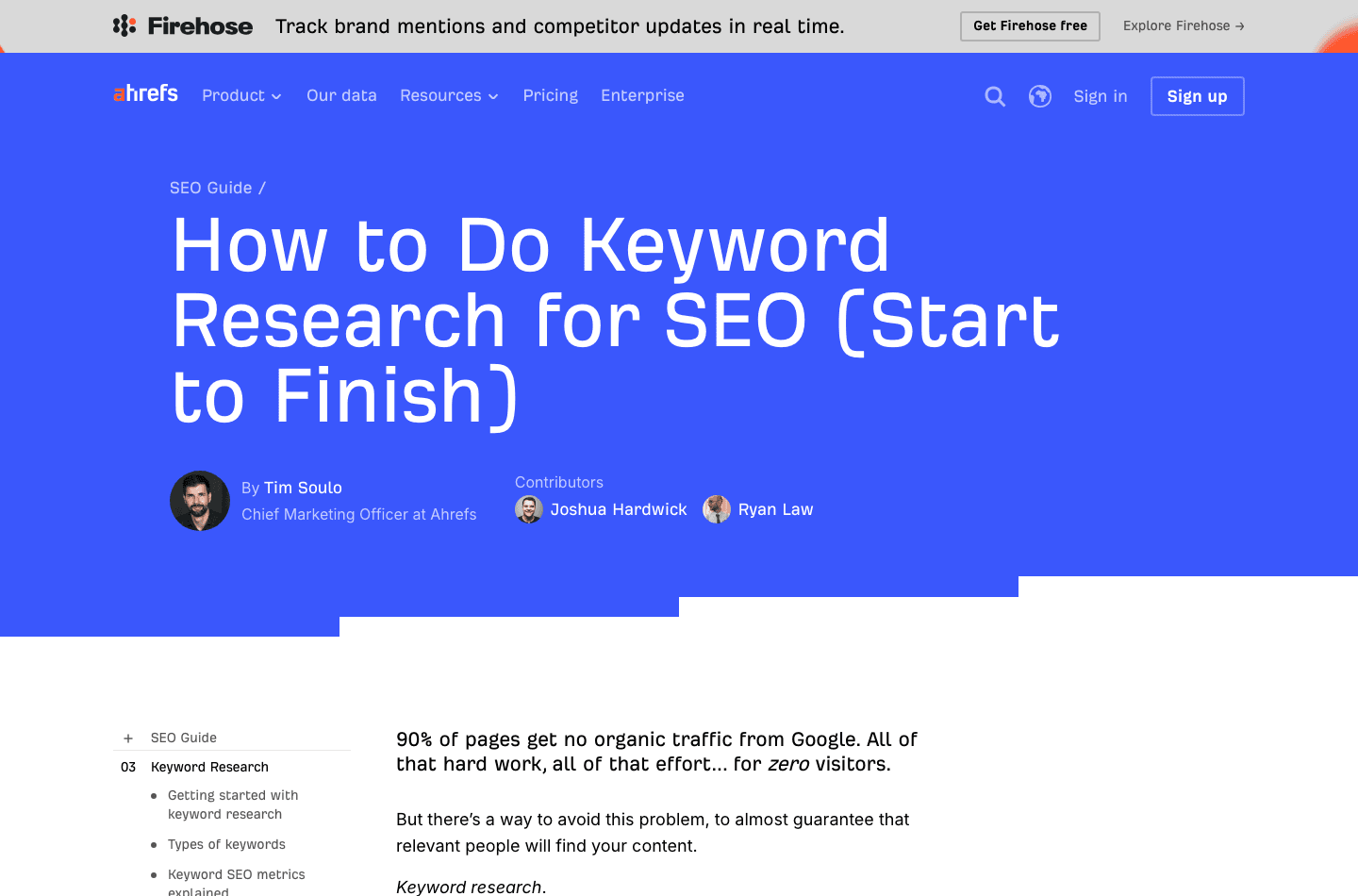
ahrefs.com/seo/keyword-research carries a breadcrumb reading "SEO Guide /" right above the headline, and the sidebar marks it as chapter 03 of the same guide, with its own subsections listed underneath. Every chapter page is built to remind you, and Google, exactly which hub it belongs to.
3. Confirm the link with one command.
$ curl -s https://ahrefs.com/seo/keyword-research | grep -o 'href="/seo"' | wc -l
       2
Two links back to the hub from one chapter page, on top of the breadcrumb you can already see. That is disciplined internal linking, not a hope that Google will notice the pages are related on its own.
The read
- One URL earns all the authority. Every chapter passes its links, shares, and citations back to
/seoinstead of scattering them across ten posts that each start from zero. - The breadcrumb is not decoration. It is a permanent internal link that every crawler and every reader sees on every visit, reinforcing the hub-and-spoke structure page after page.
- The whole guide reads like one project, not ten. Same byline, same design system, same chapter numbering. That consistency is itself a signal that this is the definitive resource on the topic.
Steal it
You do not need ten chapters or Ahrefs' design budget to run this play. Take the one topic your product actually competes on, write a genuinely useful hub page for it, and give every subtopic post you already have, or plan to write, a clear numbered slot underneath that hub. Link every one of them back in the first paragraph and in a real breadcrumb, not a "related posts" box a reader will never click.
Then defend it. Once the hub starts ranking, resist the urge to spin off a new post every time you think of a related keyword. Fold the idea into the existing cluster as the next chapter instead, so the new page inherits the hub's authority instead of competing with it for the same one.
Gotchas
- A pillar page with no cluster is just a long post. The hub only outearns a pile of posts once you actually build and link the pile. Skip the internal linking and you have written a nice article, not a system.
- Cannibalization is real. If two chapters target the same keyword, they compete with each other instead of the hub. Keep every chapter on its own distinct subtopic.
- A hub you build once and abandon gets lapped. Ahrefs revisits and rewrites its guide on a real schedule. A pillar page frozen from the day you launched it will age out while a competitor's living one keeps climbing.