Bundle Into Their Billing
Become the default backend behind a bigger platform's default frontend.
Every extra vendor is a fight your buyer has to have with procurement, or with their own tech lead, or with themselves at 11pm before a demo. Get a first-party slot inside the platform your buyer already opens first and you skip the fight entirely. Setup happens in a dashboard they already trust, and the invoice lands on a bill they already pay. You did not win a customer. You became a line item.
What to do: Negotiate a first-party integration with the adjacent platform your buyer opens before they ever go looking for you, deep enough that provisioning, credentials, and billing all happen inside their dashboard instead of a separate signup flow. Ship the "Install" button that creates the resource, injects the config, and adds your charge to their existing invoice.
Why it works: You inherit their traffic, their trust, and their checkout flow, so your product stops being a decision and becomes infrastructure.
Example: Vercel's official Supabase integration provisions a Postgres database straight from the Vercel dashboard, auto-injects the credentials as environment variables, and folds every charge into a single Vercel invoice. By Supabase's own reporting, roughly 40% of recent Y Combinator batches build on Supabase, and most of those startups ship through Vercel.
Walk it through
I opened Vercel's marketplace listing for Supabase in July 2026. Here is exactly what it shows.
1. Look at how the listing is labeled.
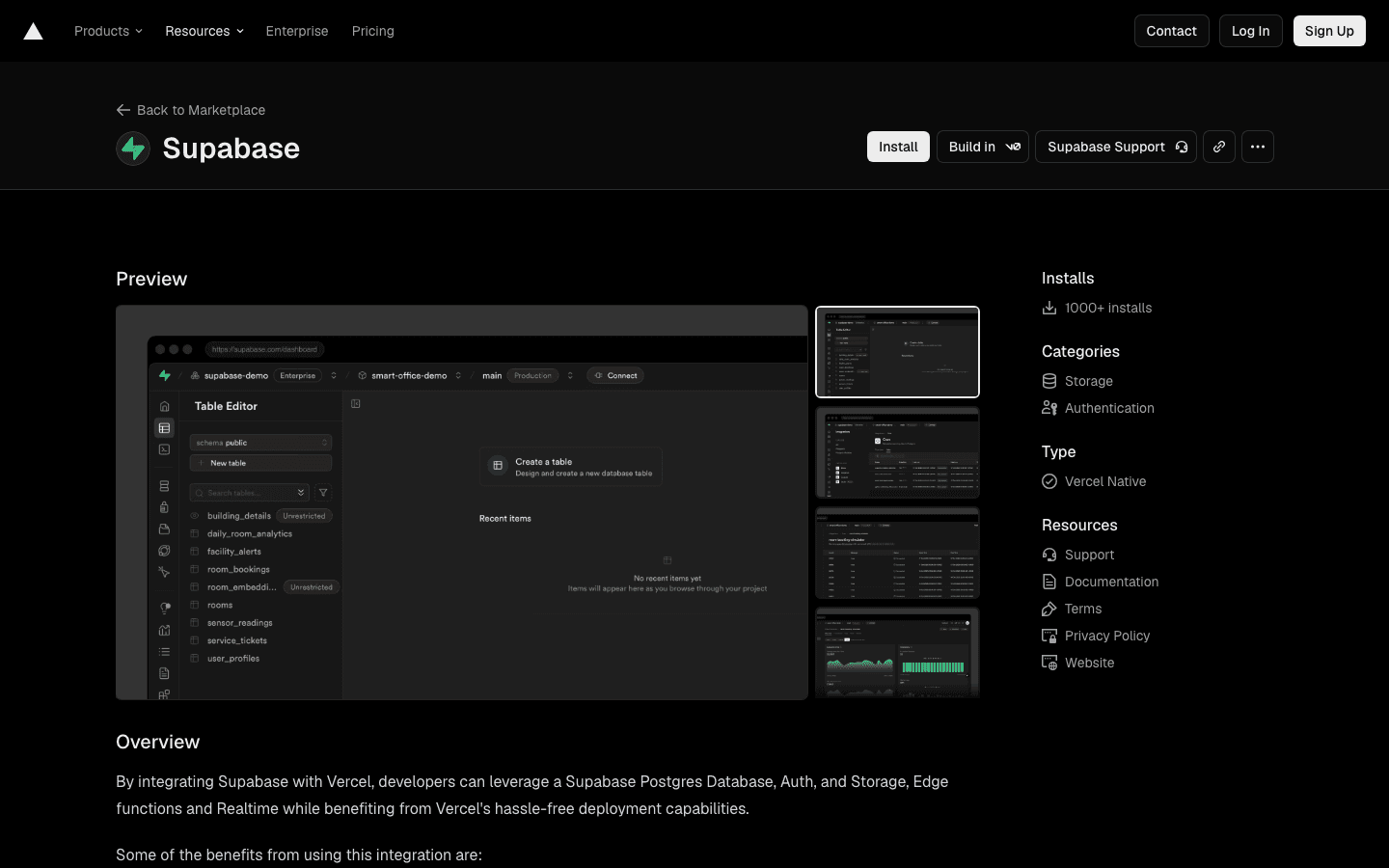
Under "Type" the listing reads "Vercel Native," not "third-party" and not "connects via OAuth." That one word is the whole strategy. Vercel is telling its own users this is not a bolt-on, it is part of the platform. The categories say "Storage" and "Authentication," filed next to Vercel's own storage products instead of buried in a generic integrations directory. "1000+ installs" is the adoption number Vercel chose to surface right there on the page.
2. Read the benefits list. It spells out the whole play in two bullets.

"Handle your invoices via Vercel instead of Supabase." That line is the entire chapter. Supabase gave up owning the direct billing relationship with a slice of its own customers, on purpose, because an install button inside Vercel converts better than a signup form on supabase.com ever will. Right above it, "Sync all your Project env vars to your Vercel projects automatically" is the setup-friction removal that turns the install button into a one-click action instead of a credential-copying chore.
3. Do the math the listing does not show you.
The install count is on the page. The bigger number lives in Supabase's own marketing: roughly 40% of recent Y Combinator batches build on Supabase, and most of those startups deploy through Vercel. That is not 40% of Supabase's customers opting to route billing through a partner after the fact. It is a founder cohort defaulting to a stack where the backend they picked was already wired for one-click billing inside the frontend platform they picked first.
The read
- "Native" beats "integration." Any vendor can build a connector. Getting labeled Native inside someone else's marketplace means their product team agreed to make you look like part of the core product, not an add-on.
- Billing language reveals leverage. "Handle your invoices via Vercel instead of Supabase" tells you Supabase decided losing the direct billing relationship was worth the volume Vercel sends its way. When a platform in your space starts saying that about a bigger one, that is the ecosystem forming around a new default.
- The stat that matters is off the page. Install counts are public and easy to fake with free tiers. The 40%-of-batches number is proof the bundle works at the top of the funnel, at the moment a founder chooses a stack, not just at checkout.
Steal it
Find the platform your buyer already opens before they ever go looking for you. That is the first-party slot worth fighting for. Do not pitch a partnership deck full of "synergy." Pitch a concrete integration spec: what gets provisioned, what config gets auto-injected, and exactly how the line reads on their invoice. The platforms that say yes are the ones where your product removes a real setup step for their users, not the ones where you are only asking for a badge on their website.
Defend the same seat once you are the bigger platform. If you are the frontend or the platform of record, the play runs in reverse. Every adjacent tool your users install by hand today is a first-party slot waiting to be claimed, and whoever gets there first owns the default the way Vercel now owns the database decision for a big share of new Next.js projects.
Gotchas
- You are betting on their roadmap, not just yours. If the platform changes its marketplace terms, revenue split, or featured-integration rules, your distribution moves with it and you find out on their timeline, not yours.
- Support gets tangled fast. A customer billed through the platform who hits a problem with your product does not know which company to call first. Nail down the support handoff before launch, not after the first angry ticket.
- Native status is earned, not requested. Vercel did not build this integration because Supabase asked nicely. Bring real usage numbers and a working prototype before you pitch "first-party," or you will get offered a basic listing instead of a dashboard-level one.