The Visible Status Ladder
Give your most active members a title worth defending, not just earning once.
Most community programs hand out a badge and call it done. A "Top Contributor" flair, a colored username, a line in a Discord bio. Nobody defends a badge, because nobody can lose it. Docker built the opposite kind of status. The Captain title expires every year, so keeping it, not getting it, is the whole game.
What to do: Give your most active contributors a real, named title, not a badge. Set two rules: the title expires on a fixed schedule and gets re-evaluated against the same bar that earned it, and it comes with access nobody outside the title gets, a direct line to your product team, an early build, an invite-only gathering. Publish the current list of who holds it, in public, so the title means something to everyone who doesn't have it yet.
Why it works: A badge you keep forever gives you no reason to keep showing up, while a title you can lose gives you a reason every single year.
Example: Docker's Captains title runs on a strict one-year term, renewed only if the Captain keeps meeting the entry bar and keeps contributing to the community. Stay in and you get direct interaction with Docker's engineering and product teams, early beta access to Docker products, and a seat at the annual Captains Summit, held in Lisbon in 2024 and Istanbul in 2025. Stop contributing and the title lapses at renewal.
Walk it through
I pulled Docker's live Captains page in July 2026. Here is the actual mechanics of the ladder, and how to build your own version of it.
1. Look at the page Docker actually ships.
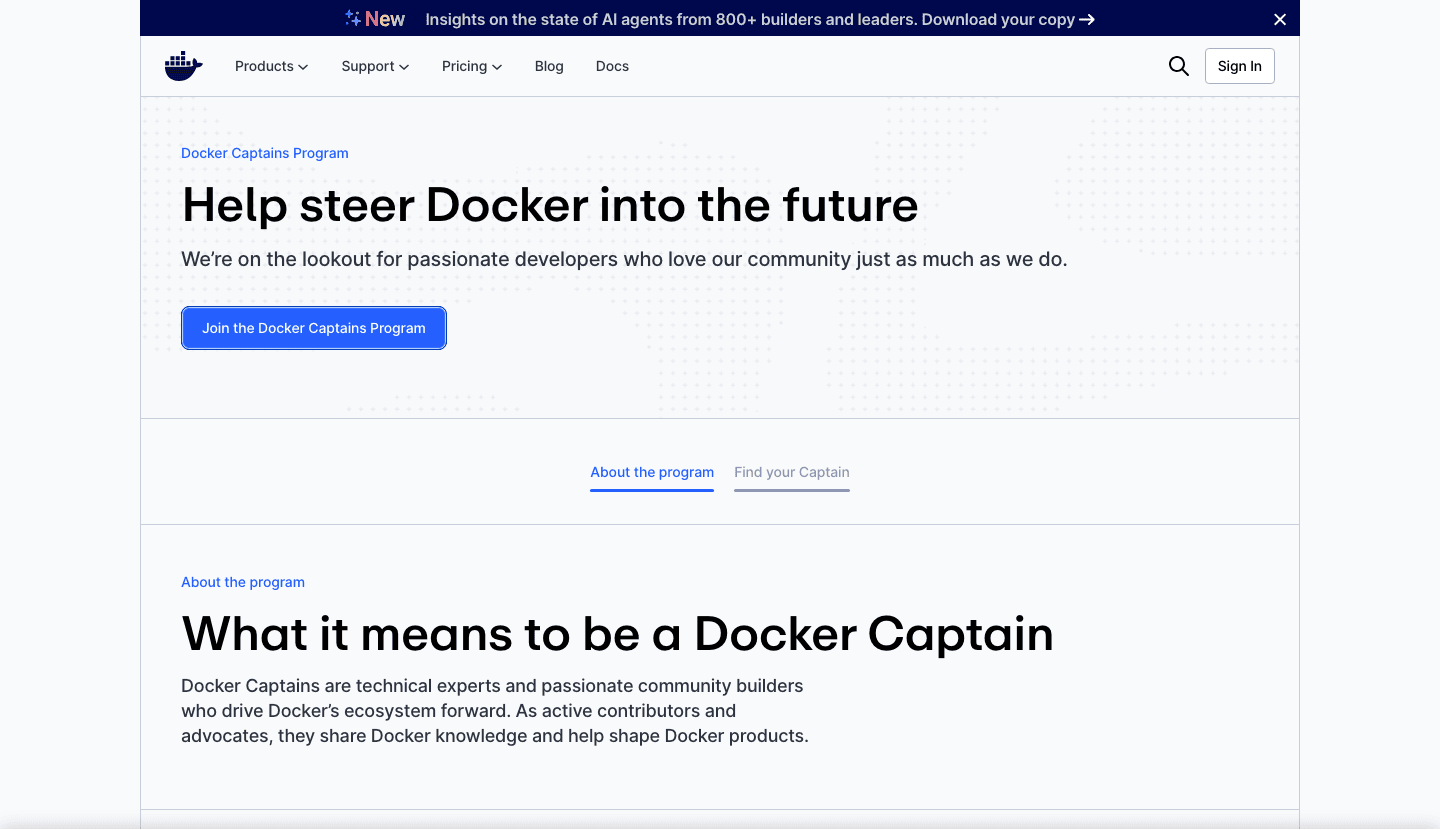
No secret application buried three clicks deep. The page states outright what a Captain is, what the title is for, and how to apply, in public, indexed by Google, for anyone to read.
2. Read the entry bar. It is a real bar, not a vibe.
Docker qualifies people through three named paths, each with a stated criterion. Docker Advisor needs a direct endorsement from someone on Docker's own engineering or product team. Docker Thought Leader needs real reach, at least 5,000 monthly views across blogs, social media, or other public channels. Docker Community Contributor needs real tenure, 5+ years leading a community or helping people online through content, events, or open source. Three different kinds of contributor, three concrete gates, none of them "just be enthusiastic."
3. Match the perks to the title, not the other way around.
The perk list only works because none of it could exist without the title attached. Beta access, direct interaction with staff, a private Slack channel, an annual offsite, an education budget. None of that is a sticker. Every item is something Docker would otherwise hand out one relationship at a time, bundled instead into a status a contributor has to keep earning.
4. Make the roster public.
Docker runs a searchable "Find your Captain" directory, filterable by expertise, location, and what each Captain is available for. A title nobody can see is an internal spreadsheet. A title with a public directory is a status other contributors can see, want, and work toward.
The read
- The clock is the mechanism. A title with no expiration date is a certificate. A title with a renewal date is a job the person has to keep doing.
- The perks have to be access, not merch. A direct line to your product team costs you a Slack invite and some patience. It is worth more to a serious contributor than a t-shirt, and it is the reason people fight to keep the title once they have it.
- Public visibility is what makes status status. The directory does as much work as the title itself. Nobody defends a rank that only they can see.
Steal it
You do not need Docker's headcount to run this. Pick the one behavior you actually want more of, answering support threads, writing docs, running local meetups, and set a bar for it you can measure without guessing. Name the title something specific to your product, not "Super User." Attach one real perk you would otherwise ration by hand, a roadmap call, an early build, a private channel with your team, and put an expiration on it that matches your own release cadence.
The harder half is defending the ladder once people are on it. Put an actual review on the calendar and check every titleholder against the bar, then let the title lapse for someone who stopped contributing, even when that is an awkward conversation. The day you quietly let everyone renew regardless of activity is the day the title turns back into a badge.
Gotchas
- An unenforced renewal is worse than no renewal. If everyone auto-renews, contributors figure that out fast, and the title stops motivating anyone.
- A vanity metric invites gaming. Follower counts and post counts get gamed easily. Tie the bar to something closer to real contribution, the way Docker's product-team endorsement path does, and it holds up better.
- Small programs feel harsh at first. With ten titleholders, letting one lapse is visible and personal. Do it anyway. The first enforced renewal is what tells everyone else the title is real.