Memory as the Retention Moat
The Ikea Effect's 2026 upgrade banks investment as living memory, not a static saved list.
Netflix figured out years ago that a list you built yourself is harder to abandon than a list someone built for you. My List works because you spent effort curating it, and effort spent feels like ownership. The 2026 version of that trick does not wait for you to spend the effort. It banks the same switching cost automatically, off data you were generating anyway, and hands it back as a system that seems to know you better every single day.
What to do: Stop treating "remembering the user" as a profile field they fill in once at signup. Build a background process that rereads sessions, tickets, and settings changes on a schedule, resolves contradictions, retires facts that have gone stale, and writes an updated model of the user without asking them to click save. Then surface it back to them inside the product so the accumulation is felt, not just used behind the scenes.
Why it works: A manual saved list only grows when a user bothers to curate it, but a system that synthesizes memory from ordinary use captures the deposit from every single user, every single session, at zero marginal effort.
Example: OpenAI's June 2026 ChatGPT memory rebuild, which it calls "dreaming," replaced a static saved-memories list with a background process that continuously rewrites what ChatGPT knows about you. OpenAI's own published evals show factual-recall task success rising from 41.5% on 2024-era saved memories to 82.8% on the 2026 system, and preference adherence rising from 31.4% to 71.3%, across the same three years.
Walk it through
I read OpenAI's own announcement, published on openai.com in June 2026, end to end. Here is what it actually says, and the screenshot below is straight off that page.
1. Start with what "saved memory" used to look like.
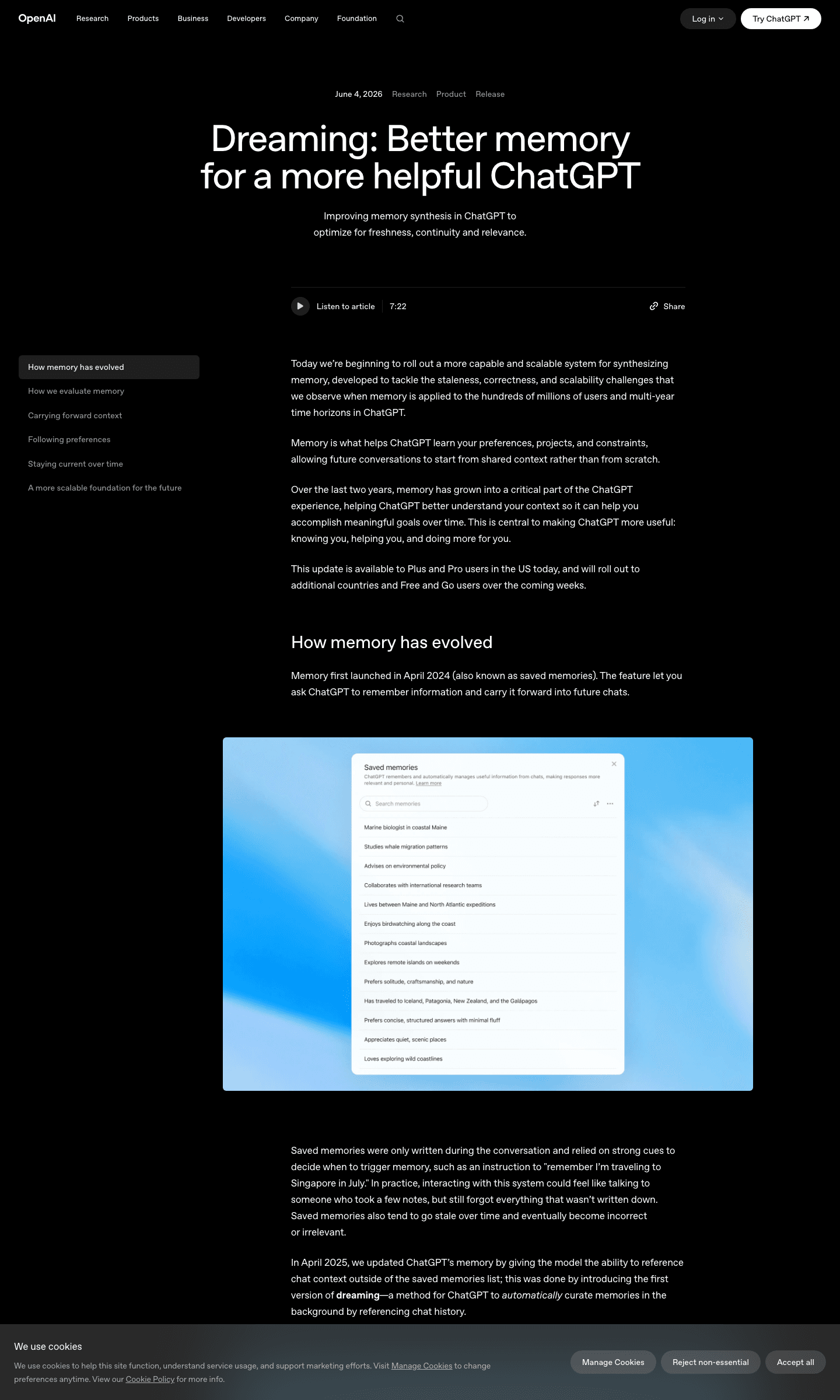
That panel is Netflix's My List with a different skin. A flat list of facts, captured once, sitting there until a user opens settings and edits it by hand. OpenAI's own post admits the limits plainly: saved memories only got written when a conversation happened to trigger a save, and they went stale the moment circumstances changed.
2. Then read what replaced it.
The post describes a single background process that rereads a user's conversation history and keeps rewriting its model of them, with no "remember this" instruction required. OpenAI's own example is a memory noting an upcoming Singapore trip in July that silently rewrites itself into a past-tense fact once the trip has ended. Nobody clicked save for that update. The deposit just kept compounding on its own.
3. Then read the numbers attached to that shift.
| Metric | 2024 (saved memories) | 2025 | 2026 (dreaming) |
|---|---|---|---|
| Factual recall | 41.5% | 67.9% | 82.8% |
| Preference adherence | 31.4% | 55.3% | 71.3% |
| Time-sensitive accuracy | 9.4% | 52.2% | 75.1% |
These are OpenAI's own benchmarks, not an independently audited figure, but the direction across three full years tells the real story. The system got dramatically better at the exact thing that turns memory into a moat: using what a user already gave it, correcting itself as facts age, without ever asking for more input.
The read
- A static list is a smaller moat than an automatic one. Netflix's My List only compounds for the fraction of users who bother to curate it. A background synthesis process compounds for all of them, whether they ever open a settings page or not.
- Staleness kills trust faster than gaps do. The biggest jump in OpenAI's numbers is time-sensitive accuracy, 9.4% to 75.1%, because a system that confidently repeats an outdated fact is worse than one that admits it forgot. Correcting is not optional, it is the whole upgrade.
- The moat is invisible until someone tries to leave. A user never notices how much context they have banked in a product until they imagine starting over somewhere else with nothing remembered.
Steal it
Run the same move on your own product. Pick the interaction data you already collect, support tickets, in-app settings changes, usage patterns, past purchases, and instead of storing it as a dumb activity log, run a scheduled job that synthesizes it into a working model of the user: what they care about, what they have already told you, what has changed since last time. Surface a piece of it back inside the product, a recap, a smarter default, a settings panel that shows what the system has picked up, so the value is felt, not just consumed invisibly in the background.
Defend it the same way OpenAI had to. Its post is explicit that users can open settings, review what the system has inferred, edit it, or tell it to forget something specific, with the source of every inference shown. Build that visibility in from day one. A memory system that quietly reshapes what a product shows you, with no way to see or correct it, reads as surveillance the moment a user notices, and one privacy backlash can undo years of accumulated trust faster than any competitor's feature could.
Gotchas
- These are vendor-reported numbers. OpenAI ran its own evals and published its own benchmarks. Treat the 82.8% and 71.3% as directionally real, not independently audited, the way you would any company's self-reported metric.
- Silent rewrites can feel invasive without a window into them. The same background process that makes memory feel effortless can feel like being watched if a user has no way to see what was inferred or undo it.
- This is real infrastructure, not a toggle. Synthesizing memory instead of just logging it means conflict resolution, decay logic, and versioning. Budget it as a system to build, not a checkbox to ship in a sprint.