The Review Mine
Their 1-star reviews write your positioning and roadmap.
Every company with a review profile has a graveyard of one-star write-ups it hopes nobody reads end to end. Read them anyway. The customers angry enough to leave a public, dated complaint are the cheapest market research you will ever get, and they write in exactly the words your landing page needs.
What to do: Filter a competitor's reviews on Capterra and Trustpilot to 1 and 2 stars, sort by most recent, and read for the complaint that keeps repeating in different reviewers' own words.
Why it works: The high end of a review profile can be seeded by the vendor's own review-generation push. The low end is the one nobody was asked to write, so it is the more honest signal, and the same wording surfacing across unrelated sites is a pattern, not a mood.
Example: Zapier carries a 4.7 out of 5 on Capterra from 3,058 reviews. Filter to 1 and 2 stars only and the count drops to 30. On Trustpilot, a completely different reviewer pool scores the same company 1.4 out of 5, rated "Bad," from 307 reviews.
Walk it through
I ran this against Zapier in July 2026. Here is exactly what came back.
1. Open the competitor's Capterra profile, filter to 1 and 2 stars, sort by Most Recent.
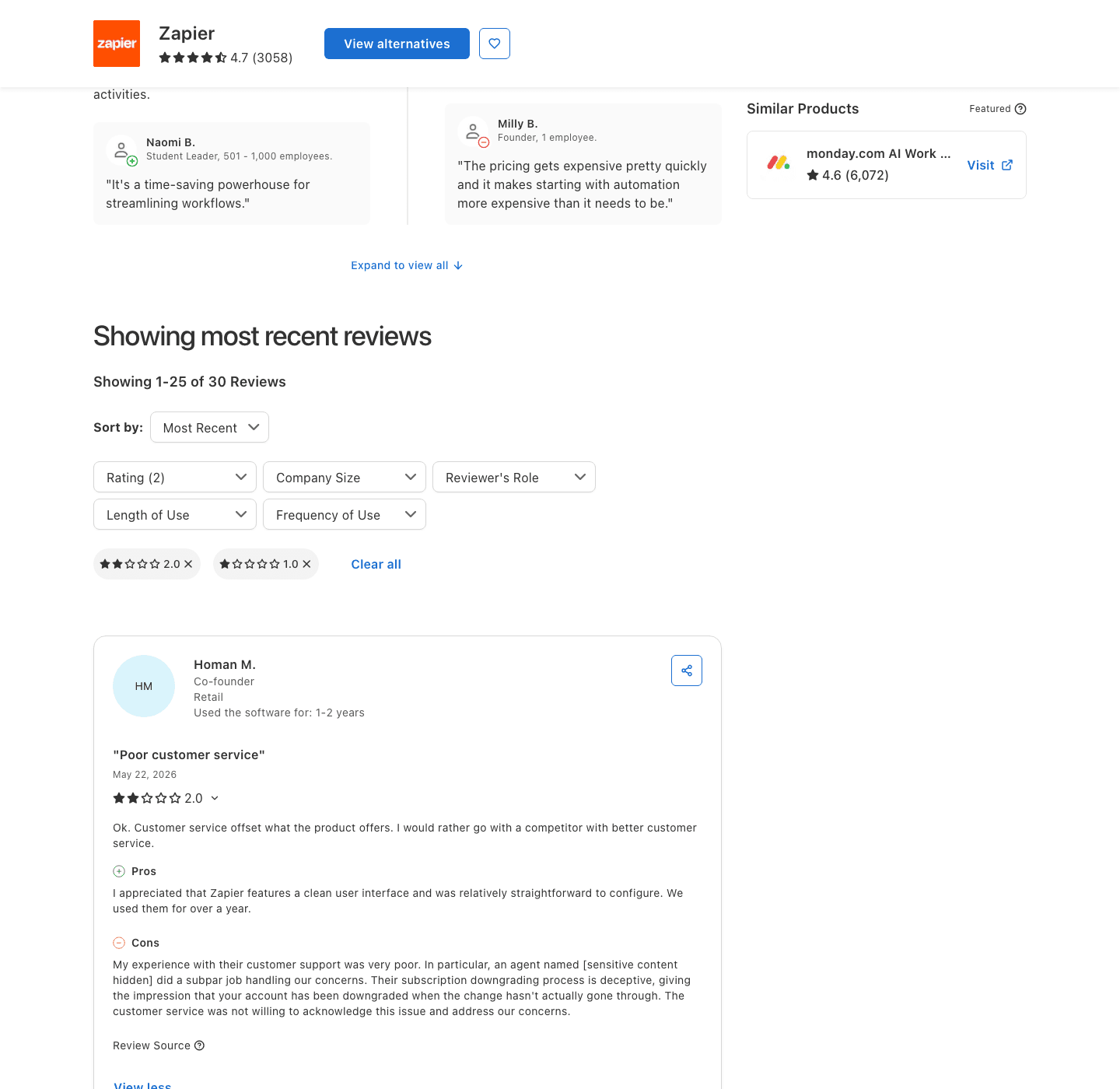
Two clicks on the rating filter and one on the sort order and the 3,058 reviews collapse to 30. The newest one is dated May 22, 2026, a two-star write-up from a co-founder at a retail company. That is the honest slice of the profile, the part the 4.7 headline number doesn't show you.
2. Read the stack for the complaint that repeats, not the angriest one.
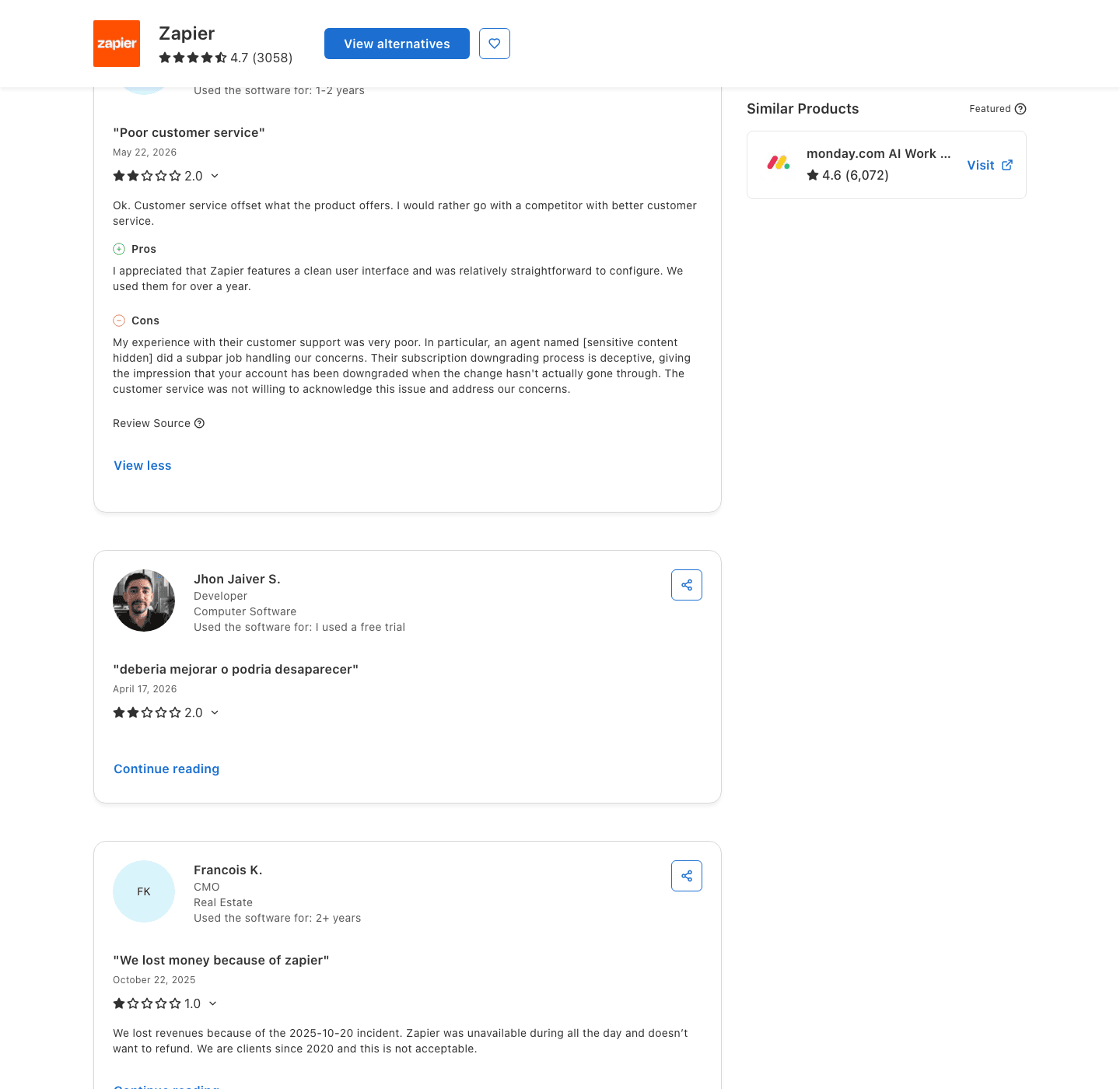
Read down the stack and one thread runs through most of the 30: a support ticket that goes nowhere, or a refund that gets refused after a billing surprise. A co-founder describes a downgrade that never actually applied. A product manager describes a denied refund after being routed through a chat bot. A founder describes losing revenue during an outage with no compensation. Different industries, different years, same shape of complaint. Capterra's own aggregate tagging backs this up in numbers: it marks 63% of the 247 reviews mentioning errors as negative, and 50% of the 514 mentioning price as negative.
3. Confirm the same complaint on a second, unrelated site.
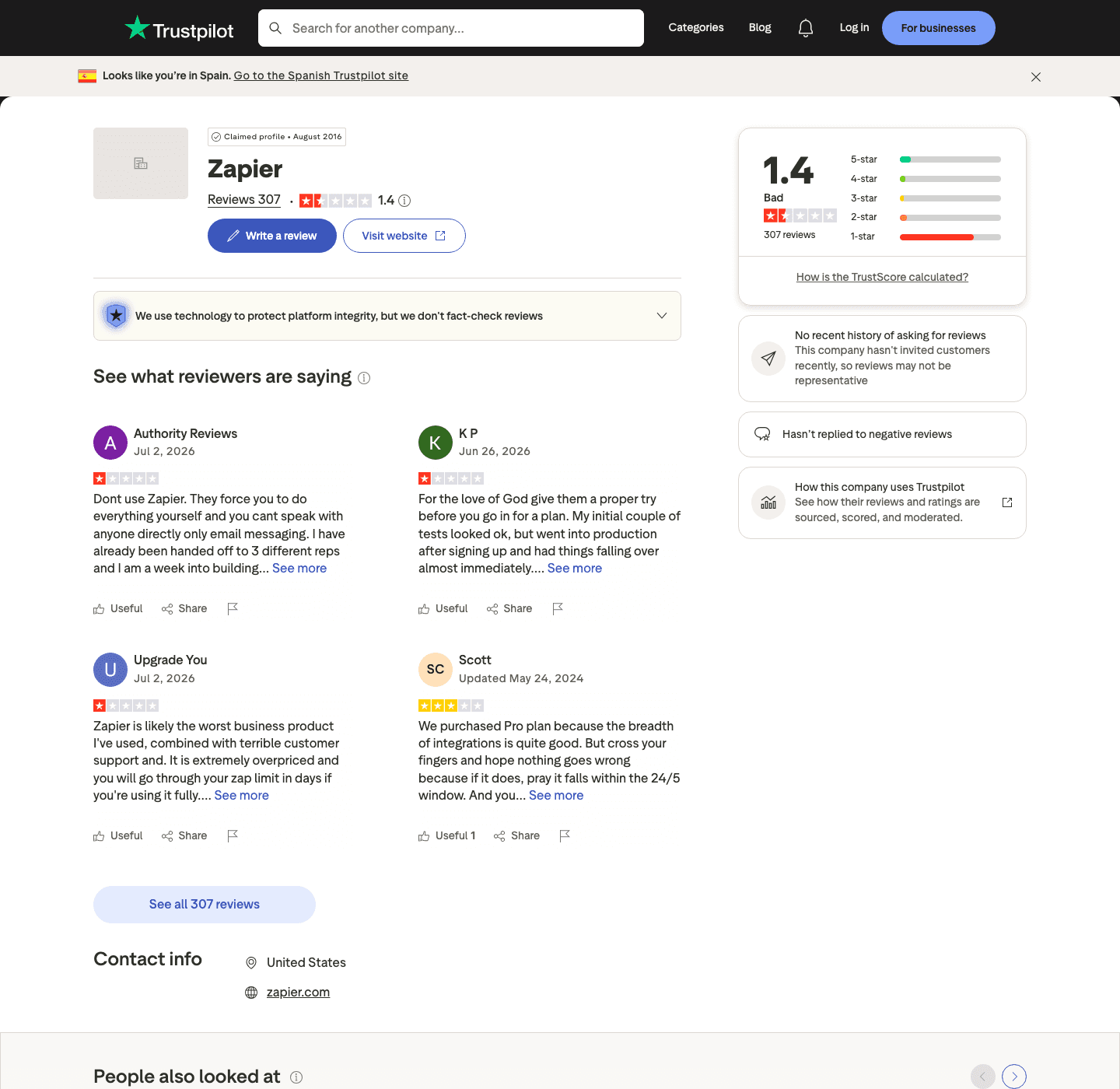
Trustpilot has no overlap with Capterra's reviewer pool, and it tells the same story harder. A 1-star review posted July 2, 2026 describes being passed between three different reps over email with no direct line to a person. A second Trustpilot reviewer, posting the same day, writes that it is "likely the worst business product I've used," citing support and pricing as the reasons. The complaint isn't one bad ticket. It is showing up on two sites, in two different years' worth of reviews, in strangers' own words.
4. Search the competitor's name plus "alternative" on Reddit for the unfiltered version.
Reddit's own search blocked the headless request outright with a network security page, so this step is a manual capture: search "[competitor] alternative" on old.reddit.com or in the product's niche subreddit, sort by new, and read the comments underneath the top post, not just the post itself.
Screenshot: a Reddit thread on "[competitor] alternative" with a specific complaint in the top comment and replies agreeing with it.
The read
- A complaint repeating across unrelated sites is policy, not a mood. Support and refund friction showing up independently on Capterra and Trustpilot, from different people in different years, means the company has decided that tradeoff on purpose.
- Aggregate percentages tell you where the pain concentrates before you read a single quote. 63% negative on errors and 50% negative on price are two numbers you can act on without reading a single review.
- The wording is the copy. The specific, unglamorous detail in a complaint, being routed through three different reps, or burning through a usage cap within days, is the kind of line a copywriter would never invent from scratch, and the theme behind it, described in your own words, is what belongs on your landing page.
Steal it
Run the same filter against your own reviews before a competitor does. Pull your Capterra and Trustpilot profiles down to 1 and 2 stars, sorted by most recent, and look for your own repeating thread. If it is the same one you just found in a rival, whoever fixes it first and says so publicly wins the comparison page.
Then build the wedge. Take the theme, not the review's exact sentence, and turn it into a headline that promises the opposite. If the market's incumbent is known for routing every support request through a bot, "talk to a real person in minutes" is a positioning line you earned by reading, not guessing.
Gotchas
- G2 sits behind bot detection that blocks a plain script outright. A direct request came back with an explicit "access is temporarily restricted" page, no partial data, nothing to read. Capterra let a real browser session through, but its rating filter has no shareable URL, so each pull means clicking through a live page rather than fetching a link.
- The high end of a review profile can be bought. Vendors run review-generation campaigns that skew the 4 and 5-star end. The 1 and 2-star end is the one nobody was paid to write, which is exactly why it's worth mining.
- One angry thread is not a pattern, and mining reviews at scale is not the goal. Confirm a complaint shows up across at least two independent sites before you act on it, and pull the theme into your own words rather than republishing anyone's review wholesale.