Instrument the influence, because the click is gone
Most AI visibility never produces a click, so measure the influence.
What to do: Stop judging AI by referral clicks in Google Analytics, where it shows up as almost nothing. Watch for branded-search lifts and direct traffic after you gain citations, and add "where did you hear about us" to your signup form.
Why it works: Most AI visibility never produces a click, so your default analytics will undercount it toward zero and you will kill a channel that is quietly working.
Example: Pew found only 1% of people click a link inside an AI summary, so the visit rarely shows as a referral. The conversion data is genuinely mixed. A peer-reviewed study of 973 e-commerce sites found ChatGPT traffic converted 13% below organic search, while Adobe and Webflow report the opposite in their categories. Measure your own, and do not assume either way.
Walk it through
I checked what your analytics tool can actually see, then pulled the proxy metric that fills the gap, in July 2026. Here is exactly what came back.
1. Check what your analytics tool can even see.
open "https://support.google.com/analytics/answer/9756891"

Google Analytics ships a dedicated "AI Assistants" channel now, one line of proof that the click-based model finally noticed AI referrals. Read the last sentence again. It excludes AI Overviews and AI Mode, which for most sites is the single biggest AI-visibility surface there is. The tool built to measure this explicitly does not measure the largest part of it.
2. Pull the proxy metric instead: branded search over time.
open "https://trends.google.com/trends/explore?date=today%205-y&geo=US&q=Zapier"
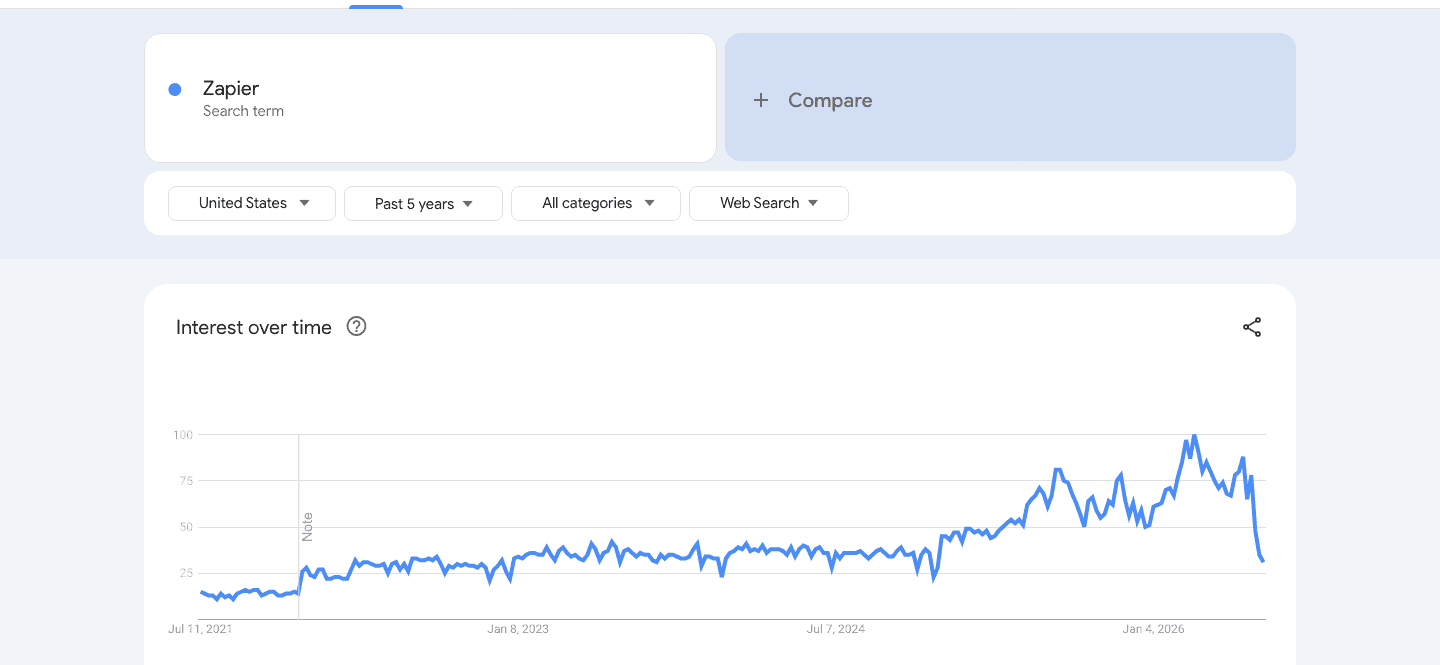
A flat line for three straight years, then a real climb starting in the back half of 2024 that nearly quadruples the baseline by early 2026. Trends does not tell you why. It has no idea about citations, campaigns, or a competitor's bad quarter. What it gives you is the one signal that survives an AI answer with no link in it: someone reads a response, does not click anything, and goes and types your name into Google an hour later. That search shows up here. It never shows up in your referral report.
3. Add the field that actually asks.
Screenshot: a signup or demo-request form with a "How did you hear about us?" dropdown, an explicit AI-assistant option sitting next to "Google search," "a friend," and "social media"
Trends and channel reports both work in aggregate, across your whole market. Neither tells you that the specific person converting right now typed your name because an AI answer put it in their head a minute earlier. The one thing that closes that gap is asking, at the moment they convert. Add "ChatGPT," "Perplexity," or "an AI tool" as its own option, and self-reported answers start piling up in a column you didn't have before.
The read
- The exclusion in GA4's own definition is the whole card in one sentence. Google's own analytics product carves AI Overviews and AI Mode out of the one channel meant to catch AI traffic, so the biggest slice of AI-driven exposure keeps arriving disguised as direct or as organic search.
- A branded-search climb is a lagging, aggregate signal, not proof of a citation. Zapier's Trends line does not name a cause. Treat a real climb as a flag to go check a citation-tracking tool for a date that lines up, not as a number to quote on its own.
- Self-reported attribution is noisy but it is the only signal with your buyer's own words attached. A "how did you hear about us" answer of "ChatGPT" isn't a scientific measurement, but across a few hundred signups it is a real, growing count you didn't have before.
Steal it
Run your own brand name through Trends today. Five years, your top market, web search. If the line is flat, that's your baseline. If it already climbed, go find the date and check what you shipped or got cited for around then. Then open your own signup or demo form today and add the option. It costs one line in a dropdown and starts a column of real, attributable answers within a week.
Defend it by not over-trusting any single number. A branded-search lift can come from a funding round, a competitor's outage, or a viral post as easily as an AI citation. Cross-reference the timing against an actual citation-tracking tool before you tell your CEO "AI is working." The honest version of this tactic is triangulation across three weak signals, not proof from one strong one.
Gotchas
- Google Trends is index data, not raw volume, and it rate-limits scripted requests hard. Load it in a real browser tab by hand if you're checking it on a schedule, don't try to automate the pull.
- The AI Assistants channel in GA4 depends on referrer strings the AI tools choose to send. A chat app that opens your link in an in-app browser, or strips its own referrer, still lands you in "Direct," undercounting the exact channel it was built to catch.
- Honest caution: none of this gives you attribution to a dollar. You're building a directional case, branded search up, self-reported AI mentions up, a citation tracker showing new wins, all pointing the same way. That's a business case, not an experiment with a clean control group.