Sell Through the Cloud Marketplace
Let your invoice draw down budget the buyer already committed.
Every enterprise you are chasing signed a multi-year spend commitment with AWS, Azure, or Google, and someone inside that company is judged on burning it down. A new vendor contract competes for a separate, harder budget conversation. A line item on the cloud bill they already pay does not. List a private offer on the cloud marketplace and your invoice stops looking like new spend and starts looking like progress against a number procurement already has to hit.
What to do: List your product as a transactable private offer on AWS Marketplace, then apply for the ISV Accelerate co-sell program once you clear the eligibility bar. A private offer lets you set custom pricing and terms for one named buyer, and the resulting invoice is paid out of the AWS bill, not a new line in their software budget.
Why it works: AWS lets Marketplace purchases retire a slice of a buyer's committed spend, so a procurement team racing to hit that number would rather buy your product this way than cut you a check directly.
Example: Contentsquare built its enterprise motion around exactly this. In AWS's own case study on the partnership, Contentsquare reports a 14x year-over-year increase in enterprise software sales after leaning into Marketplace private offers as its default path for large accounts.
Walk it through
I pulled a live AWS Marketplace listing in July 2026 to see exactly what a buyer sees before they ever talk to a rep.
1. List the product and turn on private offers.
Get a real listing live in AWS Marketplace and enable private offers on it. This is table stakes, most serious enterprise-facing vendors already have one. The listing is not the pitch. It is the plumbing that makes the pitch possible later.
2. Look at what the buyer actually sees.
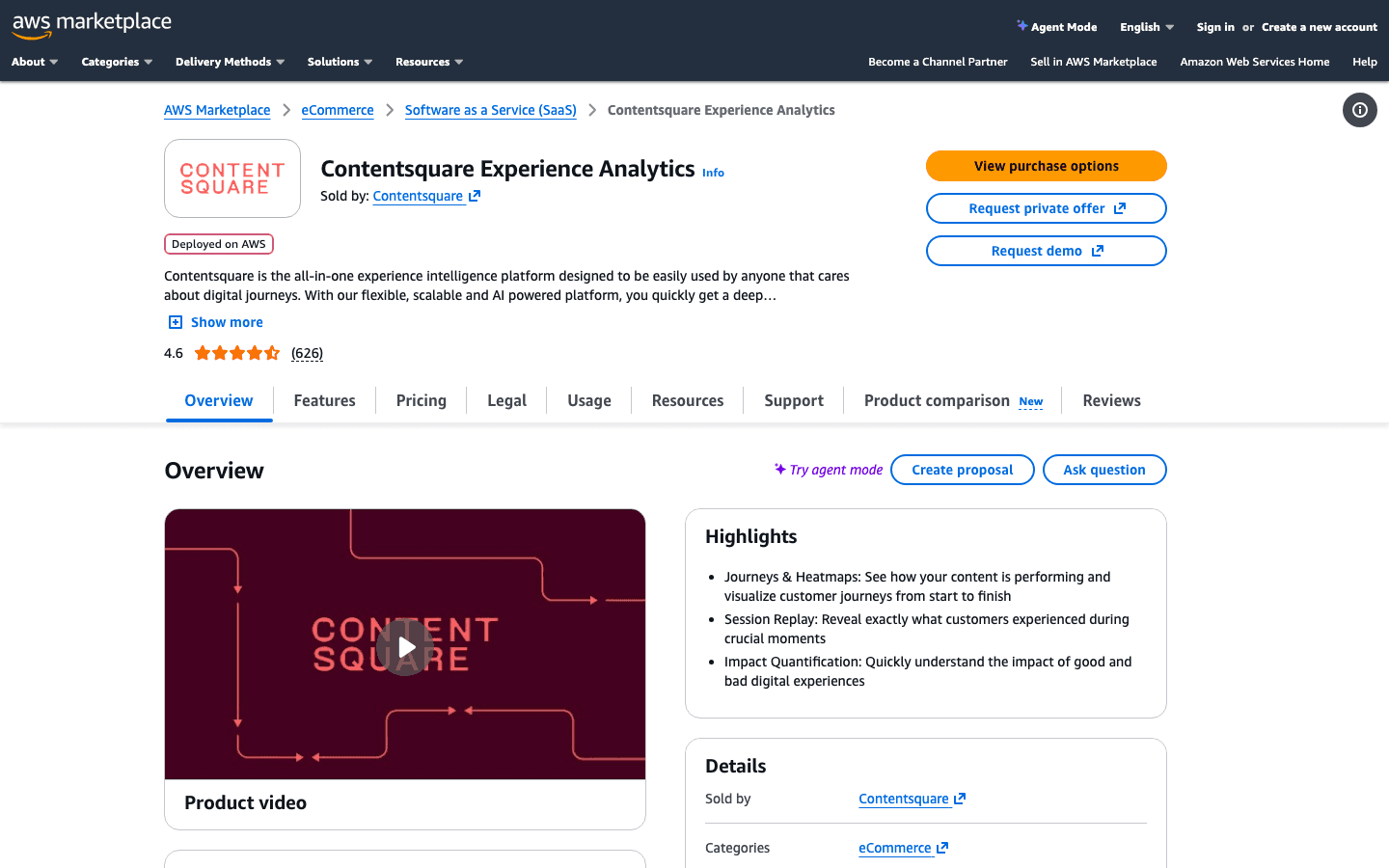
That is Contentsquare's real, public listing page. No login wall, no gated pricing page, just a "Request private offer" button sitting next to "View purchase options." A buyer's procurement team can click that button, get a custom quote, and pay for it out of their AWS bill without you ever sending a traditional invoice.
3. Clear the bar, then apply for ISV Accelerate.
ISV Accelerate is not open on day one. AWS wants to see at least 5 launched opportunities through ACE or Marketplace private offers in the trailing 12 months, at least 15 qualified ACE opportunities in that same window, one person on your team who has completed AWS's co-selling training, and a minimum of $2,000 in recognized AWS account revenue. Run private offers manually until you clear that bar, then apply.
4. Structure the deal so it visibly draws down committed spend.
Once you are in, say the quiet part out loud in the pitch: "this purchase counts against the commitment you already signed." AWS caps how much of that commitment Marketplace can retire at 25% per year, and as of May 2025 only products fully hosted on AWS, application and control plane both, qualify at all. Know both numbers before you promise a buyer this will move their number.
The read
- The invoice is the sales pitch. It says "this draws down what you already promised to spend," not "please approve a new vendor." That sentence does more to unstick procurement than any feature comparison.
- The fee cut is a side effect, not the prize. ISV Accelerate drops the Marketplace transaction fee from 3% to 1.5%, worth $7,500 on a $500K deal. The real unlock is the co-sell motion: your deal gets routed to AWS's own field organization of 10,000-plus sellers, who are financially incentivized to bring you opportunities.
- The 25% cap sets the ceiling. A buyer cannot retire more than a quarter of their annual commitment through Marketplace, so this play supplements a sales motion, it does not replace one.
Steal it
You do not need to be an enterprise incumbent to try this. If your buyer runs mostly on AWS and carries any kind of committed-spend agreement, a private offer removes the slowest step in an enterprise sales cycle, which is getting new budget approved. Get a real listing live, quote your first few six-figure accounts as private offers, and say directly in the pitch that the deal draws down committed spend. That one sentence gets you past gatekeepers who would otherwise slow-walk an unfamiliar vendor for months.
The trick runs both ways, so defend your own budget with it too. Once you are spending real money on AWS yourself, check whether the vendors you already pay offer Marketplace private offers, and route your own purchases through them instead of paying direct. Every dollar you push through Marketplace as a buyer counts toward your own commitment, up to that same 25% cap, which is money you are leaving on the table every month you keep paying vendors outside of it.
Gotchas
- You cannot cold-start this. ISV Accelerate requires sales history you do not have on day one, five launched opportunities and fifteen qualified ones in the trailing year. Run private offers the manual way first and apply once you clear the bar.
- "Deployed on AWS" is now literal. Since May 2025, a SaaS product only qualifies to retire committed spend if it runs entirely on AWS, application and control plane both. If you are multi-cloud or hosted elsewhere, the exact pitch in this chapter may not hold for your product, confirm eligibility before you promise a buyer anything.
- Pre-approved budget still has to clear procurement. A private offer shortens the "is this new spend" argument, not the legal and security review every enterprise deal goes through regardless of how it is paid for. Do not sell it as a fast lane past diligence, only past the budget fight.