One Audience, Every New Launch
Build the community once and point every future product at the same base.
Most founders restart distribution from zero on every new product. New landing page, new cold outreach, new begging for the first hundred users. Pieter Levels stopped doing that after his first couple of launches. He built one audience, a community of remote workers around Nomad List plus a personal following stacked on top of it, and every product since has launched straight at that same base instead of starting cold.
What to do: Pick one asset you fully own, a newsletter, a paid community, an audience on a platform you post to daily, and grow it around a topic you understand better than anyone. When you ship something new, announce it there first, before Product Hunt, before ads, before a single cold email.
Why it works: A new product launched to an audience that already trusts your judgment skips the part where trust and reach have to be earned from nothing.
Example: Pieter Levels built Nomad List in 2014 into a paid membership community for remote workers. Remote OK grew out of a job board he originally built for that same community, then launched on its own in 2015. Interior AI shipped in 2022, built in five days. Photo AI launched in February 2023 and pulled in $5.4K in its first week, a fast start multiple case studies credit to the roughly 350K-strong following Levels had already built through years of posting in public, one that has since grown past 600K. On his own tracker at levels.io/projects, all four sit in the same short list.
Walk it through
1. Open the tracker Levels keeps on himself. At levels.io/projects he logs every single thing he has shipped and tags each one by outcome. It is his own scorecard, in public.
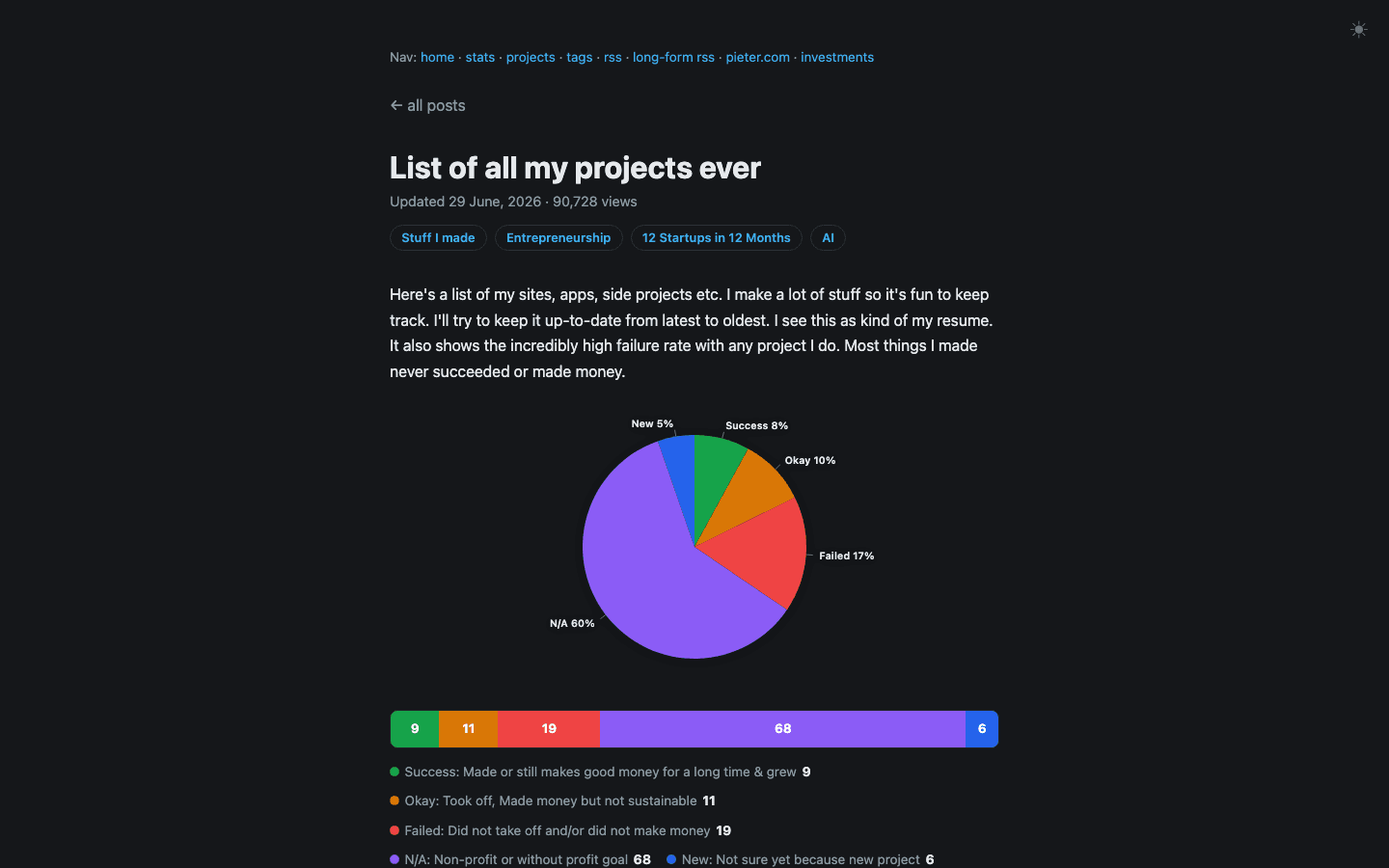
113 things shipped. Only 9 of them, 8%, are tagged "Success: made or still makes good money for a long time and grew." That failure rate is the honest backdrop for the tactic. Most of what he built never got a second product to launch off of, because most of it never became an audience.
2. Scroll to the 9 that made the cut.
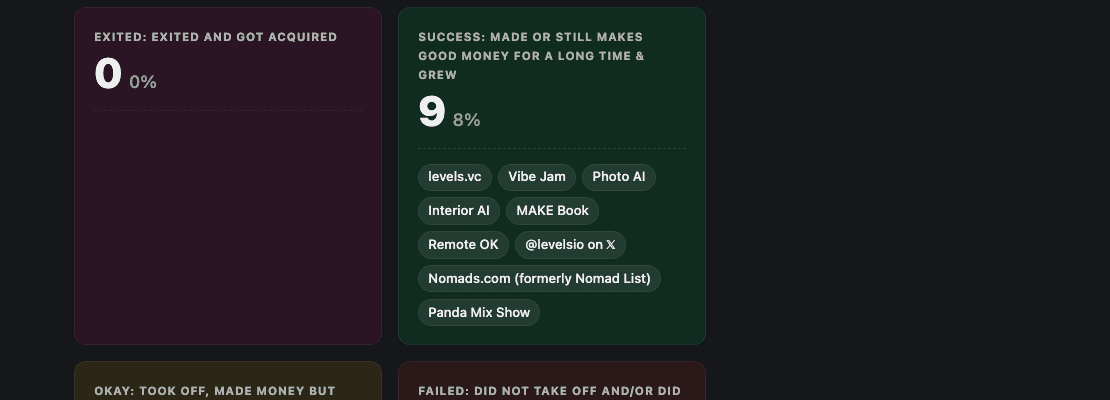
Four of the nine are Nomads.com (the site was renamed from Nomad List), Remote OK, Interior AI, and Photo AI. @levelsio on X is in that same list, tagged as a success in its own right. That is the tell. The following is not a marketing channel sitting off to the side, he counts it as one of his products.
3. Read the timeline, not just the list. Nomad List launched in 2014. Remote OK spun out of a feature built for Nomad List members and went live on its own in 2015. Interior AI shipped in 2022. Photo AI launched in February 2023. Nine years between the first and the last, and every single one of them opened to an audience that was already there and already growing, instead of to a cold market.
The read
- The audience is the product he never has to relaunch. Nomad List, the X following, and years of build-in-public posts are the one asset that carries over. Everything else gets rebuilt from scratch each time.
- Being counted as a "success" tells you what actually compounds. He tags his own X following next to his revenue-generating products, not next to his marketing line items. That is a founder telling you which asset actually did the work.
- The gap between launches is the point. Nine years separate Nomad List from Photo AI. The audience did not go stale in between. It grew, which is what made each later launch faster than the one before it.
Steal it
You do not need 600K followers to run this. You need one channel you own outright, not rented reach on a platform that can throttle you tomorrow, built around one audience you can describe in a sentence. Before your next product exists, put effort into the newsletter, the community, or the following that will hear about it first. When you ship, message that list before you touch a single paid channel, and watch how much less convincing you have to do compared to a cold launch.
Defend the asset itself once you have it. Levels' following sits on a platform he does not control, but the part that is genuinely his is the Nomad List membership base and years of archived, dated posts nobody can retroactively take from him. Put your version behind something you own, an email list, a paid membership, your own domain, so a platform policy change or algorithm shift cannot zero out the one advantage every future launch depends on.
Gotchas
- The audience has to be general enough to want more than one thing from you. A list built around one narrow topic will not stretch to cover a product in a different category. Levels' following formed around watching him build things in public, which is broad enough to carry a job board, a design tool, and a photo app.
- A loyal audience will try your next product once, not indefinitely. They showed up because you earned it with the last thing you shipped. A weak product spends that trust without earning it back, and the next launch lands quieter.
- Honest caution: this is a personal-brand tactic as much as a company one. Levels himself is a large part of the initial distribution for each product. A company that tries to bolt a community onto a faceless brand account, instead of a real person people already follow, will get a fraction of the effect.