Flood Variants, Cut by Noon
Let AI collapse the cost of a variant to zero, then judge it in a day.
A media buyer used to defend one big creative idea because one big idea was all the budget could produce. Write it, shoot it, edit it, maybe translate it if the quarter allowed, then live with it for a month because a second version cost almost as much as the first. AI production breaks that math. The same script can become a dozen hooks, thumbnails, and language versions before lunch. Once a variant is nearly free to make, the only real cost left is whether you have the discipline to kill the ones that lose, fast.
What to do: Use AI video and voice tools to generate far more creative variants, new hooks, new opening frames, new languages, new thumbnails, than a human production team could ever shoot on a normal timeline. Launch the full batch at once, check performance again within a day, and cut anything underperforming immediately instead of giving it the usual multi-week grace period.
Why it works: Cheap variants turn creative testing from a guess about one ad into a numbers game you win on volume, and a same-day kill rule stops you from paying to keep feeding a loser.
Example: SumUp's Card Reader team used the AI ad-production platform Superscale to launch 20 Black Friday creative assets in a single week, localized across 8 languages and 8 countries, a volume a traditional shoot-translate-edit workflow would have needed months to match.
Walk it through
1. See what "far more variants" looks like in practice, not in theory.
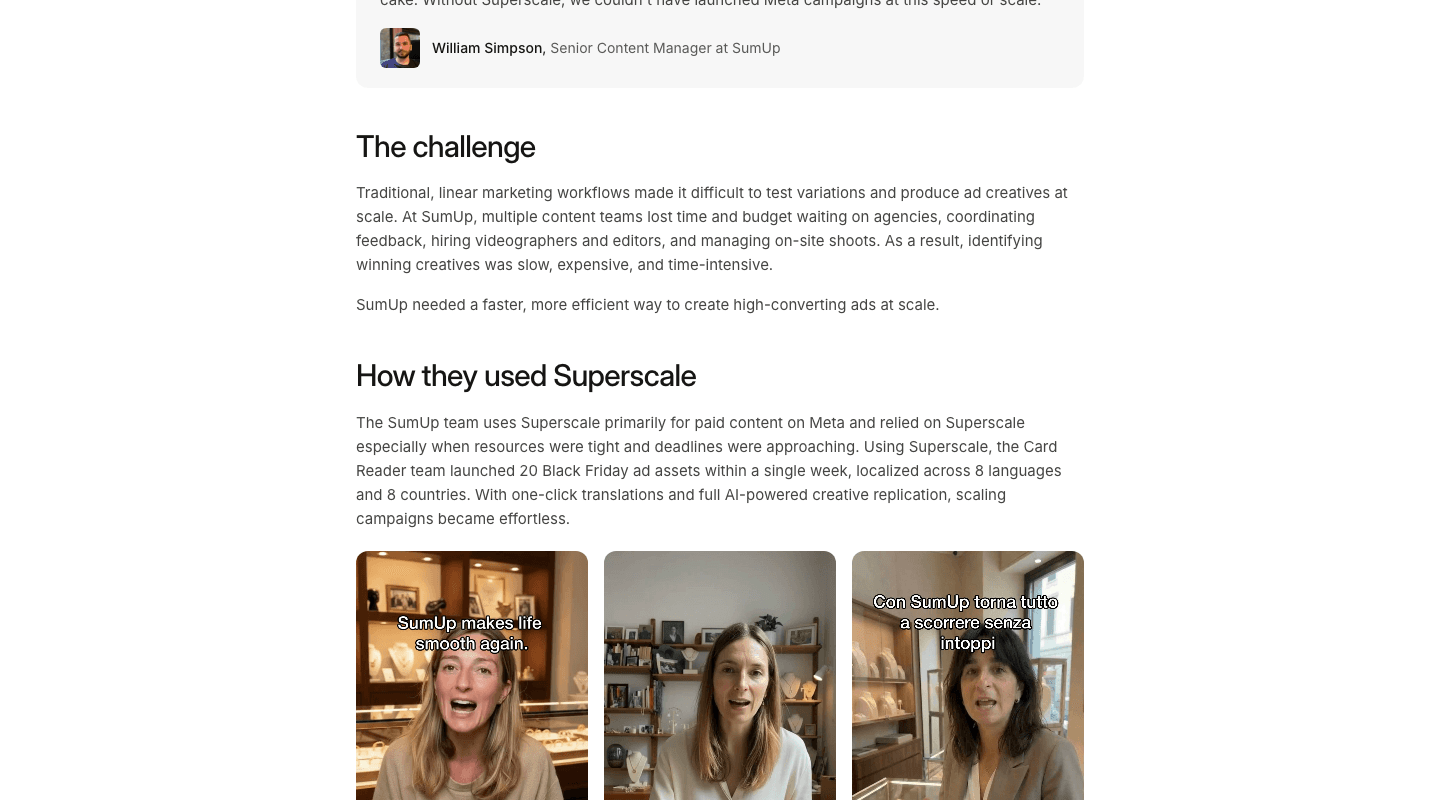
Superscale's own case study spells out the numbers plainly. Twenty Black Friday assets, eight languages, eight countries, one week. The section headed "How they used Superscale" reads almost like a spec sheet: the Card Reader team ran the whole burst through one platform instead of coordinating an agency relationship per market.
2. Notice it is one script wearing eight coats, not eight scripts.
The three video thumbnails on that same page make the trick visible. Same presenter, same jewelry-shop backdrop, same beat-for-beat delivery, and a different on-screen caption burned in for each market. AI handled the voice, the translation, and the subtitle per market, so the marginal cost of "one more language" dropped close to zero. That is the only reason twenty assets across eight markets fit inside one week instead of one quarter.
3. Set the kill clock before launch, not after you see the numbers.
Decide the threshold in advance. A fixed spend per variant, say the cost of a few thousand impressions, after which anything below your baseline CTR or CPA gets paused, no exceptions and no "let's give it one more week." Write the number down before the test goes live, because after launch you will always find a reason to be generous to your favorite variant.
4. Reinvest what you save into the next batch, not into resuscitating the last one.
Cut losers early and the budget they would have burned goes straight into the next round of variants instead of sitting parked in a test already decided. SumUp did not stop after the Black Friday burst either. Within two months, six product teams inside the company had pulled the same workflow into their regular weekly Meta launches, not just the one campaign that proved it out.
The read
- Volume beats prediction. Nobody can reliably guess which single hook wins in advance. What you can do is make guessing cheap enough to run in parallel instead of in sequence.
- Localization is a variant, not a separate project. Treating "the Italian version" as its own creative brief is what made international testing slow in the first place. Treat it as one more variant of the same asset and it arrives almost free.
- The kill rule is the actual product, not the AI. Anyone can generate twenty ads now. The team that wins is the one that actually pulls the underperformers same-day instead of letting them run because someone already approved the budget.
Steal it
You do not need Superscale specifically, and you do not need a Black Friday deadline to force the discipline. Take one ad that is already working and use an AI ad tool to spin off ten to twenty variants: different hooks, different opening frames, different languages if you sell in more than one, different presenters if the format allows it. Launch the whole batch in one push instead of trickling variants out over weeks, so you are comparing them against the same market conditions instead of against last month's algorithm.
Defend the discipline as hard as you defend the production. Write the kill threshold down before launch and put someone other than the person who made the ad in charge of enforcing it, because the person who wrote the hook is the last person who should decide whether it gets to live another day. Motion's 2026 creative benchmarks found that in every spend tier, the top quarter of advertisers ships two to three times more creative than same-budget peers and walks away with roughly double the winners on identical spend. The gap is not talent. It is that they actually kill the losers instead of nursing them.
Gotchas
- More variants without a kill rule is just more spend. Volume only pays off if you are actually cutting the bottom half same-day. A pile of live ads nobody prunes is a slower, more expensive version of the one-big-idea problem.
- Same face, same voice, every market gets suspicious eventually. Viewers in different countries can tell when an AI-cloned presenter gets reused too often across campaigns. Rotate the underlying footage every few cycles so "AI-assisted" does not read as "AI-obvious."
- A same-day kill needs same-day data. If your daily spend cannot produce a statistically meaningful signal in 24 hours, shrink the batch size instead of the test window, or you will end up killing winners on noise.