Their Comparison Page Is Proof
When the incumbent builds a page about you, you've already won the query.
A comparison page costs a company real time. Legal has to clear the claims, design has to build the table, someone has to decide which competitor gets named in a headline on the company's own domain. Nobody spends that budget on a rival they're beating. They spend it on the one search term where they're losing deals and can't say so out loud internally. Find that page and you've found the exact query the incumbent has already conceded is contested, which is the best position you can be in.
What to do: Search "[competitor] vs [you]" on Google, and ask the same thing in ChatGPT and Perplexity. If a bigger, older competitor has built a page comparing itself to you by name, that's the term to build your own alternatives page around, aimed straight at whatever their page can't afford to mention.
Why it works: A big company can rewrite a comparison page in an afternoon, but it can't discount its own product or unwind its own pricing model without cannibalizing revenue it already collects, so its rebuttal always argues around the vulnerability instead of fixing it.
Example: In February 2026 Atlassian raised Jira Data Center list pricing 15 percent, and 18 to 40 percent for anyone still on legacy Advantaged plans. On atlassian.com it also runs a page headlined "Jira vs. Linear," built around a nine-row "Why choose Jira over Linear?" scorecard, green checks under Atlassian and red X's under Linear straight down the table. Not one of the nine rows is about price. Linear, founded in 2019, still runs a free tier with no cap on members, and its paid plans start at $10 a user a month.
Walk it through
I looked this up in July 2026. Here's exactly what's on the page.
1. Search the exact term the incumbent is defending.
The query "jira vs linear" puts Atlassian's own comparison page on page one, ahead of half the SEO blogs that also cover the matchup.
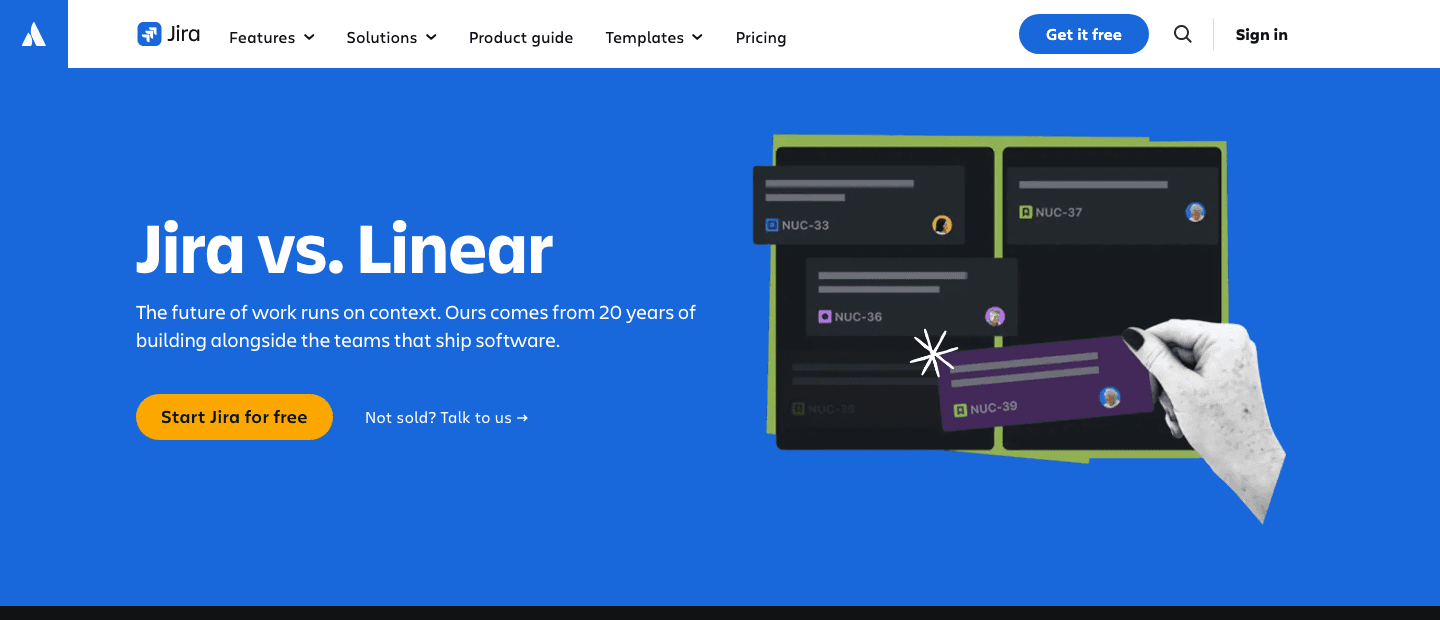
The headline is not subtle. Atlassian put its own name next to a seven-year-old competitor, on its own domain, in the biggest type on the page. That is not what a company writes when it is confident the comparison ends in its favor by default. That is what a company writes after watching enough deals go to the other name to decide the safest move is to control the page buyers read when they type both names into a search bar.
2. Read the scorecard, not the copy above it.
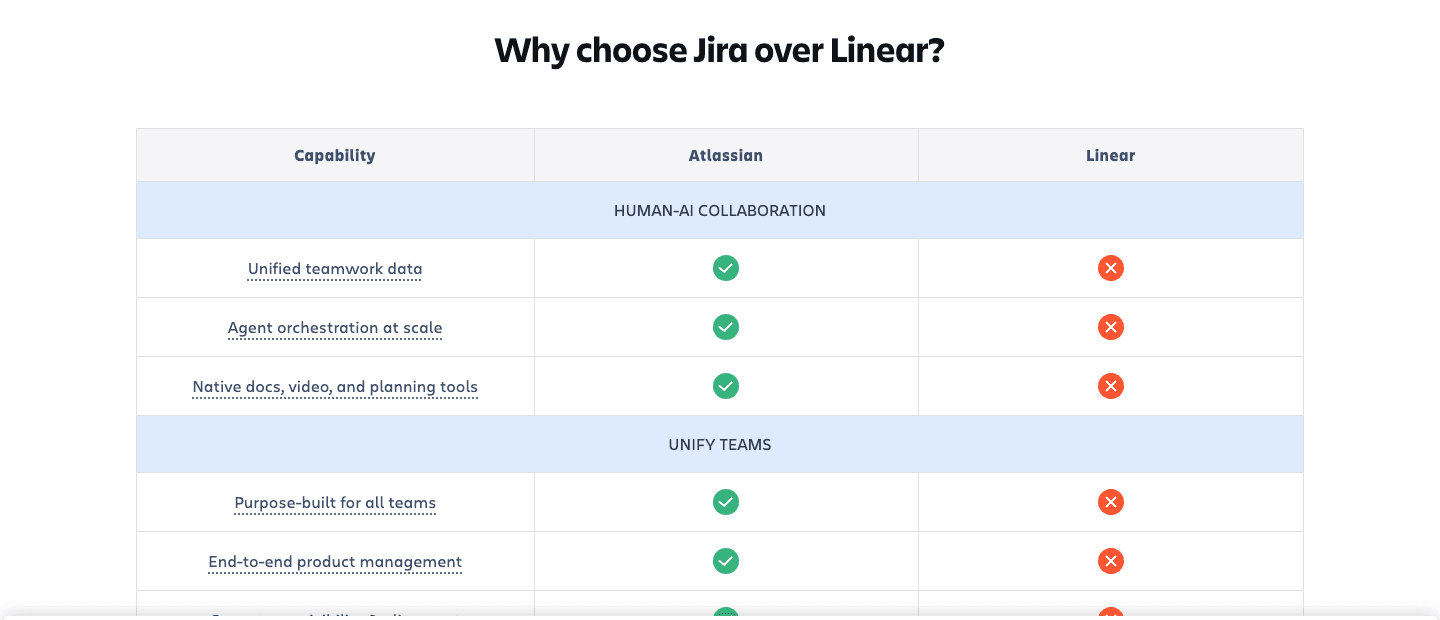
Nine rows, three categories: Human-AI Collaboration, Unify Teams, Built for Scale. Every row is about integration depth, org-wide visibility, or platform scale. None of them is price. That's the tell. Nine rows is a lot of real estate to fill on a page built specifically to beat one competitor, and the one dimension Atlassian just made worse for its own customers is the one dimension the page never brings up.
3. Check what the page does say about pricing.
Scroll further and the page promises "Free to start. Predictable as you grow... Per-user pricing, no hidden fees." That's a claim about Jira Cloud, a different product line from the Data Center SKU Atlassian just repriced, so it isn't technically false. But the word doing the damage is "predictable," sitting on the same domain that told Data Center customers to expect a 15 percent increase, or more if they were on an older plan. Linear's own pricing page, checked this July, still lists an unlimited-member free tier and a $10 entry price for paid seats. Nobody at Atlassian wrote "predictable" with Linear in mind. You just put the two pages next to each other anyway, for free.
The read
- A named competitor in a headline is a concession, not an insult. Atlassian didn't have to mention Linear at all. Naming it on its own domain means "jira vs linear" was already costing Atlassian deals in the wild, badly enough to justify a dedicated page.
- What the scorecard leaves out is the real scoreboard. Nine rows and zero on price, on a page that exists specifically to argue Jira over Linear, tells you exactly which argument Atlassian knows it loses.
- The page is a lagging indicator, not a live one. By the time a company ships a full comparison page, the competitive threat is old news internally. The page tells you what they decided to fight, not what they're worried about right now.
Steal it
Find the comparison page a bigger competitor has built about you, and read it for the gap, not the copy. Then build the page they left a hole for. If they dodge price, your alternatives page leads with price, in dollars, on the page, no "contact sales." If they dodge migration effort, yours leads with a real import tool and a timer running. Don't argue their whole page point for point. That's their frame and their categories, built to flatter them. Pick the one row missing from their scorecard and make it your entire page.
Defend the same way. If you're big enough that someone might build a page about you next, get ahead of the obvious one yourself. Publish your own honest pricing comparison before a challenger forces it into the open, and make sure the search term with your name next to theirs turns up your page first, not just theirs.
Gotchas
- A comparison page is marketing, not a leak. Unlike a sitemap or a cookie, this is content the company wants you to read, so treat every claim on it as their pitch, not neutral fact. Verify anything before you repeat it.
- The absence of a row is not proof of a dodge. Atlassian may genuinely see Data Center pricing as a niche detail next to a Cloud-first comparison, not a deliberate omission. Weigh both readings before you build a whole strategy on one theory.
- Don't build your alternatives page as a mirror of theirs. Copying their table with your logo swapped in reads exactly like what it is. Build the argument you'd make if their page didn't exist.