Ride the Platform You Don't Own
Let a bigger platform's own feed distribute your product for you.
Most growth advice tells you to build an audience from scratch. The faster move is to borrow someone else's, on a platform that has already built a duplication button into its feed. Airbnb ran this play in 2010 with a hidden cross-post into Craigslist. TikTok runs a cleaner, fully sanctioned version of it today, built right into CapCut, and any founder whose product produces something visual can ride it without a BD call or a partnership deck.
What to do: Edit your product demo, onboarding clip, or before-and-after in CapCut and save it as a template before you post, not just a plain export. TikTok attaches a "Use this template" (or "Try this template") button to the post, and anyone who taps it duplicates your exact cuts, pacing, and captions with their own footage dropped in.
Why it works: TikTok's own recommendation engine, not yours, decides who sees each new duplicate, so your reach compounds off the platform's feed instead of your ad budget.
Example: CapCut, ByteDance's video editor, ships this mechanic natively. Open its own "For You" template tab and every thumbnail carries a running use-count next to a flame icon, an ordinary black-and-white clip sitting at 1,500 uses, a photo-dump edit at 18,700, right beside a dedicated "TikTok" category tab that exists because so much of this traffic starts and ends there. No ad account touched either number.
Walk it through
I opened CapCut's template gallery in July 2026. Here is exactly what it showed.
1. Open the gallery and pick the "For You" or "TikTok" tab.
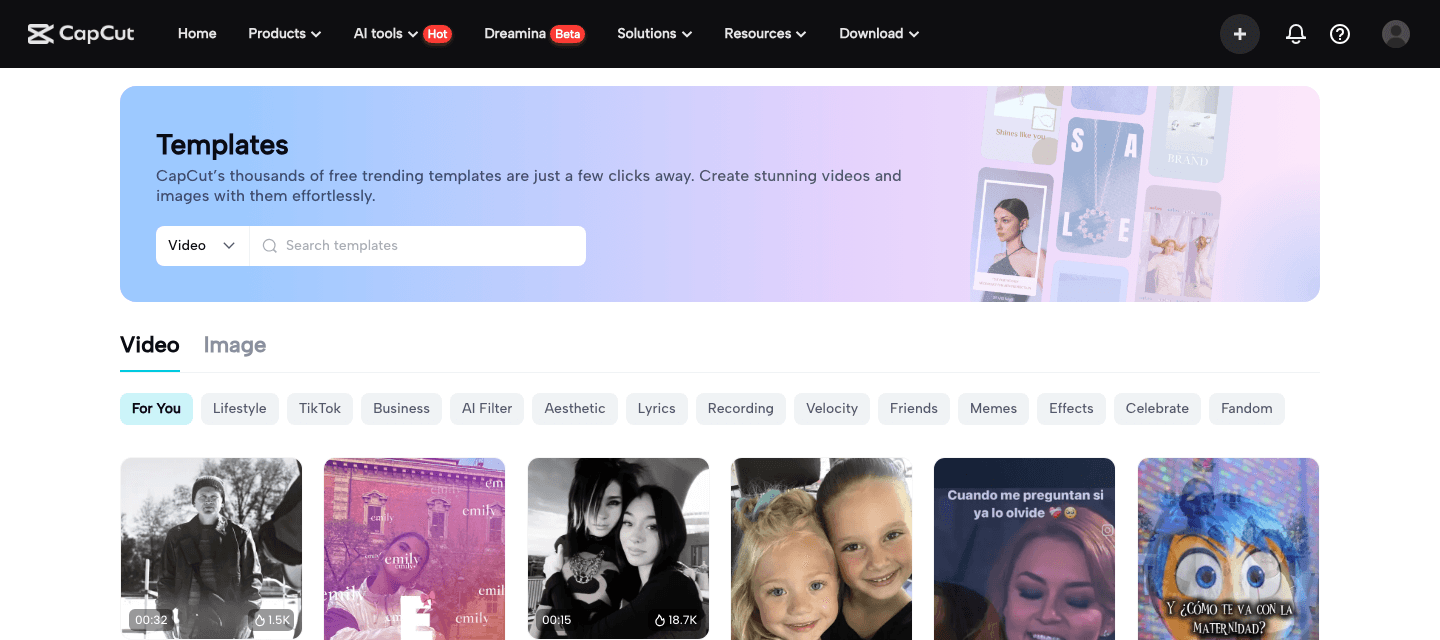
Every thumbnail carries a small flame icon and a number. Both templates visible here were built by ordinary creators, not brands. Nobody bought that reach. Someone posted a video, saved it as a template, and other people kept tapping the button.
2. Open one template and read what it actually tracks.
Every template's own page spells the mechanic out in plain numbers: how many clip slots it needs, the runtime, a use-count, and one button labeled "Use this template." That button is the entire distribution engine. Tap it, drop in your own footage, export, and TikTok attaches the same template banner to your new post, which makes your video discoverable to everyone browsing that template afterward.
3. Build your own instead of only browsing someone else's.
Cut your product demo to match a format already proven on the "TikTok" or "Business" tab. Keep it short, one clean transition, a caption slot left open. Export it as a template, not a plain video, then post normally. If even a handful of people tap "Use this template," your product is now living inside videos you never made, distributed to feeds you never bought into.
The read
- The button is the growth loop. Every duplicate is a fresh post carrying your original structure, and TikTok's algorithm treats each one as new content worth its own audience roll, not a repost.
- The use-count is a public leaderboard. CapCut prints it on every thumbnail, so you can watch which formats are compounding before you copy the shape, the same way you'd check a competitor's sitemap before copying their page structure.
- You are borrowing reach, not renting it. No contract, no revenue share, no dependency on a partnership surviving the platform's next strategy shift. Just a feature anyone with the app can use.
Steal it
You do not need CapCut specifically. The pattern is any platform that lets one user's artifact become another user's starting point inside its own feed or gallery: Notion's template gallery, a Figma Community file, a Shopify theme, a GitHub template repo. Find the one your buyers already live inside, package your best output in its native duplication format, and let the platform's own discovery surface do the marketing you'd otherwise pay for.
Defend it by treating the format itself as disposable. A template that hits big gets copied, remixed, and buried under its own imitators within weeks, so the win is the audience it hands you during the window it's fresh, not the template as a permanent asset. Bank the followers and the product awareness it buys, then build the next one instead of polishing the last one.
Gotchas
- The platform can shut the door whenever it wants. Airbnb's Craigslist cross-post worked until Craigslist started blocking the auto-posts and disabling the links back to Airbnb. CapCut and TikTok both belong to ByteDance today, but nothing stops either one from changing how templates surface tomorrow.
- A high use-count is not a converting audience. A template can rack up thousands of duplicates with zero brand connection back to you if your product never actually appears in the frame.
- Do not fake the number. Buying uses or bot-looping your own template to inflate the count is the same move as buying fake reviews, and it is exactly the pattern platform trust-and-safety teams are built to catch.