The Ad Library Raid
Every ad they run is public, and the long-runners are the winners.
Meta and Google both publish a public library of every ad running on their platforms, ordinary commercial ads included, a transparency rule that started with election law and now just sits there open for anyone to read. Almost nobody outside a compliance team treats it as a research tool. An ad still live after months of spend is not a guess about what works. It is a hook, an offer, and a landing page the advertiser has already paid real money to prove out, and you get to read the answer without spending a cent testing it yourself.
What to do: Open the Meta Ad Library and Google's Ads Transparency Center, search the competitor's name or domain, filter to active ads, and read the "Started running on" date printed on every card.
Why it works: Both libraries are public by design. No login and no scraper needed, just the advertiser's own paid history sorted by a date they cannot hide.
Example: Zapier's oldest live Meta ad started running on Jan 24, 2024, 902 days and still active as of this July 2026 check, sitting in the same grid as five others that started months apart.
Walk it through
I ran this against Zapier in July 2026. Here is what came back.
1. Search the Page in the Meta Ad Library, filtered to Active.
https://www.facebook.com/ads/library/?active_status=active&ad_type=all&country=US&search_type=page&view_all_page_id=309796912374932
Type the company name into the search box, pick the verified Page from the dropdown, and set Ad Status to Active. Meta shows a "Sort by" control, but clicking through it in this session never surfaced a duration or oldest-first option, only relevance-style reordering. Reading the date on each card by eye is still the method that works.
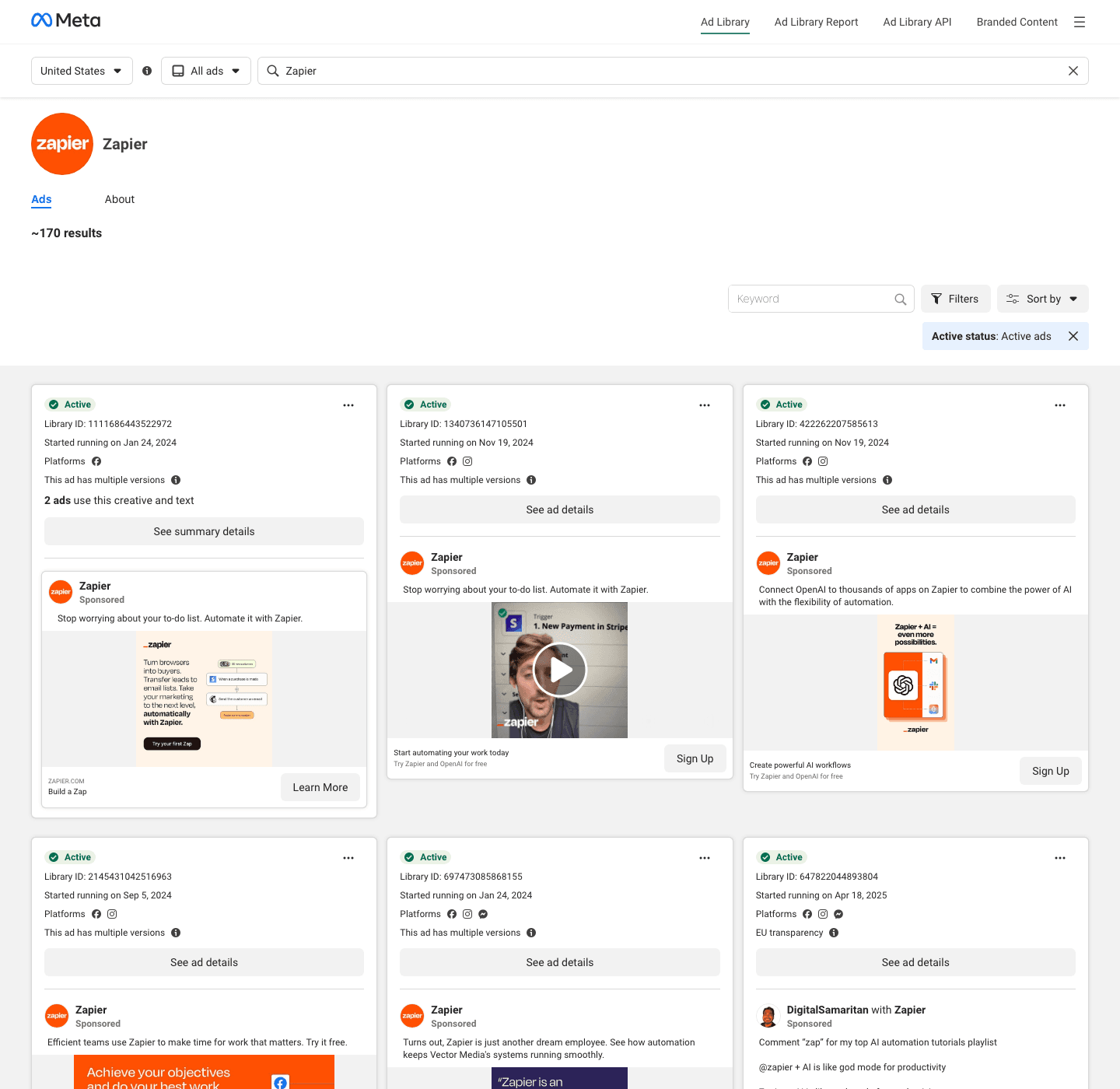
~170 active ads came back for the US alone. Six cards fit on one screen and they already carry four different start dates: Jan 24, 2024 (twice), Nov 19, 2024 (twice), Sep 5, 2024, and Apr 18, 2025. Every one of them is still active today, which means Zapier is running a 2024 ad and a 2025 ad to the same audience at the same time and neither has been pulled.
2. Open the oldest card and read it like evidence.
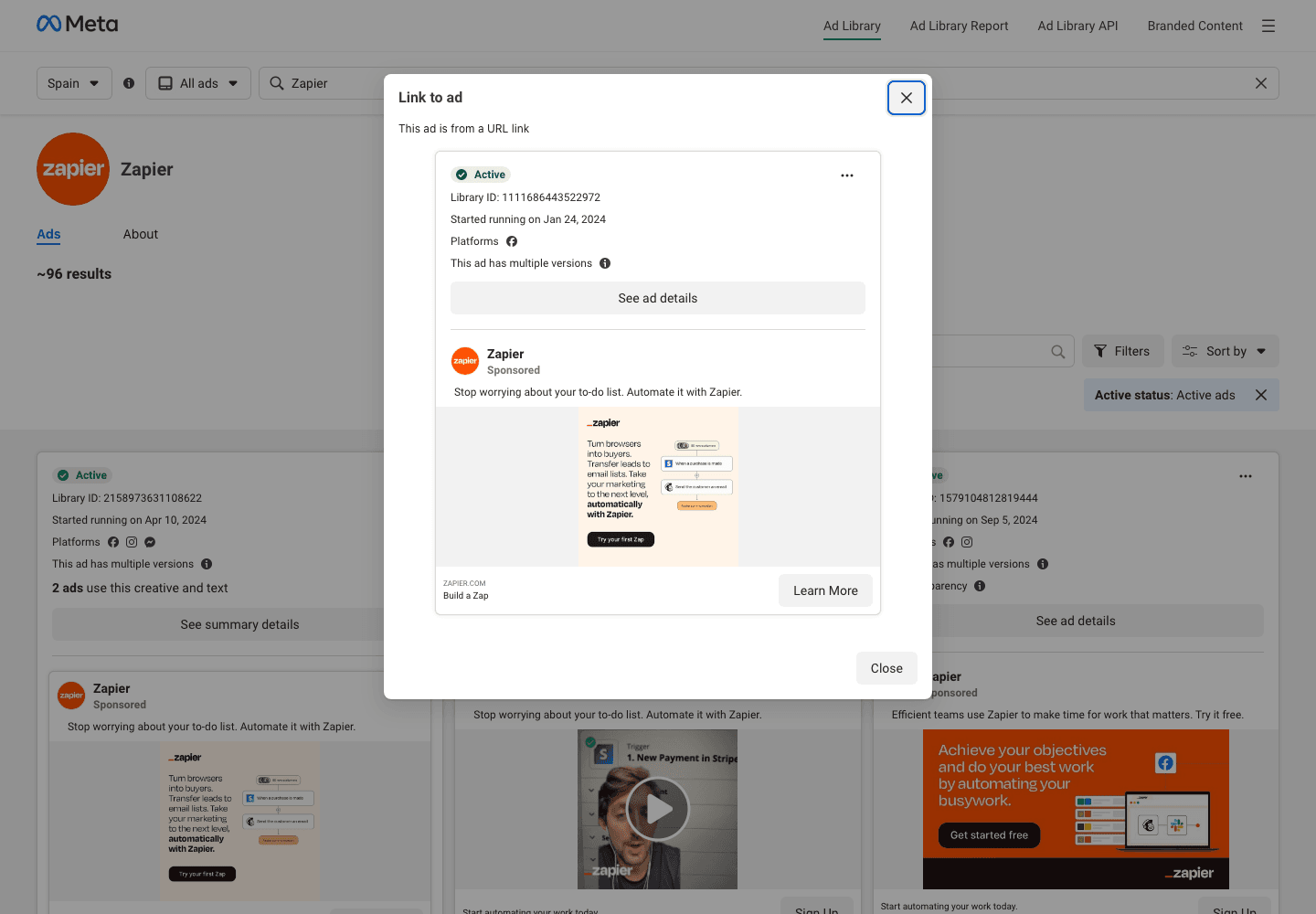
Started running on Jan 24, 2024. That is 902 days of continuous spend on one static image and one line of copy: "Turn browsers into buyers. Transfer leads to email lists. Take your marketing to the next level, automatically with Zapier." Button reads "Try your first Zap," and the whole card links straight to zapier.com under the label "Build a Zap." Nobody funds the same static image for two and a half years by accident.
3. Cross-check the same domain in Google's Ads Transparency Center.
https://adstransparency.google.com/?region=US&domain=zapier.com
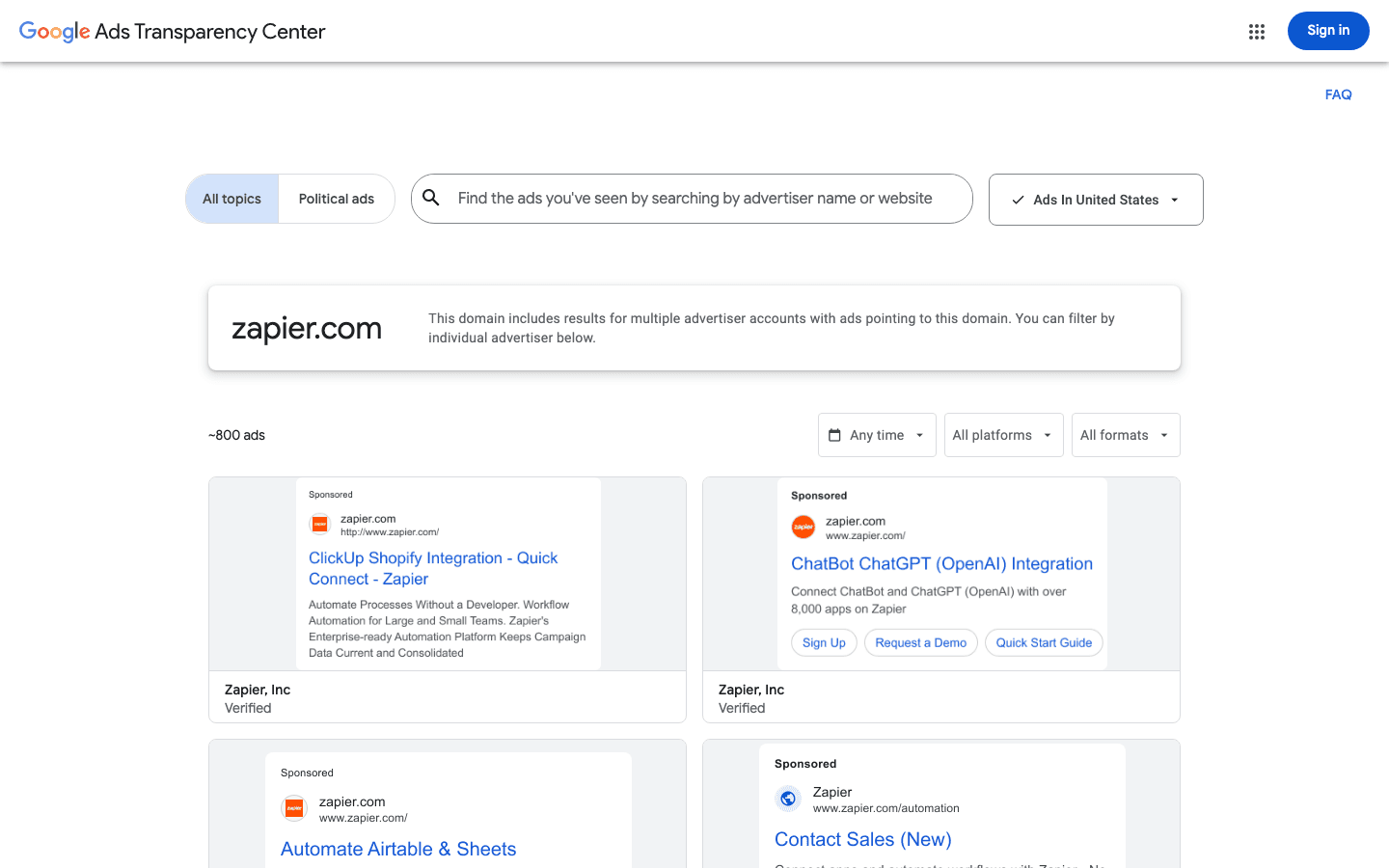
~800 ads across Zapier's Google accounts on the same day I pulled the Meta numbers. That tells you the search and display volume is real, but it does not tell you how long any single ad has been running, which is the next thing I went looking for.
4. Open one ad's detail page and notice what's missing.
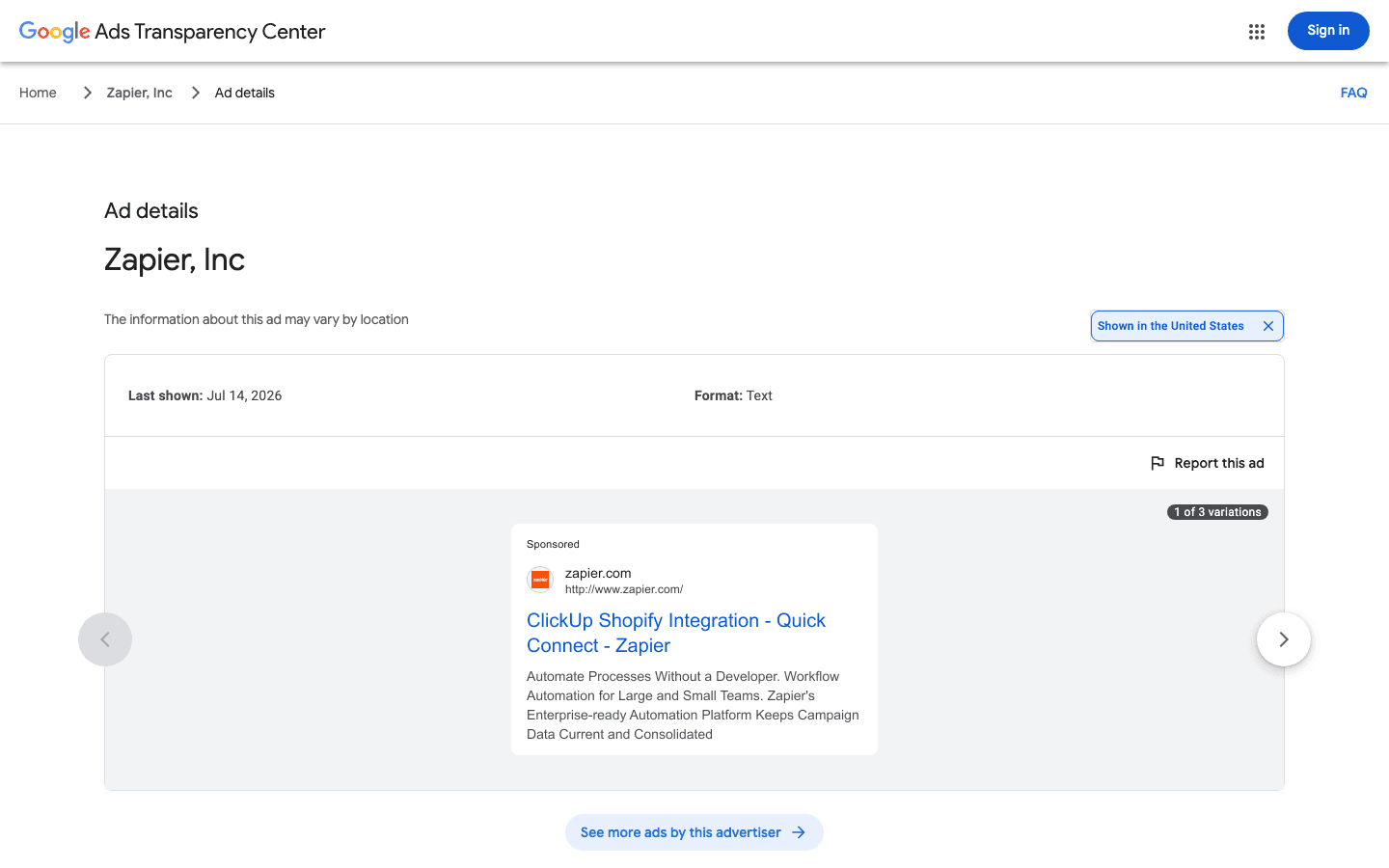
Google shows "Last shown," never "First shown." I opened two of Zapier's Google ads and both stopped at the same missing field, "Last shown: Jul 14, 2026," the day I was looking. Meta hands you the start date on a plate. Google only tells you an ad is still alive today, not when it began.
I also tried TikTok's Creative Center the same way, searching for Zapier and Notion inside its Top Ads view. It is built entirely for interactive browsing, category filters and region pickers you click through by hand, and a plain page load never returned a usable competitor-specific result. Screenshot: TikTok Creative Center's Top Ads feed filtered to a competitor's category, with the like and share counts each card shows in place of a start date.
The read
- Duration is the only proof you get. No platform shows spend or conversion numbers. An ad that has survived 900 days of budget review is the closest thing to a public "this works" you will ever see.
- Multiple simultaneous long-runners beat one. Zapier had six-plus ads active at once in a single screen, dated months apart. That is a stable portfolio of winners being rotated in front of new audiences, not one lucky test nobody got around to turning off.
- The platforms are not equivalent. Meta timestamps the start of a run in the open. Google only timestamps the most recent impression. Use Meta for dating a campaign, Google for confirming a competitor is running paid search and display at real scale at all.
Steal it
Pull the oldest two or three ads for any competitor and copy the shape, not the words: the hook in the first line, the specific offer, and where the click lands. If several long-runners all push the same landing page, that page is doing real work and yours should be tested against the same structure before you invent a new one.
On defense, put your own brand and product name into both libraries every month. A rival quietly running a "[Your Product] alternative" ad for six months, unnoticed, is a rival about to scale a campaign built entirely around people who already searched for you.
Gotchas
- Neither library sorts by duration for you. You are eyeballing the date on every card, which stops being practical past 50 or so ads. Filter by platform or format first to cut the pile down before you start reading.
- Google shows "Last shown," not "first shown." You cannot compute an ad's age from one visit there. Note the ad ID and re-check monthly if you need real duration data out of Google, or lean on Meta for the dating and Google only for volume.
- This is public disclosure, not an invitation to scrape it. Reading a handful of cards by hand is the intended use. Running an automated harvester against either library at scale will get you rate-limited or blocked, and it crosses from research into the kind of load these tools were never built to take.