Announce Big, Freeze The Churn
A flagship release announced early can suppress cancellations for months before it ever ships.
Most companies save the announcement for the day the thing is ready. That is backwards if retention is the goal. The announcement is the retention mechanic, not a preview of one. Tell people something big and real is coming, give them one credible reason to stick around and see it, and the waiting period turns into the highest-retention stretch on your calendar. Nobody cancels three weeks before the thing they are curious about finally shows up.
What to do: Pick the single most expensive, most anticipated thing you are building this year and announce it publicly the moment it is real, months before it can possibly ship. Name it, show one true detail about it, and put that detail in front of anyone about to churn, in the cancellation flow, the win-back email, the renewal reminder. The announcement has to land before the moment your customer decides whether to renew, not after.
Why it works: Anticipation reduces churn independent of the thing itself, people stay to see what happens even when most of them never end up using it.
Example: HBO announced Rome, a $9-million-per-episode flagship series, well ahead of its 2005 premiere. Venture capitalist Bing Gordon later got HBO CEO Chris Albrecht to admit that subscriber churn between the announcement and the premiere ran almost zero. People stuck around just to see what the fuss was about, and enough of them did that the near-zero churn alone covered a meaningful share of the production cost. Sean Ellis and Morgan Brown made it the textbook case in Hacking Growth, and it has been the reference example for anticipation-driven retention ever since.
Walk it through
I checked how Apple TV+ ran the identical play in June 2026. The mechanic is timing, not content, so watch the calendar.
1. Find the moment a subscriber actually decides.
Widow's Bay, one of Apple TV+'s biggest 2026 originals, had its season one finale scheduled for June 17. That is the exact week a subscriber asks whether the show earned another month of the subscription.
2. Announce the renewal before that week, not after.
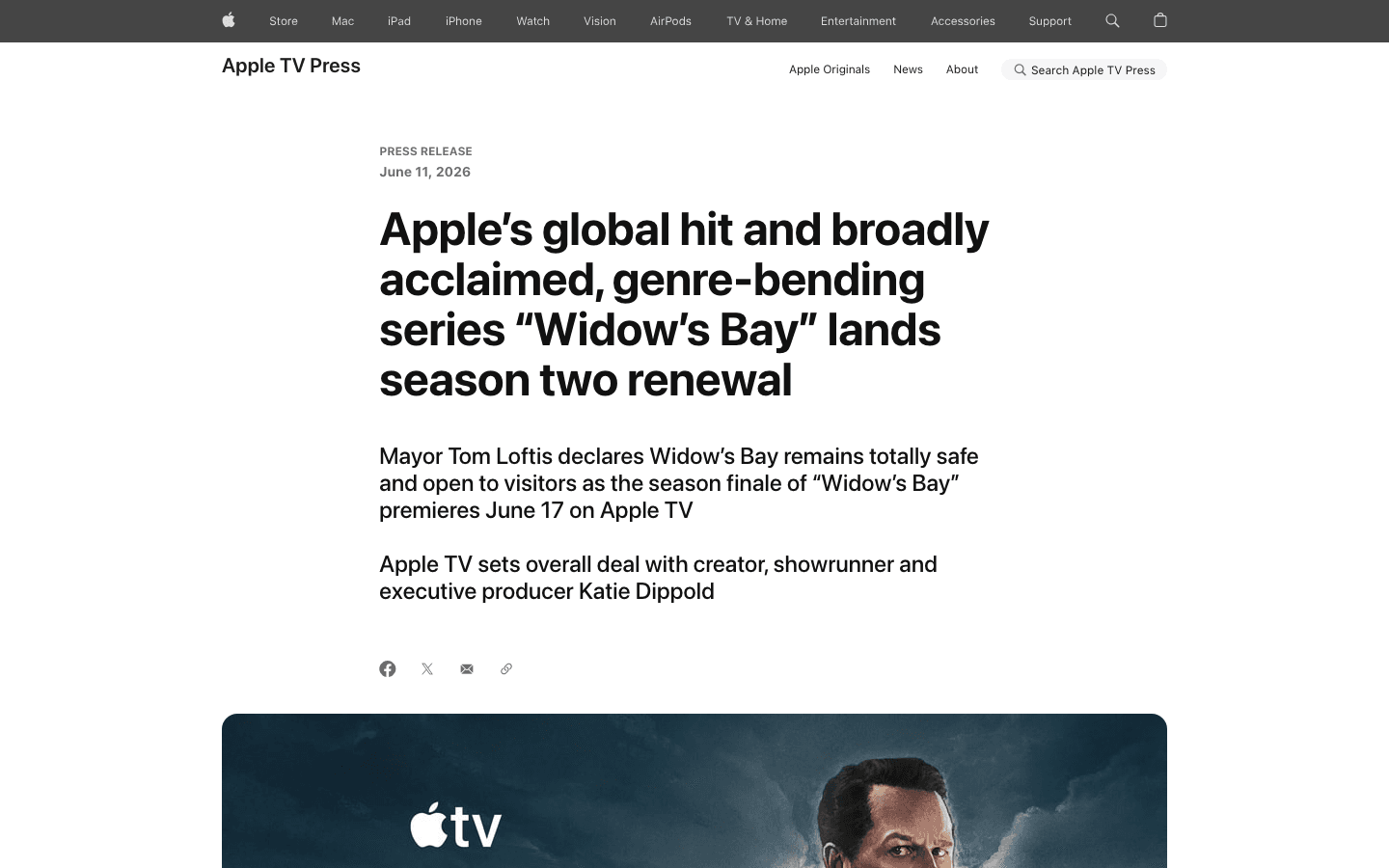
Apple put this release out on June 11, a full six days before the finale aired. It confirms season two and adds a new multiyear overall deal with the creator, Katie Dippold, so the promise reads as a funded commitment, not a maybe. Anyone about to watch the finale already knows more is coming before they even find out how season one ends.
3. Read the gap it is designed to close.
A finale is a natural churn point. Viewers finish a season, feel done, and check out. Landing the renewal news six days early kills the "I'm done" reasoning before it forms. By the time the finale airs, staying subscribed is no longer a decision, it is a foregone conclusion.
The read
- Timing beats content. The announcement only works if it lands before the churn-risk moment, the finale, the renewal date, the end of the trial. A day late and you are just doing PR.
- The promise has to be expensive to fake. A multiyear overall deal with a showrunner is not something you announce on a whim. The cost of making the promise is what makes subscribers believe it.
- One real detail beats a teaser. HBO did not tease Rome, it named it and put a number on it. Apple did not tease season two, it confirmed the deal and named the creator. Specificity is what makes anticipation stick.
Steal it
You do not need HBO's budget to run HBO's play. You need one release genuinely big enough that finishing it is expensive and delaying it would actually cost you something. Find your equivalent churn moment, an annual renewal date, a trial expiring, the point where a customer finishes the workflow they signed up for, and land a real, specific announcement about what is next before that moment arrives, not after. Put the same line in your cancellation flow. A customer halfway through cancelling who reads "the thing we are shipping in Q4 fixes exactly what you are frustrated about" behaves differently than one who reads nothing.
If you are on the other side of this, watching a competitor pre-announce a splashy roadmap to hold their base, do not wait for their ship date to respond. Anticipation is only powerful while the wait is uncontested. Ship something real and smaller now, and you take the "wait and see" argument away from them before their big thing ever arrives.
Gotchas
- The promise has to be real and big. A minor update dressed up as a flagship release reads as filler the moment people notice, and filler kills trust faster than announcing nothing at all.
- Get the timing wrong and it backfires. Announce too early and impatient subscribers churn anyway before the payoff arrives. Announce after the churn moment and you missed the entire point.
- You do not get to run this every quarter. Do it constantly and customers learn there is always a "big thing" six weeks out, which trains them to discount the next one. Save it for releases that are actually rare.