Two Touches Beat Five Bumps
A follow-up sequence that adds new value twice outperforms five reminders that just bump the same thread.
Most outbound sequences die from repetition, not silence. Founders write one good cold email, get no reply, then spend the next three weeks bumping the same thread with some version of "just wanted to make sure this didn't get buried." Five touches, one idea, repeated with less energy each time. The reader's brain files it as noise by touch two and deletes on sight by touch four. Cap the sequence at two follow-ups, make each one teach the reader something the first email didn't, then get off email entirely for the third attempt.
What to do: After your first email, send exactly two follow-ups, day 3 and day 7, and require each one to carry something new: a fresh proof point, a different angle on the problem, a resource worth reading on its own. Never send a bare "checking in." If you still want a third touch, don't send a third email. Switch channels instead, a short Loom walkthrough or a LinkedIn DM.
Why it works: New information gives the reader a reason to open the next one, and a channel switch reads as a person trying again while a third same-channel email reads as a machine that hasn't noticed you're not answering.
Example: Demand Curve's Cold Email course, the syllabus most growth marketers actually learn outbound from, states the cap outright on its public course page: "a lightweight pipeline: prospecting, outreach, two smart follow-ups, and handoff to demos or calls." Two follow-ups. Not five, not seven, then you move the lead along or let it go.
Walk it through
1. Confirm the cap isn't a house rule you invented.
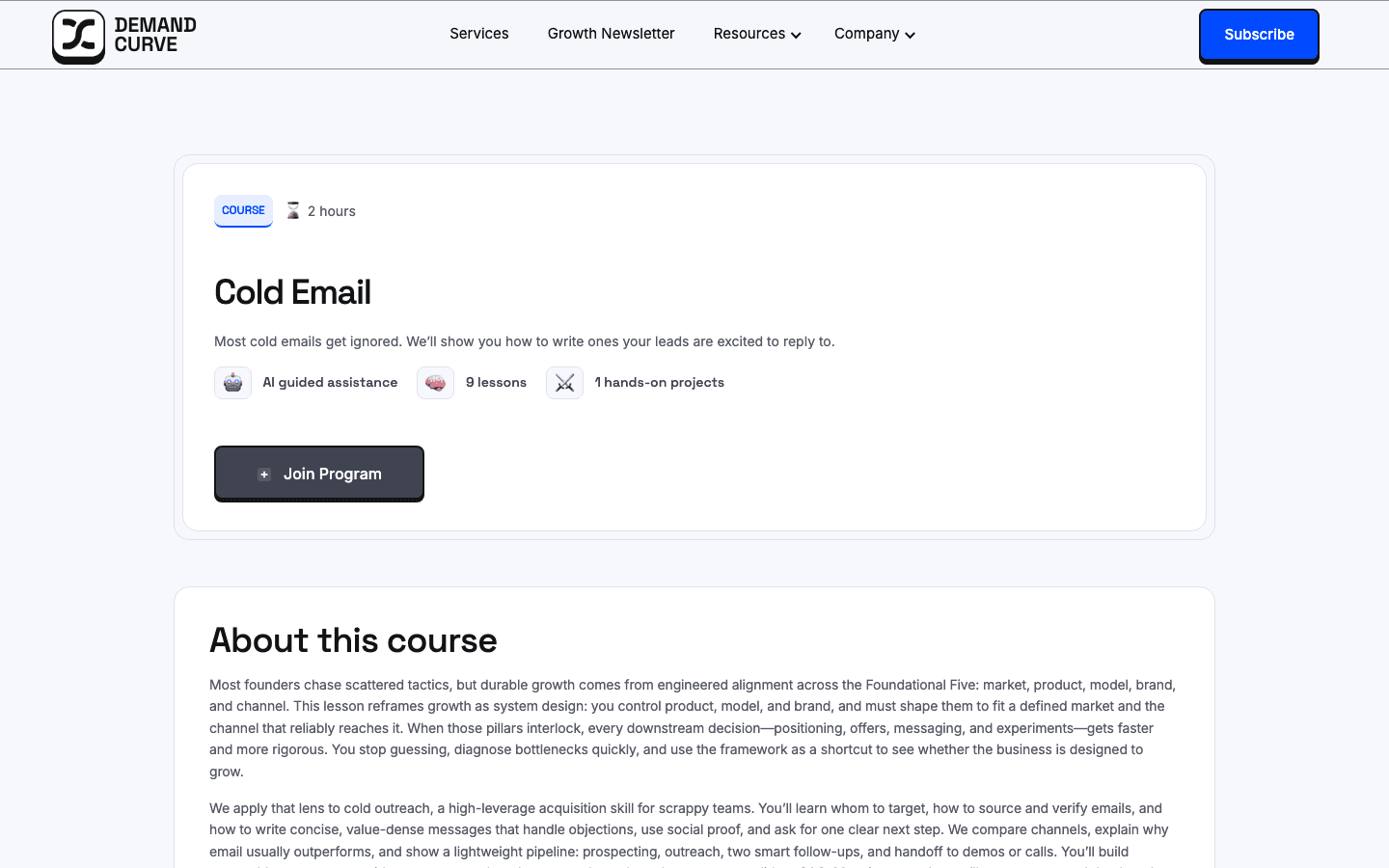
That sentence sits on a public marketing page, not behind the paywall. The course that trains growth teams to run outbound for a living plans for two follow-ups and then a handoff. If the industry's own teaching material stops at two, your fifth "bump" was never the taught technique. It was habit.
2. Write the two touches so each one earns its send.
Draft follow-up one for day 3. It cannot restate the pitch. It has to add something: a case study result, a customer logo from the prospect's exact vertical, a stat from your own product, anything the first email left out. Draft follow-up two for day 7 the same way, but from a different door: a different pain point, a short guide, a comparison the reader can use whether or not they buy from you. If you cannot find something new to put in either email, that's the sequence telling you to stop at one.
3. Replace the third email with a channel switch.
Around day 10 to 14, if you still haven't heard back, don't write email three. Record a ninety-second Loom walking through the exact thing you'd have said in a paragraph, or send a two-line LinkedIn DM that references the emails without repeating them. Something like "sent you a couple of notes on [problem], no pressure either way, here's the short version" does the job. The medium change is the message. It tells the reader a person, not a sequence tool, is still on the other end.
The read
- The value test decides whether you send it. If a follow-up doesn't teach the reader something the first email didn't, it isn't a follow-up. It's a bump, and bumps get filtered mentally before they ever hit a spam rule.
- Day 3 and day 7 is a shape, not a law. What matters is that the gap widens and the sequence actually ends. A cadence that repeats weekly forever is the same five-bump problem stretched out.
- The channel switch is where the effort signal lives. A third email off the same domain looks automated because it usually is. A Loom or a DM costs you real time to make, and the reader can tell the difference.
Steal it
Run this on your own outbound first. Cap every sequence at two follow-ups, force each one through the "what's new here" test before it goes out, and build the day 10 to 14 channel switch into whatever tool you use, even if that just means a calendar reminder to record a Loom by hand. Then run the same audit on your lifecycle email: trial reminders, abandoned-signup nudges, renewal notices. Most of them are three or four "just checking in" variants wearing different subject lines, and cutting them to two genuinely different touches plus a switch, an in-app message, a text, a call, reads as more attentive while costing you less volume.
Defend the other side too. If you run a sales team or an agency sending on your behalf, audit their sequences the way you'd audit a competitor's. A rep still working through email four of five is burning your domain's sender reputation on messages your own prospects already decided to ignore, and that reputation cost shows up in inboxes you actually care about landing in.
Gotchas
- This assumes email one already earned its read. No cadence, however disciplined, rescues a first email with no clear ask or no reason to care. Fix that before you touch the follow-ups.
- B2C lifecycle and cold B2B outbound don't run on the same clock. A cart-abandonment flow can fire three times in 48 hours because the intent is fresh and the channel is expected. This cadence is built for cold or lukewarm outbound, where every touch is an intrusion until proven otherwise.
- Don't force a channel you don't have. A Loom sent to someone who never asked for video, or a LinkedIn DM to a stranger who hasn't accepted your connection, can read as more invasive than a third email would have. Only switch channels where you'd already earned the right to be there.