One Value Prop Per Ad Set
Mixing two pitches in one ad set lets the algorithm quietly starve the one it likes less.
An ad set is not a folder. It is a small competition, and Meta declares a winner fast. Put two different pitches inside one, a discount angle and a trust angle, say, and the algorithm does not test both fairly. It watches the early clicks, picks a favorite within hours, and starves the other ad of the impressions it would need to prove itself. You end up killing a message that might have won, only because it happened to share a room with a message that won faster.
What to do: Give every distinct value proposition its own ad set, never two pitches sharing one. Inside that ad set, test different copy and creative that all sell the same single angle. If you are running Advantage+ or campaign budget optimization (CBO), put competing value props in separate campaigns too, not just separate ad sets, since budget flows between ad sets inside one campaign automatically.
Why it works: Meta compares ads within a set on early click-through signal and quietly stops serving the ones behind, so a second value prop sharing that set gets read as a worse version of the first instead of a different pitch that needs its own sample size.
Example: Demand Curve, the ad agency and growth-marketing school, states this as a hard rule in its own public Growth Guide: "On Facebook, it's critical you don't group multiple value props into a single ad set... Facebook assesses the CTR for every ad in a set then stops serving the worst-performing ones." That guide has taught this exact structure, one ad set per combination of value prop and audience, to the startups and marketers who go through Demand Curve's program.
Walk it through
I pulled up Demand Curve's own Growth Guide chapter on running ads in July 2026 to check whether the rule still reads the way people quote it. It does, word for word.
1. Read the hierarchy first.
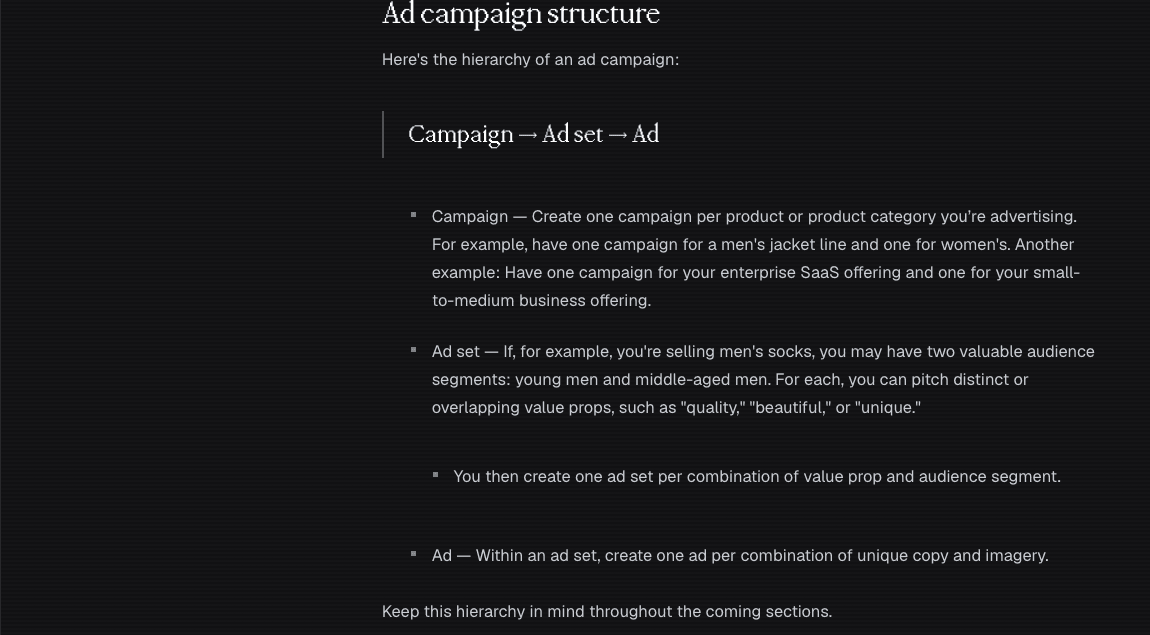
The guide's own example is a sock company. Two audiences, young men and middle-aged men, and a handful of possible pitches, quality, beautiful, unique. The rule is not "one ad set per audience." It is one ad set per combination of value prop and audience. Two audiences times three pitches is six ad sets, not two.
2. Read the warning underneath it.
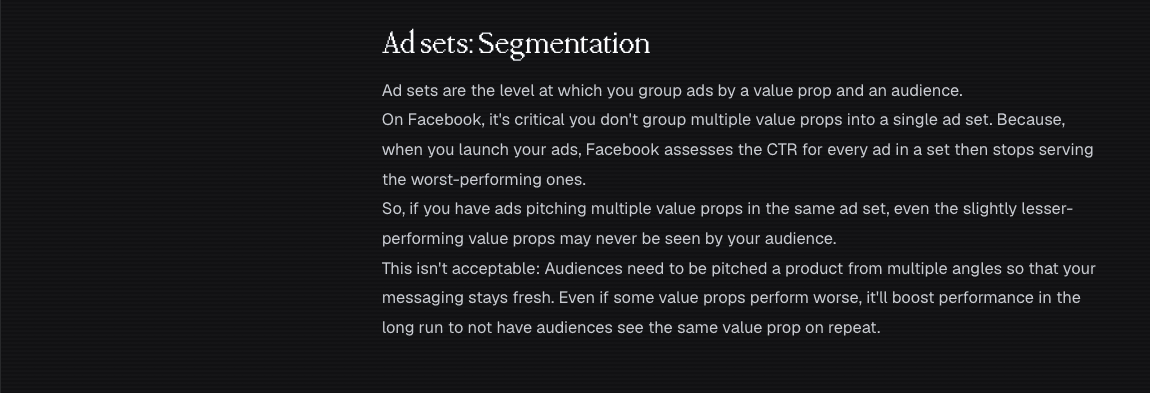
This is the whole mechanism in three sentences. Facebook checks the click-through rate of every ad in a set and starts suppressing the worst one. Mix two value props into the same set and one of them, maybe the better long-term pitch, gets treated as a losing variant of the other and quietly stops getting shown.
3. Update the timeline for 2026.
The guide does not mention CBO or Advantage+ because it did not need to when it was written. It does now. Meta still uses roughly 50 optimization events per ad set as its own rule of thumb for exiting the learning phase, but Advantage+ and CBO now move spend toward whichever ad set is producing signal fastest, hour by hour, not week by week. A slower-building message used to survive on a flat, evenly split budget while it found its feet. Today the budget itself drains toward the early leader before that message ever earns its 50 events.
The read
- The ad set is the unit Meta judges, not the campaign. Comparisons happen between ads sharing a set, so anything sharing a set is in direct competition for impressions.
- Speed changed, the rule did not. Demand Curve wrote this rule for a slower Facebook. CBO and Advantage+ just make the same selection happen in hours, which makes the split more urgent, not less relevant.
- A slow starter looks identical to a loser for the first day. Without its own ad set and its own budget, a message that needed more data than its ad-set-mate never gets the chance to look different.
Steal it
Structure your own account the same way before you write a single headline. List your distinct value props first, price, speed, status, safety, whatever your product actually sells, and list your audience segments second. Every cell in that grid gets its own ad set, and if you are on Advantage+, its own campaign, so its budget cannot be quietly siphoned toward whichever cell got lucky on day one. Name the ad sets after the value prop, not the audience, so you never accidentally drop a second pitch into one labeled for a different job.
Defend the other side of this too. Splitting is not free. Every ad set you create needs its own runway to reach real signal, and an account with forty thinly-funded ad sets learns nothing quickly, about anything. Fund fewer, cleaner splits well rather than many starved ones, and only add a new value prop as its own ad set once you can actually give it a fair shot at those 50 events.
Gotchas
- Advantage+ can undo your split without telling you. Some Advantage+ campaign types pool audiences and creative decisions back together behind the scenes. Check the campaign type before you assume your careful ad-set structure is being respected.
- Underfunded splits fail for a different reason than mixed pitches. An ad set that never reaches enough spend to exit the learning phase looks exactly like a starved value prop. Rule out a thin budget before you conclude the pitch itself lost.
- Honest caution: sometimes the slower ad set is just worse. Do not turn this into an excuse to keep a pitch on life support forever. Give it a real, separate shot, then kill it if it still loses once it has actually had one.