Invite The Team During Setup
Make the product multiplayer from the first session instead of waiting for a single-player user to ask for it.
Most onboarding flows ask a new user to finish setting up their own account before they think about anyone else. That ordering feels polite. It is also a bet, and for some products it is the wrong one. If the product gets better the moment a second person joins, every screen you spend on solo setup is a screen you are not spending on the thing that actually retains people: a shared workspace with someone else's name already in it.
What to do: During account creation, before the user reaches their empty workspace, ask who else should be in it. Offer a real input for teammate emails, not a buried "invite" link in settings, and if you can detect a shared company email domain, offer to auto-join anyone who signs up with it later.
Why it works: A workspace with two names in it is harder to abandon than one with just yours, and asking before the user has invested any time costs you nothing because they have not decided the product is worth defending yet.
Example: Notion builds this into the product mechanically, not just as a suggestion during signup. Its own help documentation describes an "Allowed email domains" setting: once a workspace owner turns it on, "whenever someone signs into Notion with an email that has one of those domains, they'll see the option to join your workspace during onboarding." A teammate does not need a link forwarded to them. They sign up on their own and Notion routes them into the existing workspace before they ever see an empty one.
Walk it through
You cannot capture Notion's live invite screen without an account, so read the mechanic the way Notion itself documents it, then build the equivalent for your product.
1. Notion separates two invite paths, and both fire before a user has done real work.
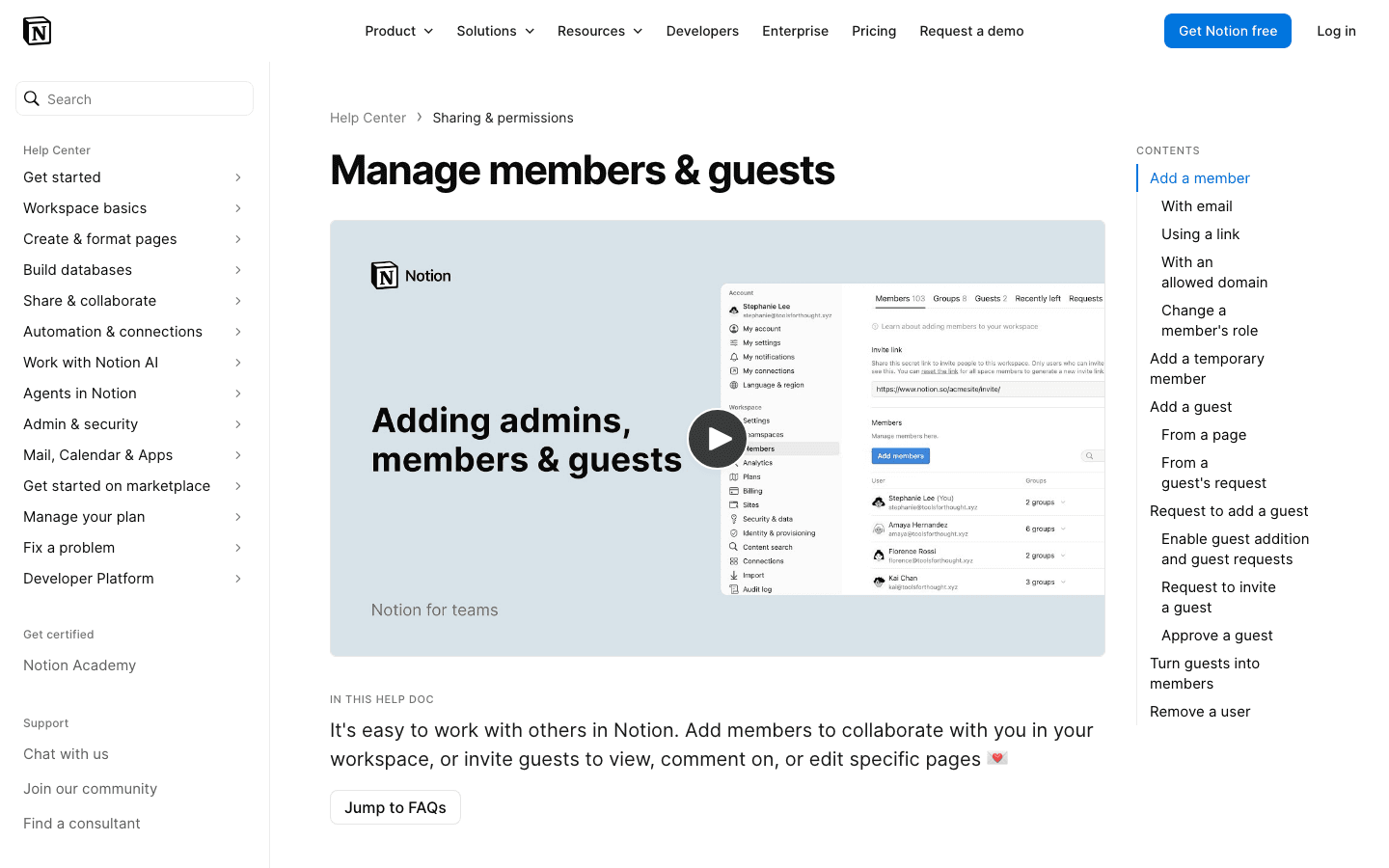
The sidebar contents on that page list the paths in order: add a member with email, add a member using a link, add a member with an allowed domain. The third one is the interesting one, because it requires no action from the inviter at all. A workspace owner sets it once, and every future signup on that domain gets routed into the shared workspace automatically.
2. The domain match happens at the point of signup, not after.
Notion's own wording is exact: the option to join appears "during onboarding," not in a follow-up email, not in a settings menu the new user has to find. The fork in the road is the first thing the new user sees, before they have named a page or clicked around alone.
3. Translate the two paths to your own product.
You do not need domain-matching infrastructure on day one. You need one text input, on the account-creation screen, that asks "who else is on this?" and sends real invites the moment the account exists. Domain auto-join is the version you build once you have enough B2B signups to justify it.
The read
- The ask has to land before the empty state does. Once a user has poked around solo for ten minutes, asking them to invite someone reads as a favor to you. Ask before that, and it reads as part of setup.
- Auto-join beats manual invites at scale. A typed-in email depends on the first user remembering to send it. A domain match depends on nothing. Notion chose to build the second one because manual invites leak, people forget, links go stale.
- This is a bet on when the product's value shows up. Notion and Figma front-load the invite because the product is genuinely better with two people in it from minute one. That bet does not hold for every product.
Steal it
Add one field to your signup or first-run flow: an email input for teammates, sent the moment the account is created, not gated behind a completed setup wizard. If your users mostly sign up from company email addresses, add domain detection next, matching Notion's move: silently connect a second signup on the same domain to the first person's workspace instead of spinning up a lonely new one. Both moves are cheap to build and both fire at the one moment a user is most willing to think about who else needs this.
Defend the sequencing choice before you copy it, though. Notion and Figma work because the canvas or the doc is visibly better with a second cursor in it, so the invite ask is honest, you are pointing at real value that exists the moment someone else shows up. Instagram ran the opposite play on purpose. Photo filters and a single-player feed were the whole pitch early on, worth using with zero followers, and the social layer got built on top once that standalone habit was already real. If your product needs a dense, working single-player case before a second person adds anything, an early invite prompt is just friction with no payoff behind it, and you are better off proving the tool works solo first.
Gotchas
- An invite step that yields no invites is a tax on signup, nothing more. If most first sessions send zero invites, you added a screen for nothing. Measure invite-send rate before you decide the ask is paying for itself.
- Domain auto-join can put a stranger in a workspace that was never meant to be shared. Personal Gmail-style domains are an obvious exclusion, but company domains shared by unrelated teams (agencies, universities, shared IT) will misfire too. Notion's version bills auto-joiners as paid seats, which means a badly scoped domain rule is also a billing mistake.
- Front-loading the ask only works if the product backs it up immediately. If the invited teammate lands in an empty workspace with nothing to react to, you have spent your one good moment of momentum on a screen with nothing in it.