Get into Wikipedia
Wikipedia is the most-cited domain across every engine.
What to do: Earn a Wikipedia presence and keep your brand's core facts accurate there and on Wikidata. Do not write your own page. Get notable enough that someone else does, then correct what is wrong.
Why it works: Wikipedia is the single most-cited domain across every engine, so a clean entry feeds your facts into answers everywhere at once.
Example: Pew found Wikipedia, YouTube, and Reddit together are 15% of everything Google's AI Overviews cite, and Ahrefs found Wikipedia is the second most-cited domain in ChatGPT with 2.7 million mentions.
Walk it through
I ran this against Stripe in July 2026. Here is exactly what came back.
1. Open the real Wikipedia article and read what it already says.
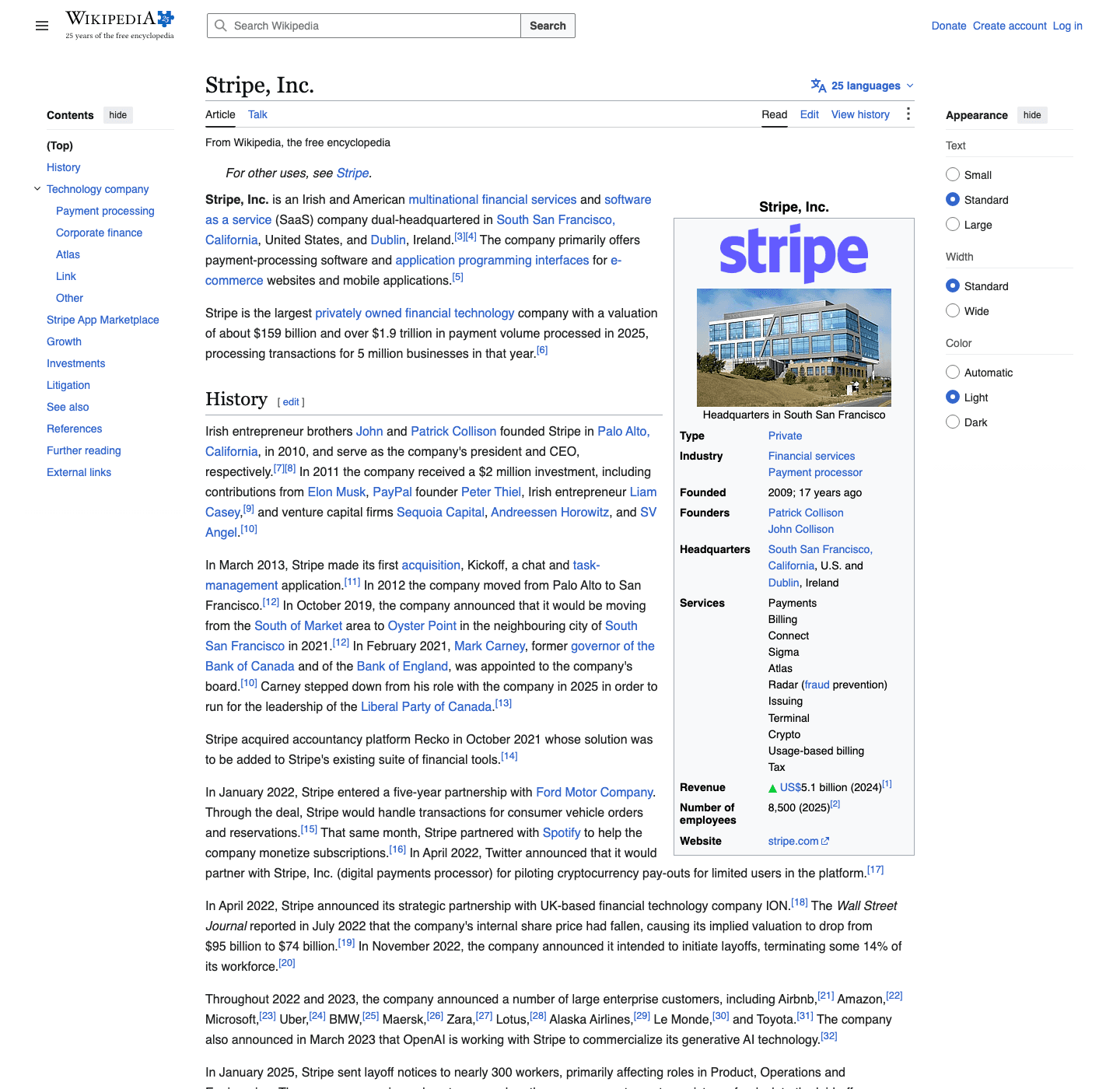
en.wikipedia.org/wiki/Stripe,_Inc. runs long: history, acquisitions, partnerships, layoffs. The infobox on the right is the part that matters most. Founders, founding date, headquarters, revenue, employee count, every field footnoted to a source. That box is the densest, most citable summary of a company anywhere on the web, and it is exactly the shape of fact an AI model likes to lift whole.
2. Find the Wikidata item behind the article and check what backs each claim.
curl -s "https://www.wikidata.org/w/api.php?action=wbsearchentities&search=Stripe&language=en&format=json"
That returns Q7624104, the machine-readable record sitting underneath the prose.
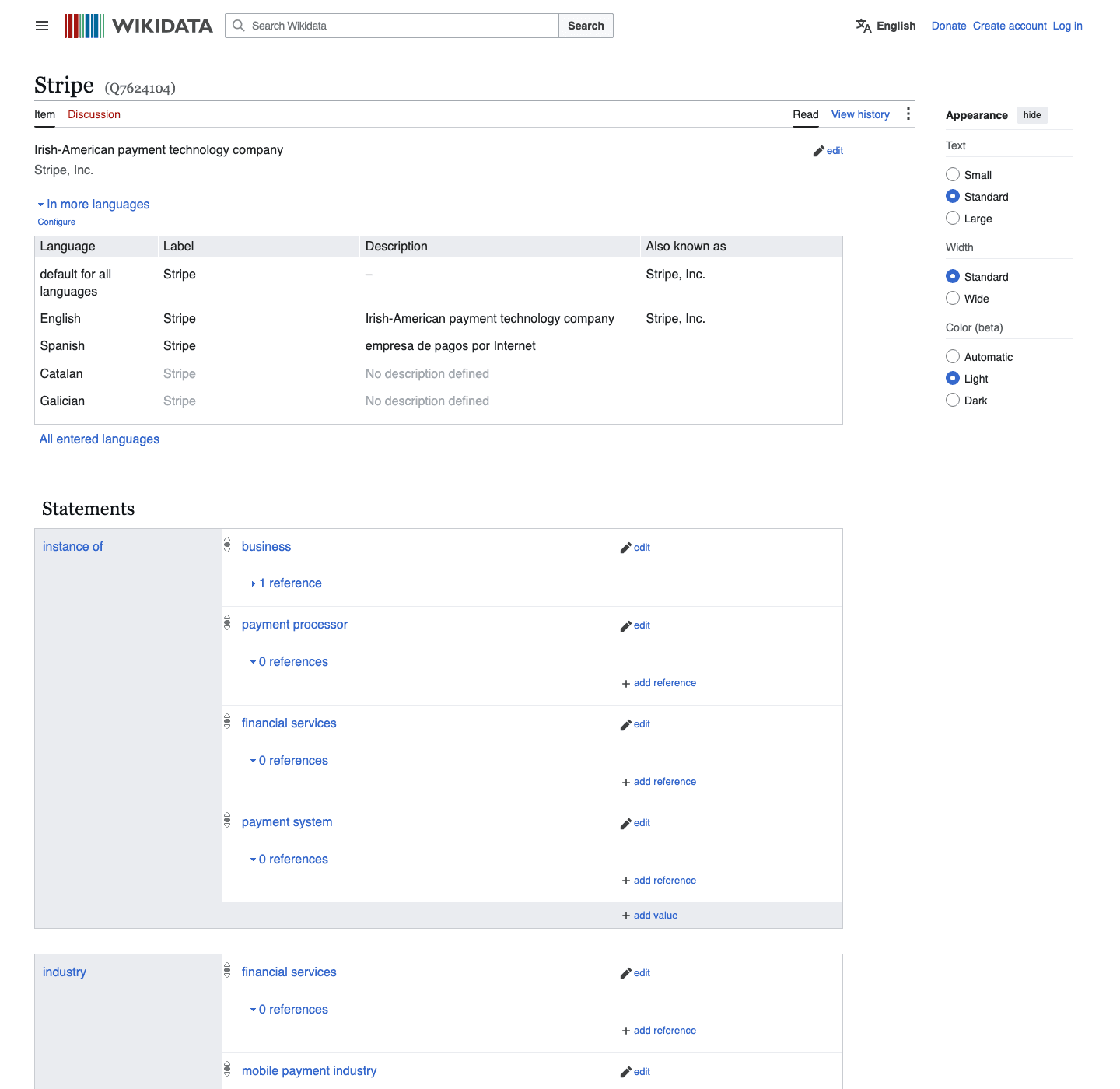
This is the part almost nobody checks. Three of the four "instance of" statements say "0 references" right under the claim. Wikidata does not require a citation to accept a fact, it only shows you when one is missing. Anyone, including you, can click "add reference" and attach a source. Anyone can also edit the claim itself.
3. Ask an AI engine the same question and watch what it cites.
I sent Perplexity a real query, no login required: "who founded Stripe and when."
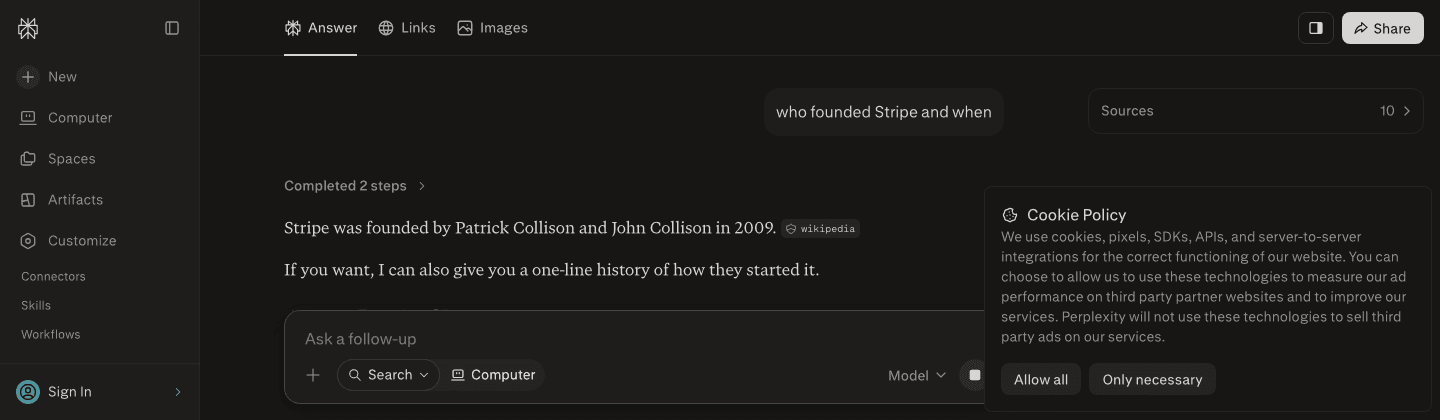
One line of answer, one source chip, and it reads wikipedia. Ten sources went into that search, and the model chose to name Wikipedia explicitly next to the sentence rather than bury it in a list. That is the whole tactic proven in one screenshot: get the facts right on one page, and the citation follows you into every engine that answers this question the same way.
The read
- Coverage is not the win, sourcing is. A statement sitting on Wikidata with zero references is a fact anyone can dispute or quietly overwrite. A statement with a reference attached is close to permanent.
- The model names the source, not just uses it. Perplexity did not silently absorb the fact, it printed "wikipedia" right next to the sentence. That naming habit is what "getting cited" actually looks like at the point of an answer.
- The infobox is the payload. Founders, dates, revenue, headcount, those exact fields are what gets extracted and repeated elsewhere. An error in the infobox does not stay contained to one page, it propagates into every model that reads it.
Steal it
Search your own company name on Wikipedia and on Wikidata before you do anything else. If nothing exists, do not write it yourself. Wikipedia's community actively reverts undisclosed company edits, and a draft with no independent coverage behind it tends to get speedy-deleted within days. Earn the notability instead: get written up by press, publications, or analysts who have no relationship to you, and let a volunteer editor turn that coverage into an article on their own initiative.
If an article already exists, audit it the way you just audited Stripe's. Open the Wikidata item, find every statement marked "0 references," and add a citation to your own pressroom, a filing, or a reputable news article wherever the fact is actually true. That single edit is one of the highest-leverage, hardest-to-fake moves available to you, because you are correcting the exact record that every AI engine treats as ground truth.
Gotchas
- Conflict of interest is real and enforced. Editing your own company's page as an employee without disclosing who you are gets flagged, reverted, and sometimes gets the page locked against you specifically. Disclose on your user page or route the change through Wikipedia's paid-editor request process instead.
- Notability has a bar. Local coverage, your own blog, and a press release do not count. Wikipedia wants independent, substantial coverage from sources with editorial standards behind them. Most startups fail this test and their draft gets deleted fast.
- This is slow and you do not fully control it. You cannot force an article into existence, stop someone else from editing it, or guarantee an AI engine keeps citing it next quarter. Treat this as a long-game trust asset, not a lever you pull for this week's traffic.