Keep it fresh
AI answers skew hard toward recently updated content.
What to do: Refresh your cornerstone pages on a schedule, update the numbers inside them, and surface the last-updated date.
Why it works: AI answers skew hard toward recently updated content, so a stale page quietly falls out of the answer set.
Example: Ahrefs found AI-cited content is about 26% fresher than the content ranking in organic Google, and ChatGPT tends to cite pages more than a year newer than the ones Google ranks.
Walk it through
I ran this in July 2026. Here is exactly what came back.
1. Open a page that treats freshness as a selling point and look for the date it shows you.
open https://ahrefs.com/blog/fresh-content/
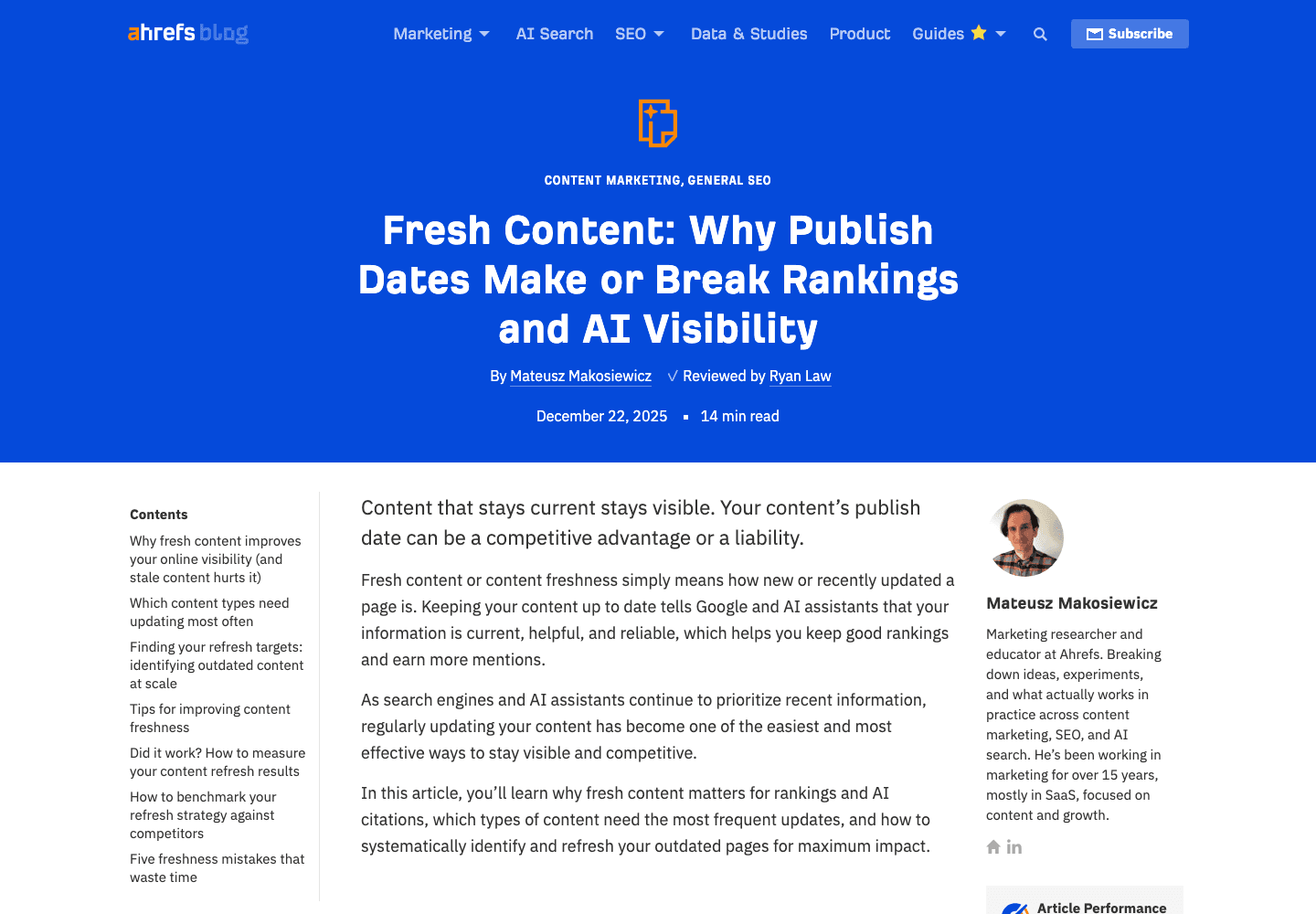
Right under the headline sits a date and a read time, in public, for every visitor and every crawler to see. December 22, 2025 is what the page tells you. That is the number a human skims and the number a language model's retrieval step can key off when it decides whether a source counts as current.
2. Don't trust the byline. Pull the real signal, the server's Last-Modified header.
curl -sI https://ahrefs.com/blog/fresh-content/ | grep -i "date:\|last-modified"
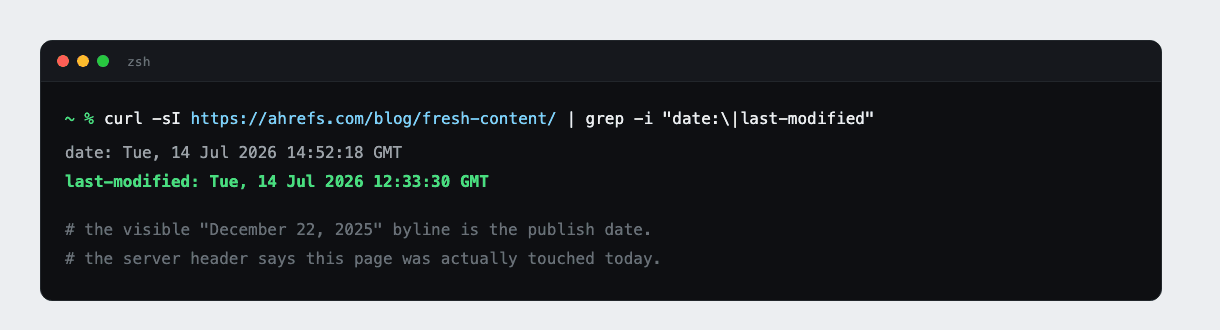
The byline says December. The header says today. Somebody edited this page again after publishing it, and the server logged the edit whether or not the visible date moved. This is the honest version of freshness, the one a crawler reads on every fetch, not the one a content team chooses to display.
3. Ask a real buyer question and watch which kind of page gets cited.
open "https://www.perplexity.ai/search?q=best+project+management+software+for+startups+2026"
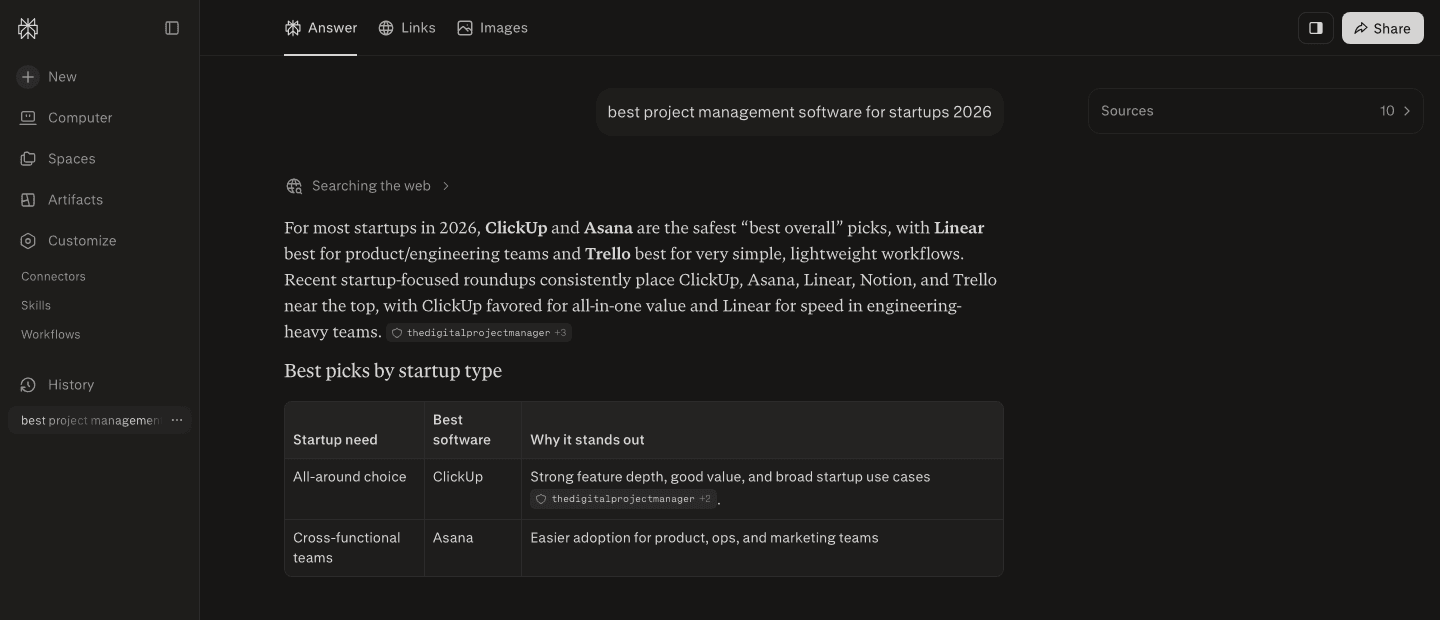
Look at the citation pill under the first paragraph, thedigitalprojectmanager +3. That single roundup domain gets cited again a few lines down in the comparison table, tagged +2 more sources. A domain that keeps a "best X for startups" page alive year over year, retitled for 2026, edited on a schedule, is the kind of source a model leans on repeatedly inside one answer. Nobody in that answer got cited for a page that last changed in 2023.
The read
- The visible date is decoration. The header is the record. Anyone can hand-edit a byline. The Last-Modified timestamp comes from the server on every request, which makes it the harder one to fake and the one worth checking on your own pages before you trust your own "updated" claim.
- The year in the query pulls the year in the answer. Searchers wrote "2026" into the question, and the model answered with sources built around that same year. A cornerstone page that still says 2024 in its title is telling both the reader and the retrieval step that it stopped being maintained.
- Repeat citations mean the model trusts the domain, not just the page.
+3and+2on the same source inside one answer is the model treating a well-kept roundup as a standing reference, the payoff for refreshing on a schedule instead of once and forgetting it.
Steal it
Pick your own cornerstone pages, the ones built to answer a buyer question your product actually solves, and put them on a refresh calendar instead of a publish-and-forget schedule. Update the numbers inside, not only the date at the top, then confirm the edit actually landed by curling your own URL and checking Last-Modified the same way you just checked Ahrefs. If that header still shows last year's date, your CMS or your CDN cache is lying to you about your own freshness, and no model is going to catch an update that never actually reached the server.
Defend the same way you attack. Run the buyer queries your own category cares about, in Perplexity and in ChatGPT, and see whether your page shows up next to competitors with a live "2026" in the title. If it doesn't, that is your signal to refresh before someone else's better-maintained roundup takes the citation slot you used to hold.
Gotchas
- Changing the date without changing the content is a bad trade. A reader or a crawler that compares the "updated" claim against the actual text and finds nothing new will trust your dates less next time, not more.
- CDN caching can make Last-Modified lie to you too. Ahrefs' header came back current because the page had genuinely changed, but a cached response can hold an old timestamp for hours after a real edit ships. Check the header more than once before you conclude a refresh failed to register.
- Freshness takes time to propagate into AI answers. Search engines and AI crawlers re-fetch on their own schedule, not yours. Editing a page today does not guarantee a citation tomorrow, so treat this as a standing habit, not a one-time fix before a launch.