Bill Only What Gets Used
Anchor the paywall to the metric that tracks real usage, not a flat seat count nobody trusts.
Every renewal call has the same fight buried in it. A hundred seats on the invoice, forty people who actually logged in this month, and a buyer who knows the other sixty are dead weight before you say a word. Flat seat pricing bills for headcount instead of value, and procurement stopped believing those are the same thing years ago. The fix is not a discount. It is anchoring the number on the invoice to something the customer can watch move, so the bill defends itself instead of you having to.
What to do: Pick one usage or outcome metric that tracks real value (resolved tickets, API calls, generated reports, active seats) and price against it. Keep a small base fee under it so revenue does not collapse in a slow month, then let the usage or outcome number ride on top. Build the metering and the credit-back into the product itself, not into a support queue someone has to fight through.
Why it works: A bill that moves with usage is one a buyer can defend to their own boss, and a bill that corrects itself without a dispute is one nobody escalates at renewal.
Example: Slack's Fair Billing Policy runs this at the seat level. Slack tracks activity, marks a member inactive after 28 days without action, and automatically applies a prorated credit for the unused time, no ticket required. Slack's own policy page puts it plainly: "Most enterprise software pricing is designed to charge you per user regardless of how many people on your team are actively using it. At Slack, we believe you should only be billed for what you use."
Walk it through
I read Slack's policy page in July 2026. Here is what it actually promises, and how to lift the same mechanic for a usage or outcome metric.
1. Read the policy the way a buyer would.
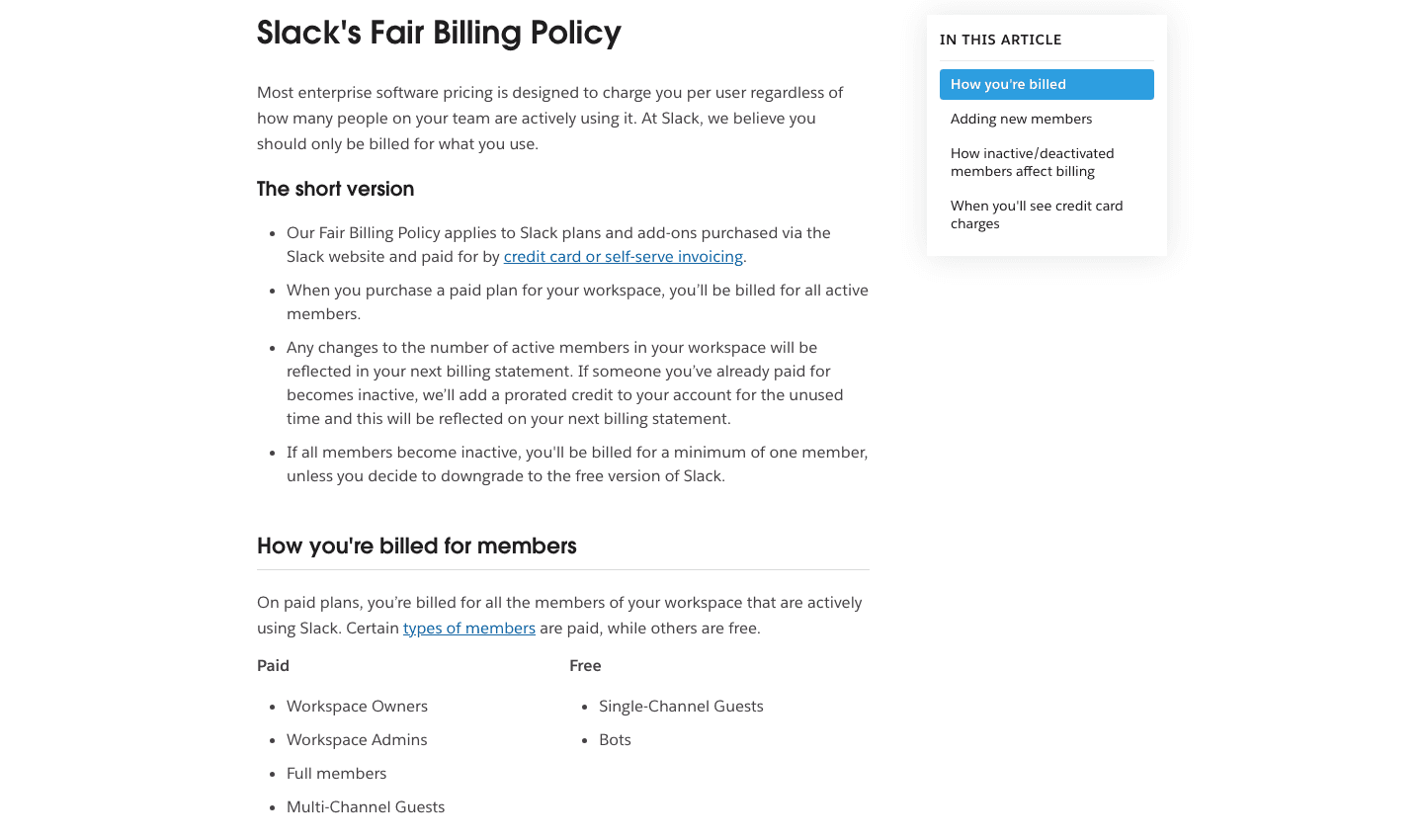
No hedging, no asterisk pointing to a sales rep. The page states the mechanism (active members are billed, inactive ones are not) and the guardrail (a floor of one member so the account never bills zero) in four short bullets.
2. Pull the three mechanics out of the plain English.
An activity window defines "used." No action in Slack for 28 days and the seat flips to inactive. A credit formula defines "fair." Cost per member divided by days in the month, multiplied by days remaining, applied automatically. A floor defines the limit. The bill drops to a minimum of one seat, never to zero, unless the account downgrades outright.
3. Swap seats for your real metric.
Say your product resolves support tickets. A base fee of $299 a month covers the platform and 300 resolutions, and every resolution past that bills at a flat rate. Now borrow the Slack mechanic for the base: if a customer's usage falls under half their committed volume for two straight billing cycles, credit the difference automatically instead of waiting for them to notice and open a ticket. The trust signal is not the price. It is that you moved first.
The read
- The metric is the definition of value. Whatever you meter is what you are telling the buyer matters. Choose something they control and can watch move, not a number your side can quietly inflate.
- The credit has to be automatic. Slack's policy works because the credit shows up before the customer asks for it. A refund you have to fight for is a support ticket, not a trust signal.
- Pure usage is not the safe default. In Kyle Poyar's 2026 State of B2B Monetization survey of 230 software and AI companies, only 26% picked pure outcome-based pricing as what investors want most, against 35% for hybrid. The loud "rip up your pricing page" trend is running ahead of what the market actually rewards.
Steal it
Run the audit before you touch the pricing page. Pick the metric that already correlates with the value a customer gets, not the one that is easiest to bill. Build the meter inside the product so the number on the invoice is never a guess, keep a base fee so a quiet month does not zero out your revenue, and write the credit-back logic before you ship the metric, not after the first angry email.
Then defend it the way Slack does. Publish the policy in plain language on a real, linkable page, so the buyer's champion has something to forward to their own finance team instead of relitigating the deal from memory. Do not let sales quietly override the metric for one account to close a deal faster. The moment the mechanic bends for one customer, it stops being a policy and goes back to being a negotiation.
Gotchas
- Metering is real engineering, not a pricing decision. If the product cannot track the metric accurately today, you cannot bill against it fairly tomorrow. Build the meter first.
- Hybrid pricing complicates forecasting. A base fee is predictable, a usage or outcome kicker is not, so finance needs to model the two lines separately instead of blending them into one growth number.
- "Outcome" is a word two sides can define differently. Settle what counts as a resolution, a completed job, or a qualified lead in the contract before the first invoice goes out, not after the customer disputes it.