Build Where Discovery Lives
Put the whole community's output on a feed strangers can scroll and learn from.
Most products treat community as a support queue, a place to file tickets where competitors can't see the mess. That wastes the real estate. The most valuable thing your users make together isn't their questions, it's their output, and if you let that output pile up in public where anyone can scroll it, you get an onboarding manual and a growth engine that write themselves without you touching either.
What to do: Put every member's raw output into shared public channels or a public feed, with the input attached right next to the result, not filed away in a private inbox. Drop new members into a small beginner room first so their rough early attempts don't bury the good stuff or get buried by it.
Why it works: People learn a craft fastest by watching real examples of input and result side by side, and a public feed is a tutorial that writes itself, updated by every member, for free.
Example: Midjourney runs its core community inside one public Discord server, and every member's prompt and generated image streams into shared channels anyone can watch. That server is the largest server on all of Discord. When I loaded its public discovery page in July 2026 it showed 18,821,625 members and 776,659 people online at once, on a server Discord's own records list as created January 2nd, 2020. Discord's own build case study says the server crossed 1 million members within three months of opening to a wider beta in July 2022. Midjourney has since shipped a standalone web app, and the mechanic still holds: you can generate images without ever opening Discord, but the community, and the scroll-to-learn effect, still lives there.
Walk it through
Here's what an outsider actually sees, in July 2026, before creating a single account.
1. Look at the pitch before you even log in.
Discord's discovery page for the server doesn't sit behind a login wall. Anyone can load it and read the sales pitch for the room itself.
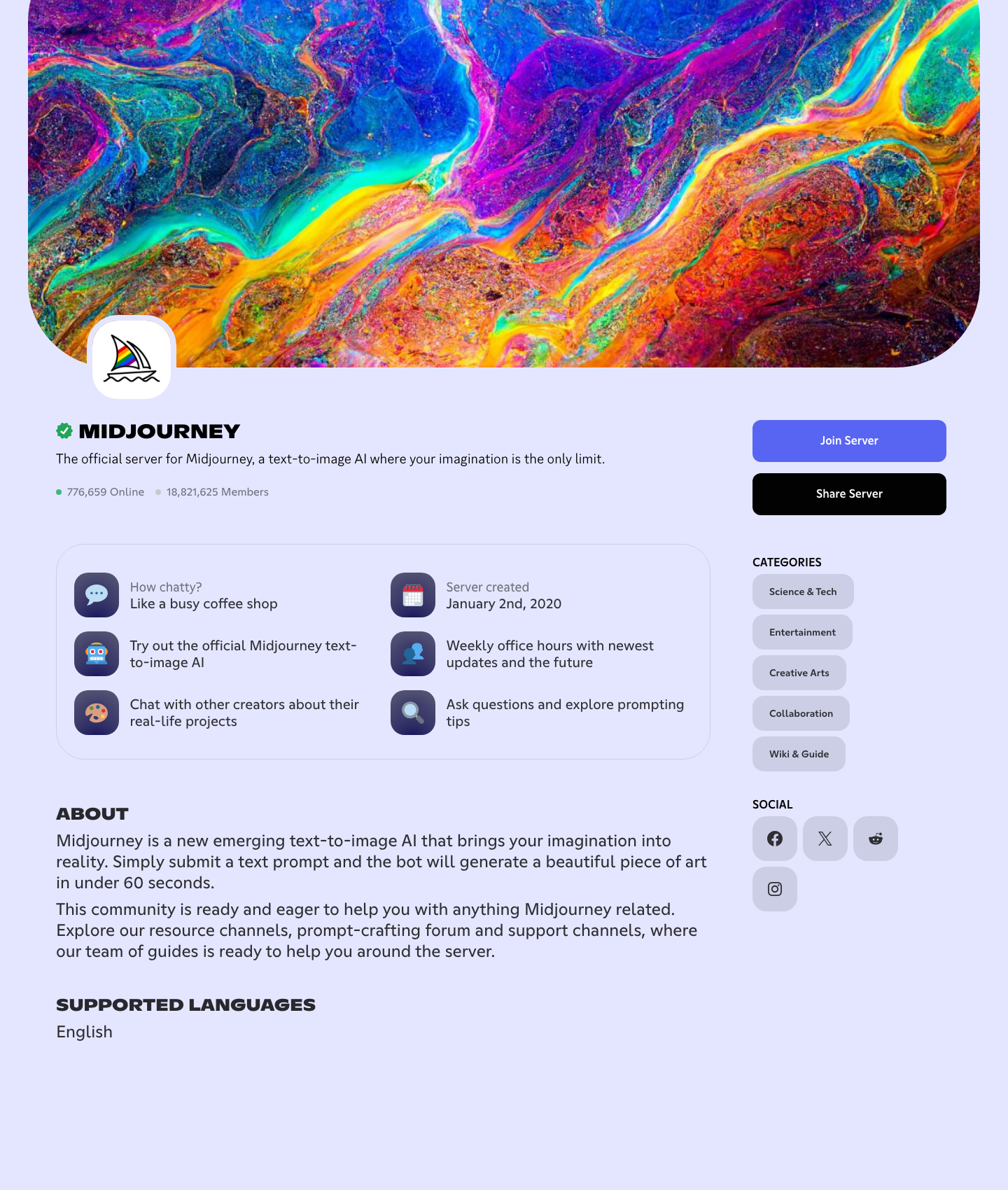
Read the callouts Discord chose to surface: "Chat with other creators about their real-life projects" and "Ask questions and explore prompting tips." Discord itself is telling you the value of this server is the people in it, not the bot.
2. Join, and the server doesn't drop you straight into the main feed.
New members land in a small set of newbie channels first, built for nothing but early, rough experiments. That's a beginner room doing quiet moderation work. It keeps a first-timer's messy attempts from drowning in the volume of the main creative channels, while keeping them just as public and scrollable.
3. Every message in those channels is the same two things stitched together: the prompt someone typed, and the image it made.
Nobody separates input from output. You aren't reading a gallery of finished art, you're reading the raw transcript, the exact words next to the exact result, again and again. That's the entire lesson plan. Scroll for a few minutes and you've seen more real prompt-and-result pairs than most tutorials show you in an hour.
4. The mechanic outlives the reason it started.
Midjourney's web app is now the primary tool for many subscribers, and Discord's old constraints, message-length limits, no proper gallery view, don't apply there. But the public-feed habit is culture now, not a workaround, so it survives the move to a better interface.
The read
Three choices make a feed teach people on its own, and all three disappear the moment you make the same content private.
- Input and output travel together. A gallery of finished results teaches taste. A feed of prompt-plus-result teaches technique. Keep the two glued to each other.
- A beginner room is triage, not gatekeeping. Routing new users to their own space first protects the newcomer, who isn't competing with experts for attention, and protects the feed, which stays legible instead of drowning in first attempts.
- Scale is the proof, not the risk. A public feed gets more useful as it gets bigger, since more examples mean a better-taught newcomer. Most products treat their community's size as a moderation cost. Here it's the entire value proposition.
Steal it
You don't need an image generator to run this. Anything your users produce that another user could learn from, a config, a landing page, a workout, a piece of writing, belongs on a shared feed with the input attached, not buried in a private dashboard only its creator sees. Pick the one artifact your product already generates per user, per session, and give it a public room. Seed it with your own team's genuinely good examples before you have members, and add a beginner-only space the day the main feed starts feeling crowded to a first-timer.
The defense is the harder half. A public feed means someone will paste a prompt they regret, or a config that leaks more than they meant to share, and you can't fully undo that once a thousand people have scrolled past it. Make privacy an explicit, visible choice at the moment of creation, not a setting buried three menus deep, and say plainly what "private" actually covers before people trust it with something they'll wish they'd kept back.
Gotchas
- "Private" rarely means fully private. Midjourney's own Stealth mode, a paid feature, only hides your generations from the midjourney.com website. Anything you generate inside a shared Discord channel stays visible to that channel, stealth mode or not. Say exactly what a privacy toggle does, because users will assume it covers more than it does.
- A quiet feed is worse than no feed. An empty room signals a dead product to the exact newcomer you needed to convert. Seed volume before you promote the feed, not after.
- Moderation becomes a full-time job, not an occasional one. Public means public: spam, off-topic noise, and abuse show up the moment the room is worth entering. Budget for the beginner-room split and real moderation before you open the doors, not after you're overwhelmed.