Prune Before You Publish More
Cutting the thin pages beats writing more of them once volume becomes the target.
Every content team eventually hits the same milestone: a dashboard that says the blog has thousands of live URLs, and a leadership team that reads that number as an asset. In 2026 it stopped being one. Google now scores your page against whatever already ranks for that query, a signal the SEO industry calls Information Gain, and a thin page outside your actual expertise loses that comparison by default. The fix is not a content calendar. It's a delete button.
What to do: Pull every URL on your site with its last-12-months organic sessions and referring-domain count, then sort each page on two axes: is this topic inside what your company actually knows, and is it earning traffic. Anything that is neither gets merged into a stronger page or cut outright and 301-redirected. Run the pass quarterly, not once.
Why it works: Information Gain compares your page to the specialists already ranking for that query, and a generic page outside your expertise cannot out-know a specialist on the specialist's own subject.
Example: HubSpot spent years publishing what amounted to an article for every conceivable marketing keyword, including guides to resignation letters, cover letters, and famous quotes that have nothing to do with its CRM. Search Engine Land tracked a 36% single-month organic drop in December 2024, and by the time Google's March-April 2026 core update finished rolling out, industry trackers were putting HubSpot's cumulative organic blog-traffic loss at an estimated 70 to 80%.
Walk it through
I checked this against HubSpot's own blog in July 2026. Here is exactly what came back.
1. Check whether the poster-child page still exists.
curl -sIL https://blog.hubspot.com/marketing/resignation-letter
HTTP/2 301
location: https://blog.hubspot.com/marketing/hubspot-blog-content-audit

HTTP/2 200
That URL used to hold a thin, generic guide to writing a resignation letter, a page with no real connection to HubSpot's CRM, published purely to catch a keyword with volume. It does not resolve anymore. It 301s straight into a different post.
2. Read where it lands now.
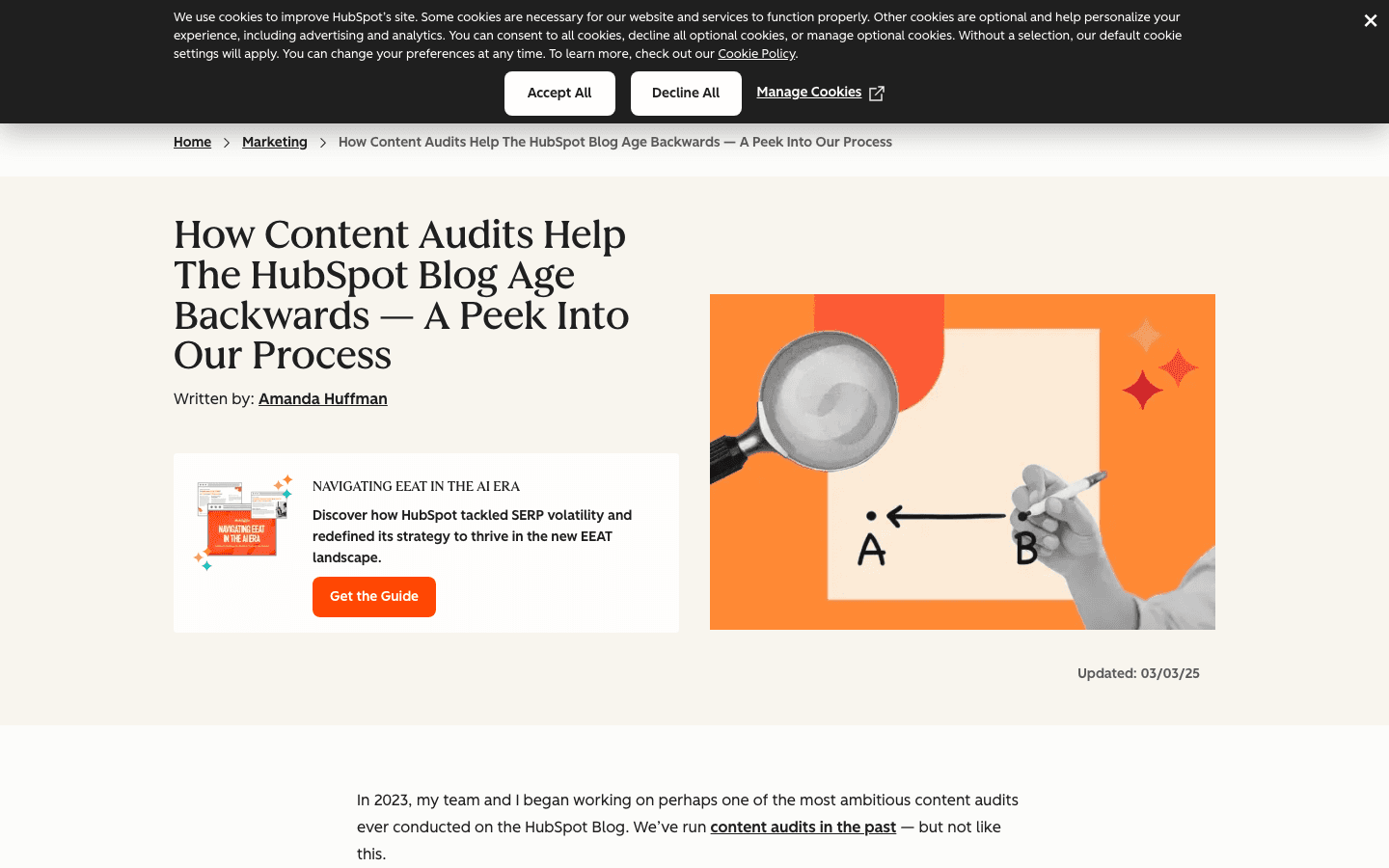
The off-topic guide that helped inflate HubSpot's page count now points straight at HubSpot's own account of the audit built to cut pages exactly like it. The company that created the problem also published the most detailed public playbook for undoing it.
3. Read the playbook, and notice what it left unfinished.
HubSpot's "De-Age the Blog" project started in 2023 against 13,822 live blog pages. Phase one alone audited the oldest 4,000 URLs and sorted every one into four buckets: Keep, Optimize, Recycle, or Prune. The result: 2,888 URLs, 72.2% of the batch, got flagged to prune. Only 23.78% had enough organic potential left to be worth optimizing or rewriting. Refreshing just 76 of the salvageable posts produced a 458% cumulative traffic increase within six months.
But that 2023 pass graded pages on freshness: outdated, stale, or current. It never asked whether the topic belonged to HubSpot in the first place. A resignation-letter guide can be rewritten until it is perfectly fresh and still have nothing to do with CRM software. That is the gap the 2026 core update closed. A freshness audit catches stale pages. It does not catch pages that were never yours to write, and closing that second gap is what actually cost HubSpot the traffic.
The read
- Freshness is not the same test as fit. A page can pass every content-audit checklist and still sit outside your expertise, and that is the exact page Information Gain now targets.
- The prune ratio is the tell. HubSpot's own audit flagged nearly three out of every four old posts for removal. If your first pass flags far fewer than that, you probably have not looked hard enough yet.
- Redirect the survivors, do not just delete. The 458% traffic increase came from refreshing 76 posts worth keeping, not from the deletions. Pruning clears the room. A small number of strong pages is what fills it back up.
Steal it
Export every URL on your site and join it against 12 months of organic sessions and referring domains, then sort into HubSpot's four buckets. Keep anything on-topic and earning traffic. Optimize anything on-topic but stale. Recycle a URL that has real backlinks but content beyond saving, new copy on the same address. Prune everything else and 301 it into the closest page that is actually about your product. Do this every quarter, because the backlog rebuilds itself the moment nobody owns it.
The defense is the same audit run in reverse. Before you prune a page, check whether it is genuinely on-topic for your company even if it does not look like your core product on the surface, adjacent expertise you can defend beats generic advice anyone could have written. And do not confuse low current traffic with zero value. A page carrying real backlinks is still earning you authority even at low direct traffic, so redirect it into a living page rather than deleting it, or you hand that authority straight to whoever ranks for the keyword next.
Gotchas
- Deleting without redirecting throws away the one asset the page had. A prune candidate with backlinks should 301 into a living page, not 404. A dead link is authority you already earned, set on fire for no reason.
- Traffic dips before it recovers. Crawl budget and rankings take time to reallocate after a prune. Do not panic and restore pages after two weeks. HubSpot's own numbers took six months to show up.
- Do not chase Information Gain by faking original research on every page you keep. Most companies cannot produce proprietary data at that scale, and forcing it reads as fake because it usually is. Cutting the pages you cannot defend is the realistic version of this play. Out-researching every competitor on every remaining topic is not.