Give Beats Get
Reframe the identical reward and referral volume jumps for free.
Airbnb ran the cleanest test in this book. Same $25 credit, same friend, same button, same mechanic. The only thing that moved was which word came first, give or get, and the difference showed up in how many people were willing to send the invite at all. It cost nothing to run and nothing to ship. A decade later, most teams still default to the losing version, because nobody goes back and rereads a ten-year-old test.
What to do: Take your existing referral copy and rewrite the headline so your friend's benefit is the first thing they read and your own reward comes second. Freeze the dollar amount, the mechanic, and every other variable. Ship it as a straight 50/50 split against your current copy and count invites sent, not just redemptions.
Why it works: Give-first reads as doing a friend a favor. Get-first reads as asking them for one, and people share favors far more freely than they share requests.
Example: Airbnb tested this directly on its referral emails. One version led with self-interest, "earn $25 for inviting a friend." The other led with generosity, "give your friends $25 to travel." Same $25, same program, only the framing changed, and Airbnb's own engineering team reported the altruistic version won, globally, across every market they checked.
Walk it through
I pulled Airbnb's live referral page in July 2026 to see where the company landed a decade after running the test that made this chapter possible.
1. Open the current page.
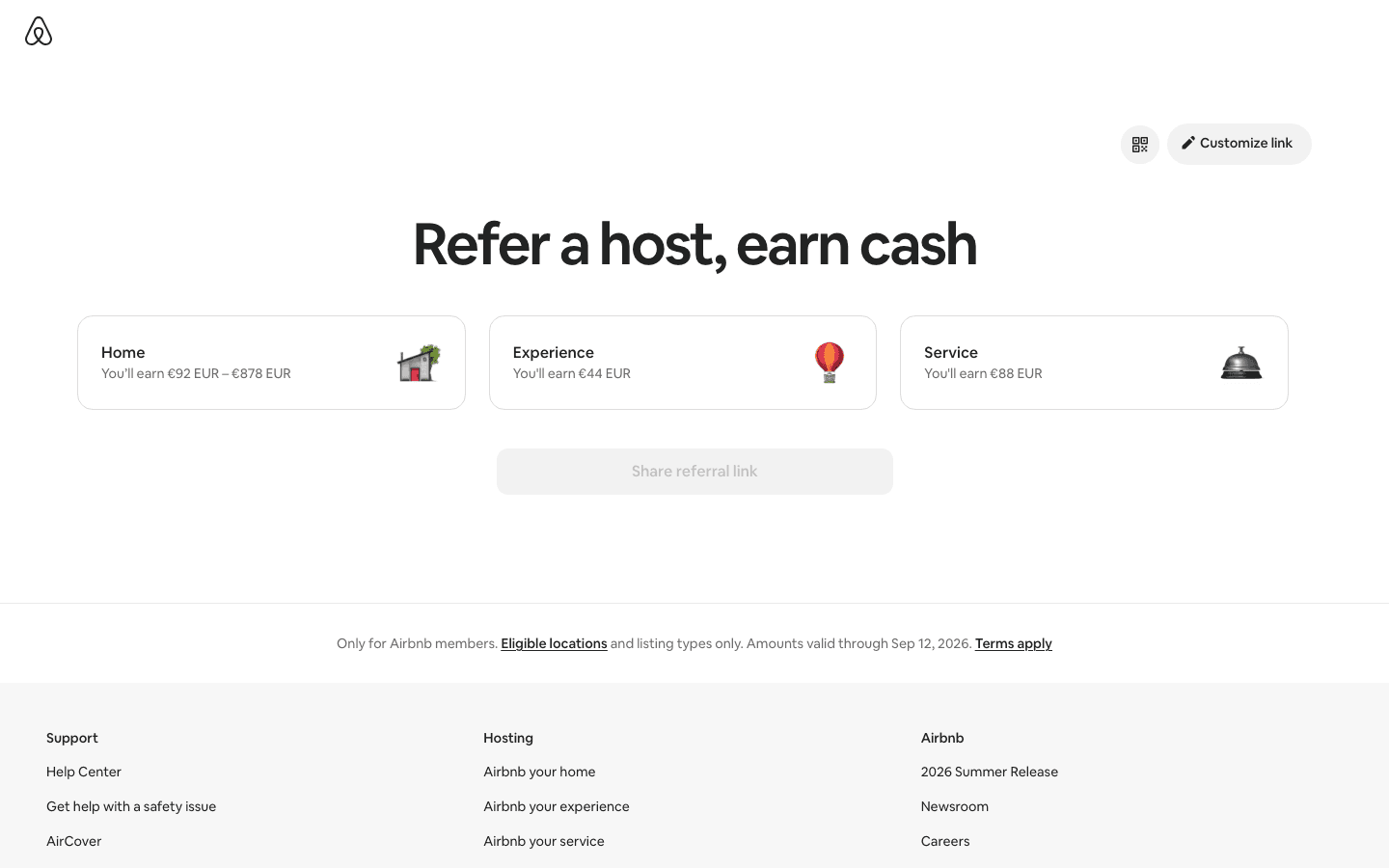
airbnb.com/refer headlines with "Refer a host, earn cash." That is get-first, the exact framing Airbnb's own research says loses. This is not the 2014 guest-to-guest test, it's a newer host-referral program, almost certainly built by a different team years later, and it still shipped with earn-first on the headline. That is how deep the default runs. Even inside the company that proved give-first wins, a fresh team building a fresh program reached for get-first anyway.
2. Go find your own referral copy and read it cold.
Pull up your referral email, your in-app share sheet, your referral landing page. Read only the first few words of the headline. If those words describe what the sharer receives, "earn," "get," "you'll receive," you are shipping the version Airbnb's own data says loses.
3. Flip the order. Change nothing else.
Same dollar figure, same button, same recipient. Move the friend's benefit to the front of the sentence and your own reward to the back. "Give a friend $20, get $20 when they book" instead of "Get $20 when a friend books, they get $20 too."
4. Split traffic 50/50 and count sends, not conversions.
The metric that moves is invites sent per visitor who reaches the share screen, not the redemption rate of the friend who receives it. Give-first changes whether people are willing to share at all, not what happens after they do.
The read
- The reward never changed, only the sentence. Same $25, same mechanic, same recipient. The entire lift comes from which party the sentence serves first.
- Volume is the metric, not conversion. The win shows up in how many people are willing to hit share, not in how the friend who receives the link behaves afterward.
- The default outlives the data. A decade after Airbnb published the result, Airbnb's own newer referral surface still ships get-first. Knowing the answer and shipping the answer are two different disciplines.
Steal it
Run this on whatever you already have. Pull the current headline on your referral email, share sheet, or landing page, and write one alternate version with the sentence order reversed and nothing else touched, same number, same mechanic, same design. Split traffic and measure invites sent per visitor who reaches the share step. If you don't have a referral program at all, this is also the cheapest possible first version to ship. One rewritten sentence, no new reward tier, no new infrastructure.
Defend the win once you have it. Give-first tends to raise raw send volume, which is exactly the number a growth-hungry teammate will want to keep pushing on next quarter. Gate the actual payout to activation, a completed booking, a paid conversion, a real session, not the send itself, so a louder top of funnel doesn't quietly turn into a more expensive one.
Gotchas
- The number has to stay identical. Change the dollar amount along with the wording and you've run a price test, not a framing test, and you won't know which one moved the needle.
- Sends are not the same as quality. More invites is not automatically more revenue. Track what happens after the friend redeems, not just how many friends receive the message.
- This isn't universal law. Airbnb's result held on a marketplace built on trust between strangers, where generosity is already the product's whole pitch. A cashback app or a trading platform may find its users respond differently to blunt self-interest. Test the flip on your own audience before you assume the direction of the effect.