Delete The Friction, Don't Shrink It
Audit the action against Fogg's six friction levers, then remove the step instead of just making it easier.
Nir Eyal's Hooked made pull-to-refresh the textbook friction fix. Twitter took the multi-tap "reload the feed" action and collapsed it into one swipe, and engagement went up because the action got easier. For a decade that was the whole playbook: fewer fields, fewer clicks, fewer taps. Shrink the step. BJ Fogg's Behavior Model gives that instinct six named reasons an action feels hard in the first place, and almost everyone uses it to make those six reasons smaller. The 2026 move is to use the same six levers to ask a blunter question: does the step need to exist at all.
What to do: Write your worst-converting action down in one sentence, then score it 1 to 5 on each of Fogg's six levers: time, money, physical effort, mental effort, social deviance, and routine fit. Wherever the score is highest, don't redesign the step to be faster. Ask if it can be automated away and the outcome delivered with the user doing nothing.
Why it works: A step you shrink still has to happen for every single user. A step you delete doesn't happen at all, for any of them.
Example: Intercom publishes named, per-customer resolution numbers for its Fin AI agent instead of one blended average. Linktree's Dane Burgess reports Fin "resolving 42% of conversations" within six days of turning it on. Robin's support team reports a 50% resolution rate on a separate page of Intercom's own site. Both figures are live on intercom.com today, attached to a real name and title, not an anonymous case study.
Walk it through
I ran this against a support ticket, the step Intercom bet an entire product on.
1. Write the action down, then score it against Fogg's six levers.
"A user asks a support question and waits for a resolution."
- Time: high. Users wait minutes to hours for a human.
- Money: high. Every conversation costs agent time.
- Physical effort: low. It's typing a message.
- Mental effort: high. Someone has to read, search, and compose an answer.
- Social deviance: none. Asking a question is normal behavior.
- Routine fit: none. Nothing disruptive about it.
Two levers, time and mental effort, carry almost the whole score. That tells you exactly where to aim.
2. Ask the deletion question, not the speed question.
The old move is to make the human faster: canned replies, better internal search, tighter SLAs. That's shrinking. The newer move is to ask whether the step needs a human moment at all. That's the question Intercom built Fin to answer.
3. Check whether the deletion claim is real, not a vendor number pulled from thin air.
Intercom names the customer behind each number instead of hiding behind a single blended average, so you can go verify it yourself. Here's Linktree's, live on Intercom's site today.
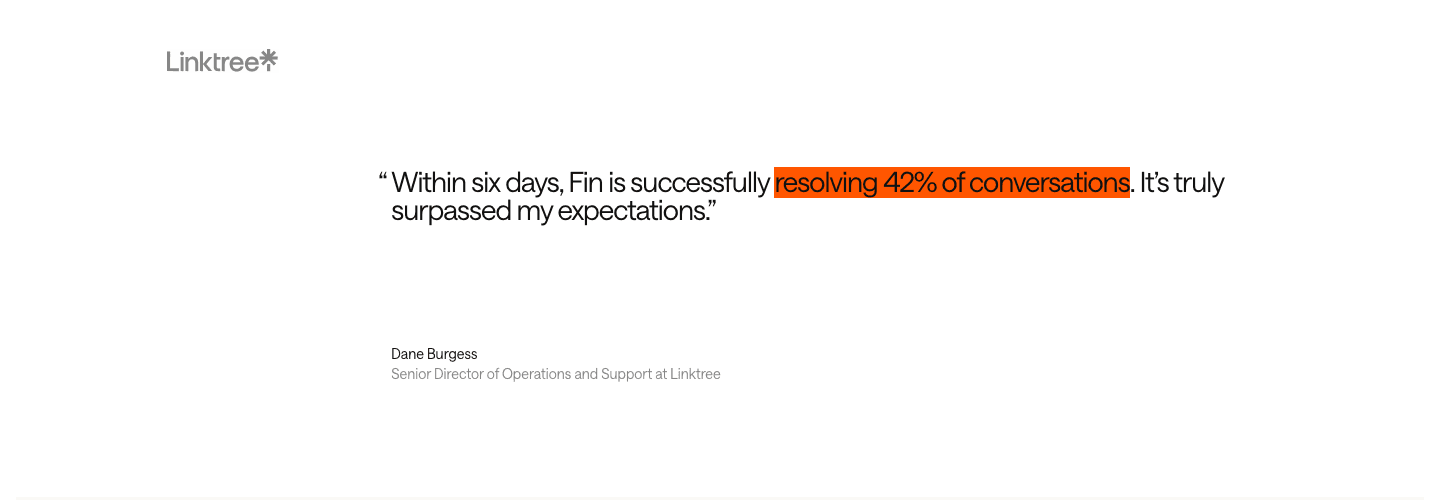
Neither Linktree's 42% nor Robin's 50% is 100%. Both are a real slice of a real support queue that no longer needs a human, with a name and a job title attached to the claim.
4. Size what deletion is worth before you build anything.
Take your own monthly conversation volume and multiply by the low end of that range, 42%. That's roughly how many tickets could close with zero agent time if you shipped the same kind of deletion, not a faster version of the step you already have.
The read
- Fogg's six levers are a diagnostic, not a checklist to clear. Score the action honestly before you open a design file, or you'll spend a sprint polishing the wrong friction.
- Time and mental effort are the two levers automation actually kills. Physical effort and money usually need a redesign or a price change instead. Social deviance and routine fit need better framing, not a bot.
- Deletion has a ceiling shrinking can never reach. A step that's 80% faster is still a step every user has to clear. A step that's gone is gone for all of them.
Steal it
Take your worst-converting step this week and run the six-lever scorecard on paper. Five minutes, no meeting required. Wherever your two highest scores land, that's your deletion candidate, not your redesign candidate. Ask the blunt question: what would it take for this step to happen with the user doing nothing at all? Sometimes the honest answer is you can't build that yet. Fine, shrink it in the meantime. But ask the deletion question first, every time, before you default to a shorter form or a faster button.
Defend it when someone says deletion is too risky. It usually is, at first. Fin didn't launch at 100% resolution and your first attempt won't either. The published numbers here, 42% to 50%, are partial deletion, not full automation, and that's the honest place to start. Automate the slice you can stand behind, keep a human on the rest, and let the resolved share climb as your data improves. Partial deletion beats full shrinking from day one, because the users who land in that slice never hit the friction again.
Gotchas
- A wrong answer delivered instantly is worse than a slow right one. Don't delete a step until whatever replaces it is trustworthy enough to run silent. An agent that confidently resolves a ticket wrong costs you more than the human it replaced.
- Published resolution rates are the customers a vendor chose to showcase. Your first deployment, on a messier knowledge base, will likely land under 42%, not over it. Budget for that gap before you promise it to your team.
- Not every lever can be automated away. Social deviance and routine fit don't respond to AI or code. They respond to better onboarding and better copy. Know which lever you're actually fighting before you reach for automation.