Win Bing, not just Google
ChatGPT search runs on Bing, so your Bing rank decides if it finds you.
What to do: Stop treating Bing as dead. Verify your site in Bing Webmaster Tools and make sure you actually rank there, not only on Google.
Why it works: ChatGPT's search runs on Bing's index, so your Bing rank quietly decides whether ChatGPT can even find you.
Example: Seer found 87% of ChatGPT and SearchGPT citations match Bing's top organic results, versus 56% for Google.
Walk it through
I ran one real buyer query, "best project management software," through Bing and then through Perplexity in July 2026, to see whether the same domains show up in both. Here's exactly what came back.
1. Run the query on Bing itself and read who actually ranks.
# open in a real browser, not curl: Bing bot-walls both curl and headless Chrome
https://www.bing.com/search?q=best+project+management+software&mkt=en-US
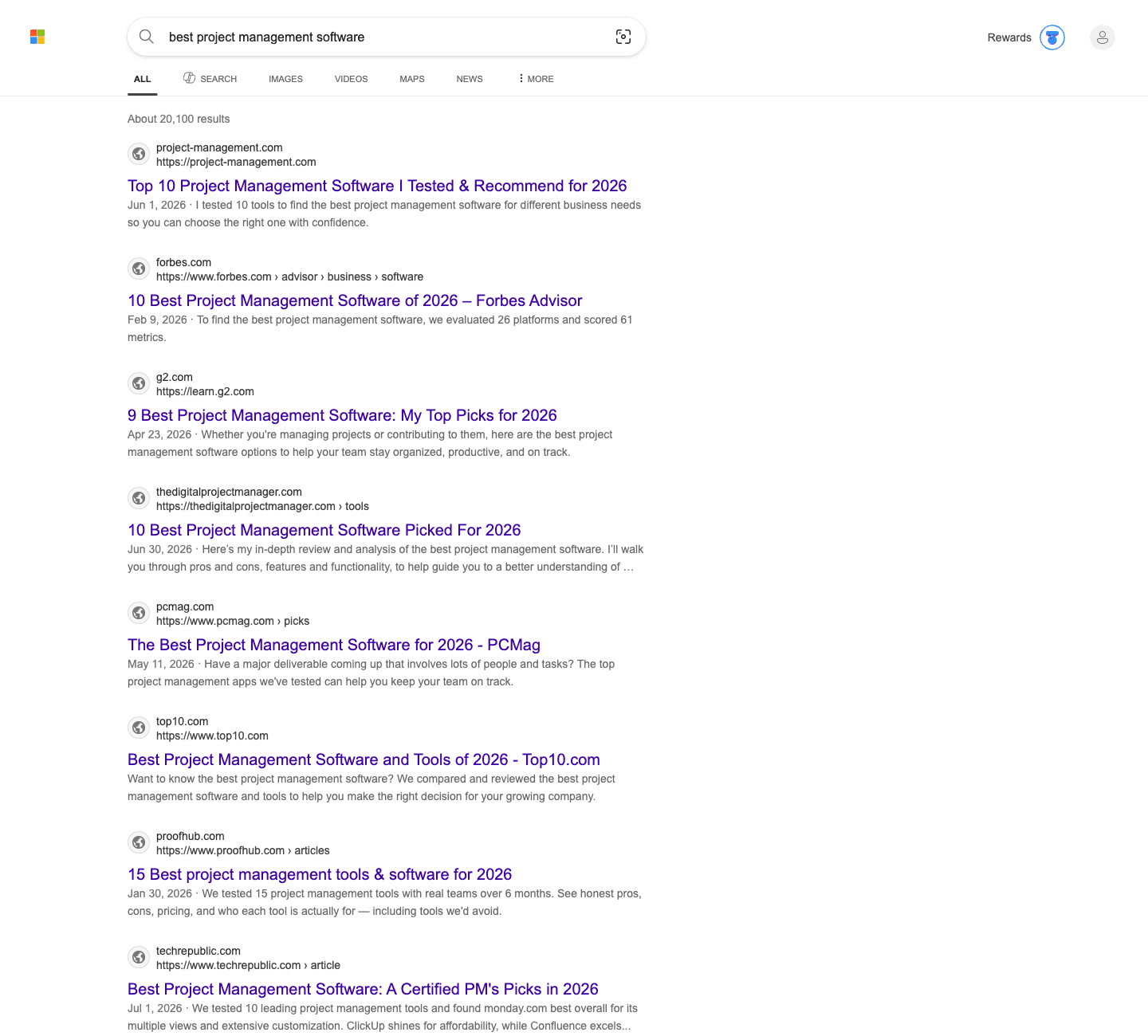
Eight organic slots, eight review sites. project-management.com leads, then Forbes Advisor, G2, thedigitalprojectmanager.com, PCMag, Top10.com, ProofHub, TechRepublic. Not one vendor homepage cracked page one. Whatever "winning Bing" means for this query, it means owning a listicle, not ranking your own product page.
2. Run the same buyer intent through Perplexity, whose search sits on Bing's index.
https://www.perplexity.ai/search?q=best+project+management+software+for+small+teams
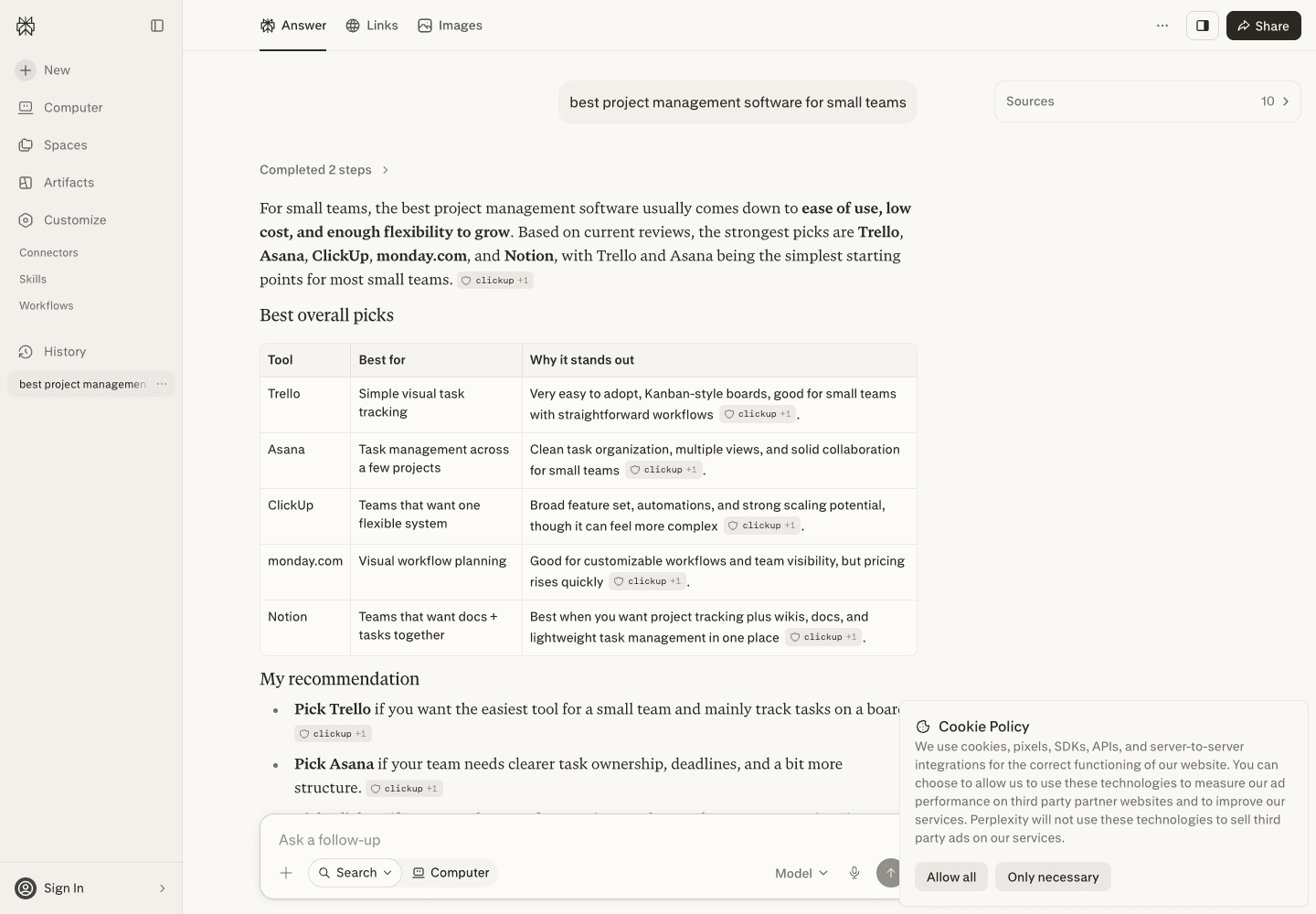
Perplexity answers with a table: Trello, Asana, ClickUp, monday.com, Notion, each row footnoted back to a source. It read 10 sources to write those five lines.
3. Open the Sources panel and match the domains against Bing's page one.
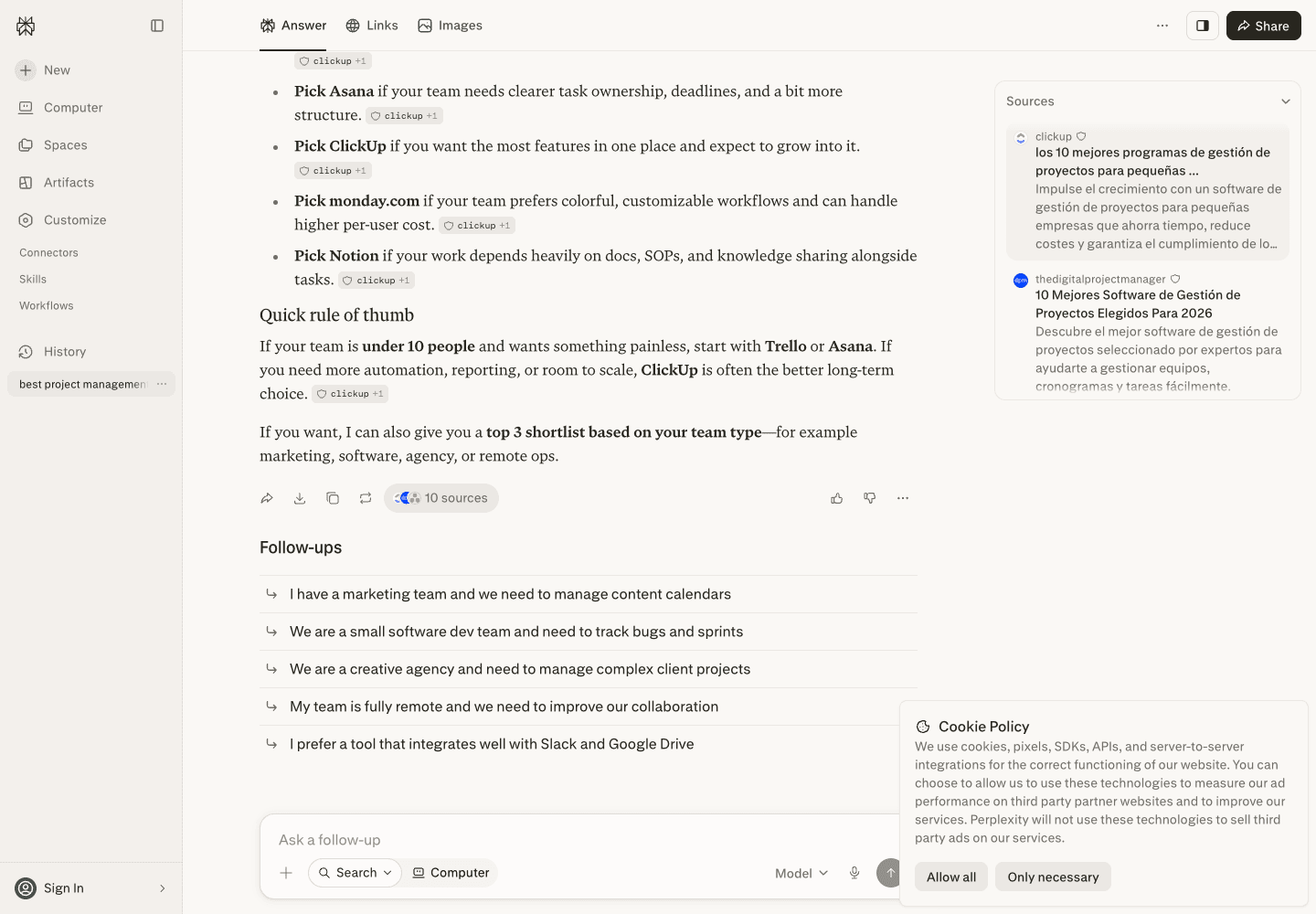
thedigitalprojectmanager.com is right there in Perplexity's source list, the identical domain that sat at rank 4 on Bing's organic results a minute earlier. Same buyer question, two different products, one shared source. That's the Seer stat happening in front of you on a single query.
4. Confirm you're actually indexed, not just guessing from the SERP.
Screenshot: Bing Webmaster Tools (bing.com/webmasters), your property's Site Explorer or URL Inspection tab, showing "Discovered" or "Indexed" status. This step needs a Microsoft login, so there's nothing public to curl or screenshot headlessly. Verify your domain, submit your sitemap, and check back in a week.
The read
- Bing's page one for a buying query is a stack of review sites, not vendors. If you're not one of those eight domains and you don't own a listicle yourself, you're invisible to whatever reads that page next, human or model.
- The domain overlap is the mechanism, not a coincidence. thedigitalprojectmanager.com ranking on Bing and getting cited by Perplexity for the same question, minutes apart, is what "87% of citations match Bing's top results" looks like at n=1. Run it again next month and watch which domain holds both spots.
- Perplexity read 10 sources to answer one question. Bing's top 8 supplied some of them, not all. Ranking there raises your odds of being one of the 10, it doesn't guarantee it.
Steal it
Run this for your own buyer query, the exact phrase a prospect types before they've heard of you. Pin the market first: my first pull, with no &mkt=en-US, came back priced in euros with Spanish ad copy for the identical query, because Bing reads your request's exit IP, not your brand's home market. Pin it, then read the top 8 like a target list. Every listicle sitting there is a site worth pitching, guest-posting, or getting a review on, because that's the shelf a model pulls from.
If you're not on that shelf yet, the fastest lever isn't your own SEO, it's outreach to whoever already ranks. Getting thedigitalprojectmanager.com or G2 to add you moves you into the citation pool this month. Getting your own domain to outrank Forbes for "best [category] software" takes considerably longer. Do both, but start with the one that isn't a multi-year project.
Gotchas
- Bing bot-walls automated checks. Scripting this same query twice in one afternoon, I got a clean render once and a literal "Verify you are human" challenge the next time. Don't build a scraper around this. Check it by hand, occasionally, in a real browser.
- Unset market parameters make your rank check meaningless. No
&mkt=en-USpin, and you're reading someone else's country's results, not yours. - One query is a demonstration, not a trend line. Seer's 87% figure comes from a real study across many queries. What you just watched is that mechanism on a single example, not a re-run of their methodology, so treat it as a "yes, this happens," not a stat to cite on its own.