Steal The Popular Question
Write the brief the market already voted for, then publish it on your site.
Most content calendars start with a blank page and a guess. Quora is the opposite. Someone already asked the question in public, thousands of people already followed it, and Google already sends search traffic to the thread. That is a demand signal, not a community to spam. Take the question that already has proof of popularity, write the complete answer on your own domain, and only then leave a real answer on Quora that points back.
What to do: Find a Quora question in your category with a large follower count or a page that already ranks in Google. Treat the question title as the headline. Write the full answer on your blog first. Then post a useful, non-promotional version on Quora with one link in the bio or at the end, not in the first line.
Why it works: You stop inventing topics. You write what the market already proved people want to read.
Example: Si Quan Ong, then an SEO educator at Ahrefs, answered at least five Quora questions a week on Ahrefs, SEO, and digital marketing from July 2018. Ahrefs later published the result on its own blog: roughly one million views generated, plus the method for picking questions that still get search traffic. The post is still live.
Walk it through
I opened Ahrefs' own write-up in September 2026 to take the numbers from the company that ran the play, not from a roundup quoting them.
1. Read the claim on their domain.
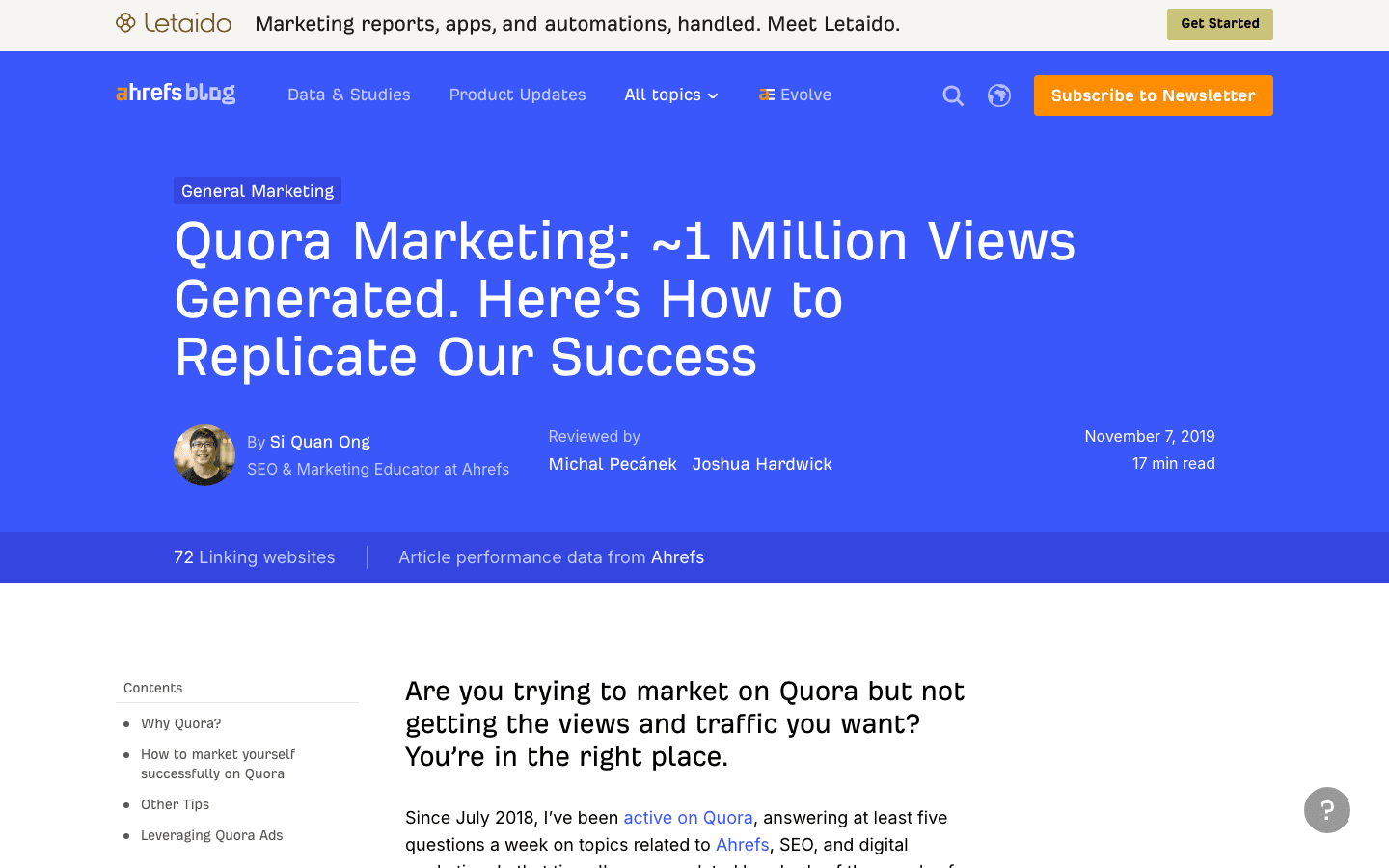
The headline is the result. The first paragraph is the cadence: five answers a week, on topics they already knew. That is not "be everywhere on Quora." That is a weekly quota against questions they could answer from work they had already done.
2. Steal the filter, not the volume.
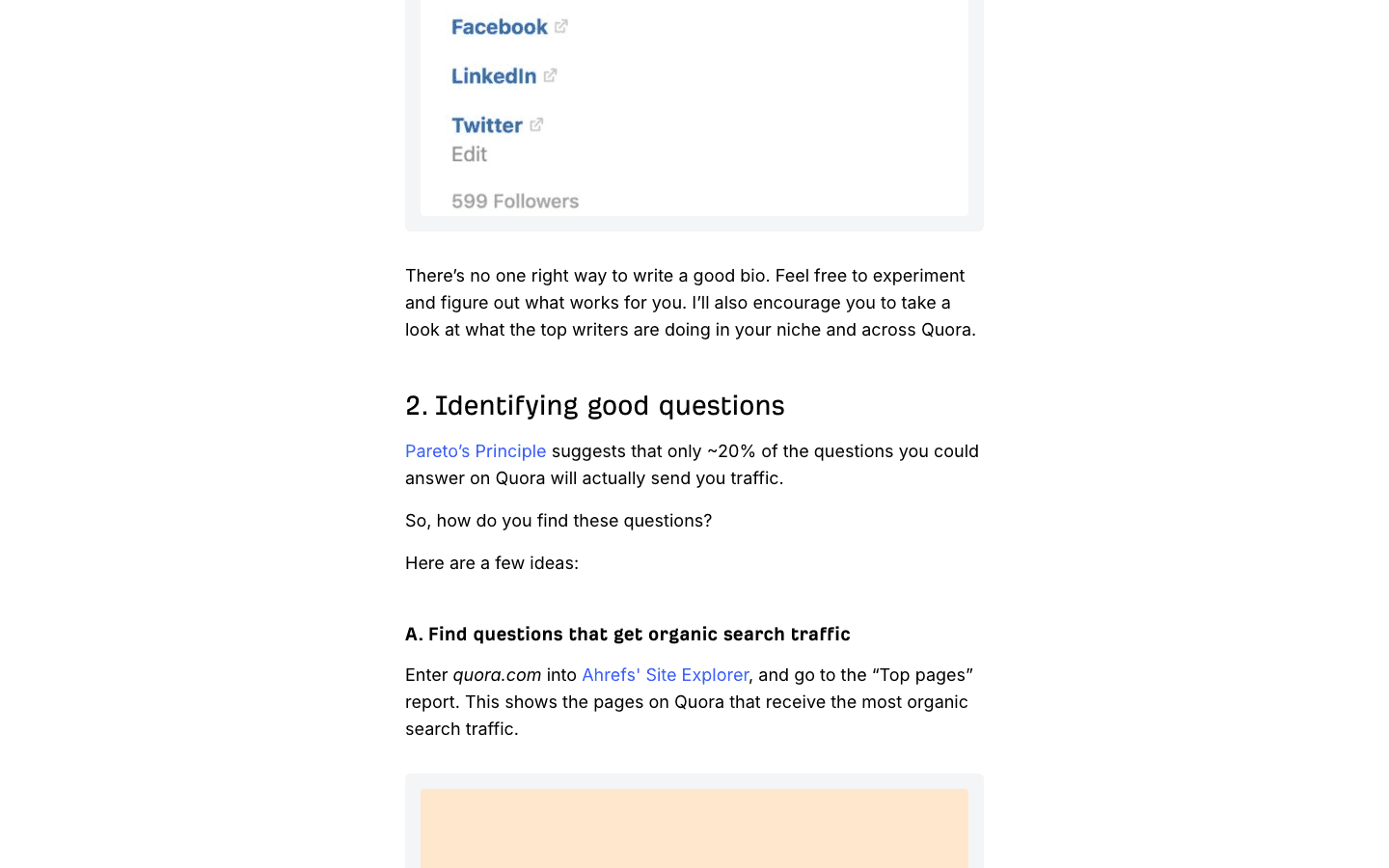
He puts a number on the waste. Pareto, in his words: only about 20% of the questions you could answer will actually send traffic. The filter under that heading is specific. Put quora.com into Ahrefs Site Explorer, open Top pages, and include a word your buyer already uses. That list is questions Google is already sending people to.
Earlier in the same post he estimates Quora ranks for about 65 million keywords and gets about 90 million search visits a month. Those figures are Ahrefs' own 2019 estimates. Treat them as the reason the platform mattered to him, not as a 2026 census.
Si Quan also says he reused Ahrefs articles as Quora answers. The blog post on how long it takes to rank on Google became a Quora answer on the same question. One piece of thinking, two surfaces.
3. Run the same filter on your category today.
Search site:quora.com plus a buyer question you already get in sales calls, "best [category] for [audience]," "[competitor] alternative," "is [tool] worth it." Open the threads that already have answers. If the top answer is thin, outdated, or written by someone who never used the product, that is your brief. Write the complete version on your site first, with current screenshots and a number you can defend. Then answer on Quora like a useful stranger, not like a landing page.
The read
- The question is the keyword research. Follower count and Google traffic are votes. A blank editorial calendar is a guess. So is asking an assistant to invent this week's post.
- Your site gets the long answer. Quora gets a real answer that can stand alone. The link is a courtesy, not the first sentence.
- Five a week beat fifty once. Ahrefs' number came from a quota they could keep, not a weekend binge.
Steal it
Pull the questions your buyers already type, from calls, support, or the Site Explorer list, and hand them to the assistant with the posts you have already published. Have it draft the long answer for the best one and short Quora versions for the other four, the way Si Quan reused Ahrefs articles. You check every claim. You post the Quora answers yourself. The assistant does not get the account. Put the product in the bio, not in the hook.
In 2026 the same questions also get quoted by answer engines. A good Quora answer is now a citation candidate, the same way a good Reddit thread is. That is extra distribution, not a reason to astroturf.
Gotchas
- A million views is not a million visits to ahrefs.com. Si Quan is clear that promoted-answer clicks often meant "click More," not "click through to the site." Judge this by referral traffic and pipeline, not by Quora's view counter.
- Jason Lemkin's 53 million views, quoted in the same post, is a different game. He answered two or three questions a day for years. Do not copy the celebrity cadence. Copy the weekly quota.
- Quora will bury a sales pitch. If the first paragraph names your product, you already lost the thread. Answer the question. Let the bio do the rest.