Feature The Room
Ask twenty people a sharp question, then let them announce they are in the piece.
A solo essay has one reason to be shared: the reader liked it. A roundup has twenty. Each person you feature has a page that now says their name, and a reason to tell their audience. That is the deal, and it only works if the question is good enough that being included is a compliment.
What to do: Write one question a practitioner would be proud to answer in four sentences. Invite 30 people you actually read. Publish with 10 to 20 replies, each with a name, a face, and a link they chose. Mail every contributor the day it goes live, with a suggested post they can edit. Do not feature 100 names so thinly that nobody can find themselves.
Why it works: You turned your distribution into their vanity, and their vanity into your traffic.
Example: Jon Morrow's Smart Blogger guide, "The Ultimate Guide to Creating an Expert Roundup Post That Gets 1000s of Shares," is still up. Inside it he describes his own roundup on blog promotion. More than 40 experts answered. The post drew over 4,000 social shares, was BuzzSumo's most-shared post of the week for "blog promotion," and started relationships he later called friendships. He also cites Richard Marriott's "50 Experts Reveal How to Promote Your Blog with Just 3 Tools" as the tighter-constraint version of the same play.
Walk it through
I opened the guide in September 2026 and scrolled to the case study. The email popup on the hero is noise. The proof is the paragraph under it.
1. Take the result from the post that is still teaching the method.
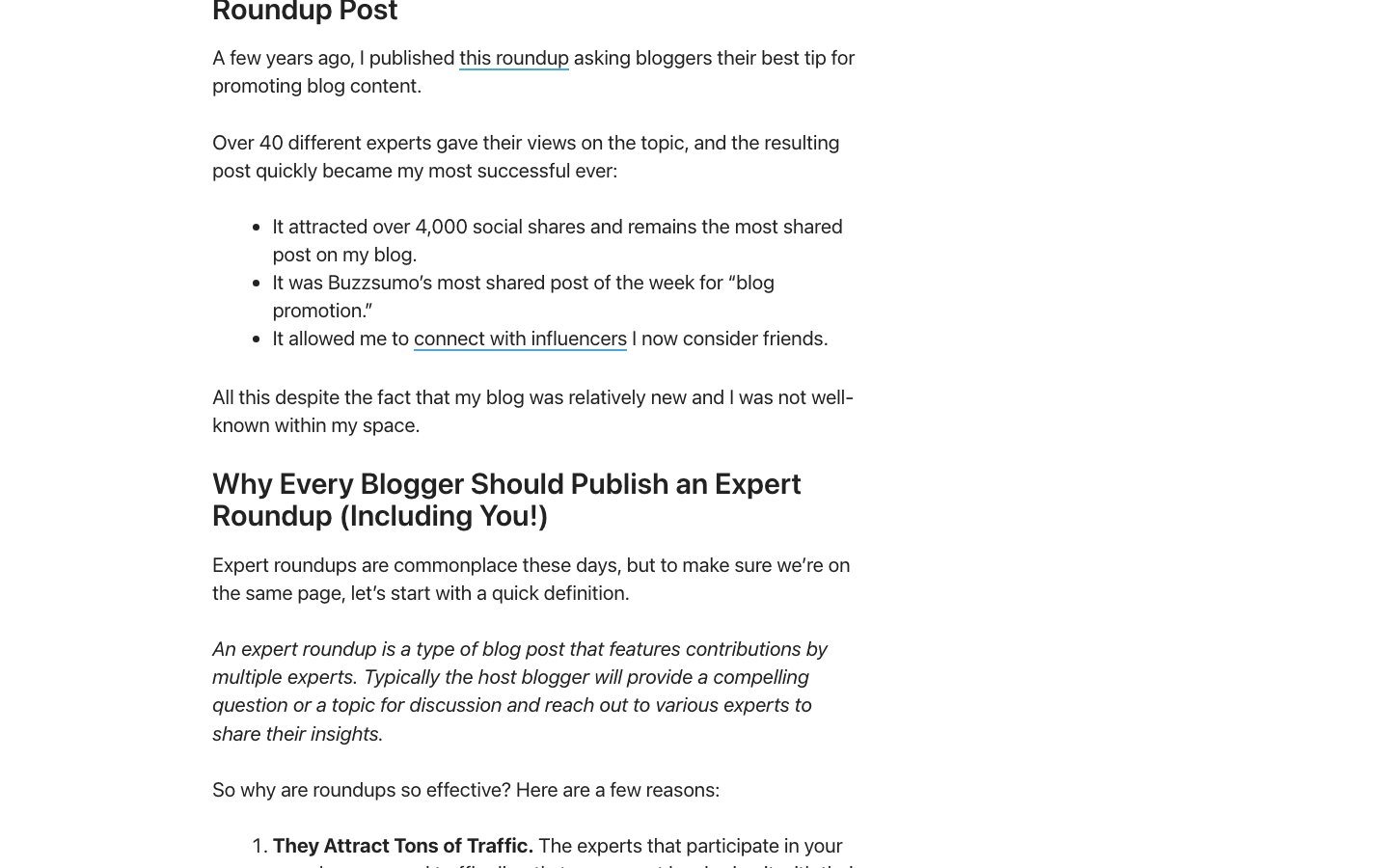
Over 40 named replies. 4,000 shares. The most shared post on a blog Morrow says was still relatively new. The mechanic is visible in the bullets: each expert had a reason to send the URL, and the URL made them look useful.
2. Tighten the ask so it is not a directory.
Fifty names turn the page into a phone book. Ten to twenty replies, each one a real paragraph, is the format that still feels like a feature. Marriott's twist, "with just 3 tools," is how you keep a larger cast from pasting the same answer.
The question has to be specific. "Any growth tips?" will get sludge. "What is the one distribution habit you kept after everything else stopped working?" will get a sentence people want their name on.
3. Make the share the last production step.
The day before publish, tell contributors the count. The hour of publish, send each person their anchor link and a draft post they can edit. A week later, send a short note with any number you can defend. Shares. Signups. Not impressions. That is how a one-off becomes a room you can ask again.
A bloated version of this play is "feature 100 experts, then sell the ebook." Ship the roundup first. If the room is real, the compilation in Syndicate The Short Book writes itself.
The read
- The question is the product. Famous names cannot save a mushy prompt.
- Fewer, deeper features beat a hundred logos. People share a paragraph they said, not a surname in a grid.
- The follow-up email is the campaign. Publishing is half of a roundup.
Steal it
Have the assistant draft one sharp question and ten invites, each one citing a specific piece that person actually wrote. You send the invites. You do not let it send them, and you do not print a reply it invented. Close the form at 12 good answers and publish. You do not need 4,000 shares. You need 12 people who will each tell their own list.
Gotchas
- 4,000 shares is a historical number on a blogging-advice site. It proves the mechanic. It is not your forecast.
- Buying quotes, or featuring people who never replied, is how you get publicly corrected. Only print what they sent.
- A roundup of the same twelve LinkedIn celebrities everyone else features will not travel. Morrow's useful variant was mixing in people from adjacent fields so new audiences showed up.