Write The Shoulder Topic
Publish the adjacent guide, not another page about your product.
Product pages convert people who already want the product. Shoulder topics convert people who want the job the product sits next to. An Instagram agency writes "how Instagram works," not "hire us." An SEO company writes "how to market on Quora," not "buy a crawler." The product becomes the obvious next click after you have been useful on the neighboring problem.
What to do: List the five questions your buyer asks before they are ready for a demo. Write the best public answer to one of them, with no pricing table and no feature grid. Distribute that piece harder than you distribute the product page. Remix it only after it works.
Why it works: People share useful adjacent teaching. They do not share your positioning statement.
Example: Ross Simmonds, founder of Foundation, took an ultimate guide he wrote about Instagram and turned it into a SlideShare deck. In his August 6, 2023 essay "Content Marketing Remix," still on rosssimmonds.com, he says that deck generated hundreds of thousands of views and dollars, then became a YouTube video, a PDF, and a course. The seed was not a page titled "Foundation's services." It was a shoulder guide about a platform his buyers already cared about.
Walk it through
I opened Ross's own remix essay, the piece where he shows one Instagram guide becoming a deck, a video, a PDF, and a course.
1. Get the seed story from him, not from a LinkedIn recap.
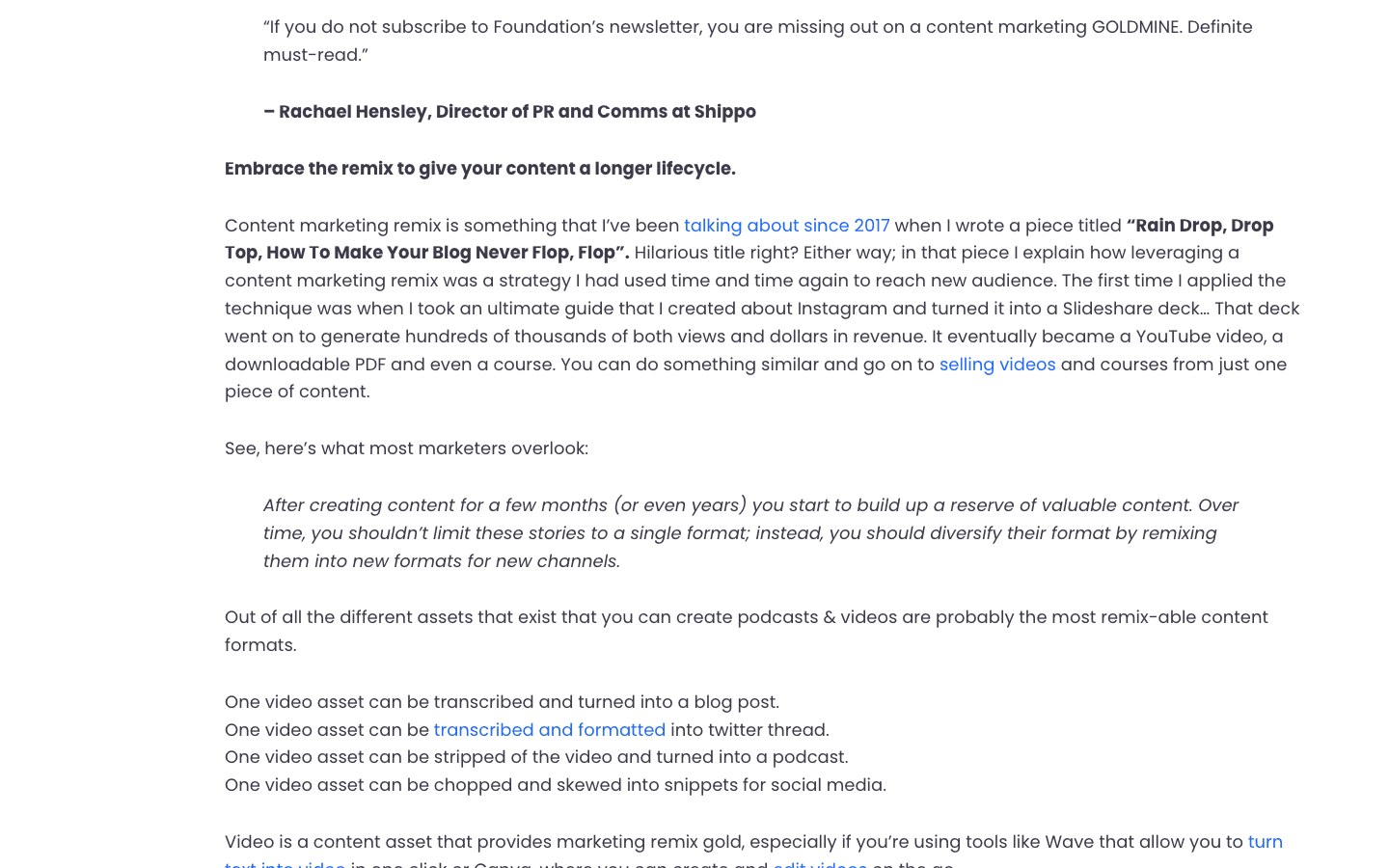
The Instagram guide is the shoulder. SlideShare, YouTube, PDF, and the course are the remix. The essay is dated August 6, 2023, and the paragraph is still on the page. The 1-3-5 Repurposing Method is how you cut a winning piece into formats. This chapter is how you choose a piece that can win without saying the product name.
2. Separate shoulder from product copy.
A product page answers "what is this and what does it cost." A shoulder piece answers "how does this world work." Ross's buyers lived on Instagram. The guide taught the world. Foundation became the firm you call when you want that world distributed. Ahrefs' Quora marketing post, in Steal The Popular Question, is the same shape: a guide about a channel, written by a company that sells a tool for channels.
3. Pick one shoulder this week.
If you sell onboarding software, the shoulder is "how to cut time-to-value," not "our onboarding suite." If you sell email APIs, the shoulder is "why your forgot-password mail is going to spam." Write that. Publish it. Do not mention the plan names until the last paragraph, if at all.
The read
- Shoulder topics are how you enter a feed that would skip an ad. The reader opted into the problem, not into you.
- One good shoulder piece is a year's remix fuel. Ross did not need a new idea for the deck, the video, the PDF, or the course.
- If the piece only works with the product name in the title, it is not a shoulder piece. It is a landing page in costume.
Steal it
Hand the assistant the last ten customer calls, or the Search Console queries that are not your brand, and have it propose one shoulder guide. You pick the question. It drafts. You cut every plan name out of the title and the first screen, then ship it. Only after that do you run it through 1-3-5 or through Run The Week After Publish.
Canva, Adobe, Notion, and the other logos in the old "feature 100 experts" note are shoulder furniture. Mention them when they are the actual tools in the workflow. Do not sprinkle them for borrowed credibility. That is a different, weaker play.
Gotchas
- "Hundreds of thousands of views and dollars" is Ross on Ross. It is a real, named example on his site. It is not a forecast for your first guide.
- A shoulder topic that never mentions how you help will teach the market and send them to a competitor. One honest paragraph at the end is allowed. A banner every scroll is not.
- Do not confuse this with keyword stuffing adjacent terms. The piece has to be the best answer, or the shoulder is just more content.